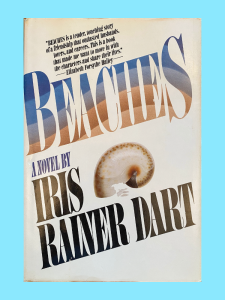
Beaches
Iris Rainer Dart
1985, Fiction, 8/10


The Boardwalk (pp.1-33)
10 September 2025, 8:30am

I’m only three chapters in, and I am trying hard to not compare the book to the film.  I’m finding it difficult to do that.  What I would have loved is just more, and it’s surprising to me.  

We open with Cee Cee in a rehearsal.  

The dancers were holding Cee Cee above their heads. “And now,” she said, “as I lie in the arms of four promiscuous homosexuals from West Hollywood, my tits pointed towards the heavens like an offering to the gods, I slowly turn my head, look out at America and ask the musical question…”
I think this establishes the character beautifully from the start.  I can tell how self-assured and how assertive she is, just from these small bits.  The films softened this moment into a performer who is much more serious, and I think I prefer this choice.

The phone is ringing, and after some time Cee Cee finally gets to it and there is nobody there.  On hearing that the call is from Roberta Barron, she leaves immediately, the director and performers still expecting her to return.

The second chapter features the iconic meeting of Bertie and Cee Cee on the Atlantic City boardwalk.  I was able to form my own characters in my mind based on the descriptions, except for Leona.  Iris Rainer Dart describes Leona so often, referencing her weight especially.  But for me, I can’t get Lainie Kazan off the page.  She is Leona Bloom, and I guess always will be for me.  

The events are sparked by some questionable attention paid to the seven year old Bertie, by her aunt and mother.  The two women are enjoying the sun, their cigarettes, and aren’t worried about the little girl who has lost track of them and ends up meeting 10 year old Cee Cee Bloom, and soon Cee Cee’s mother Leona.  Bertie tags along while Cee Cee goes to an audition, after which she is reunited with her aunt and mother.  One thing I like in the film version that does not happen in the book is how it is established that Bertie (Hilary in the film) comes from money.  There is a scene in the move where the girls get ice cream at the ritzy hotel where they are staying, juxtaposing the upper class lifestyle Bertie comes from.  That is missing in the book, so I never feel as clear on who Bertie’s family is meant to be.  It’s also possible that I missed something from the text. 

I continue to struggle with Leona.  As one of my favorite characters in the film, I’m confused by who she is in the book.  She has all of the determination and attitude I want from her, but she also is described in the way that slim people often talk about fat people—she always seems to have a sandwich in her hand, and everything she does centers around her weight or eating, except of course when it comes to Cee Cee.  I think there could be conversations about weight, but this book wasn’t the one to tackle them.  A more fully formed version of Leona might show her never struggling with her weight, but then dying young from a preventable weight-related issue.  That would at least be commentary.  As it is, Leona is a punchline, but I won’t accept that.  She is raising Cee Cee on her own, she is determined, she doesn’t complain about her own life.  She’s the backbone of the early parts of Cee Cee’s life, so I wish a little more care was taken with her.

The chapters end with letters exchanged, but I’m mildly disappointed that there aren’t more penpal letters between Cee Cee & Bertie, but I’m sure the author didn’t want to make this a four part novel, filled with boring letters.  I would have loved that, but I don’t know if we would have gotten a movie.  One thing that was definitely missing though was dates on the letters.  In a book like this, spanning decades, giving dates to letters helps ground you.  I was annoyed by it, so I flipped through the book and the author has chosen to do that throughout.  I find it a little disorienting, but at least I know to not expect that.

I’m enjoying the book so far.  And while I’m not comparing the book to the film to the best of my ability, the film does give me reference for where the book is and where it is going.  So far, we’ve done the scene of Cee Cee rehearsing her show in Los Angeles and getting the phone call from Bertie; the events from childhood in Atlantic City where the two girls meet and Cee Cee has her audition; Cee Cee getting not he plane to go see Bertie; and I’ve just started the chapter where an 18 or 19 year old Cee Cee has joined John Perry’s company of dancers and singers.


But She’s 16 (pp.34-76)
11 September 2025, 7:30am

Beaches took some dark turns, and I needed to sleep on it to really understand how I might feel about it.  I want to make excuses, say Iris Rainer Dart is from a different time, but what I keep landing on is how she knew what she was doing.  She didn’t happen across the characters; she created them.

The first thing I started to take umbrage with was a sort of lack of understanding who Cee Cee is, or rather who she would be culturally.  I think the author might be removed enough from who she was writing to grasp it, but it is clear to me that Cee Cee, even as a child, would know LGBT people and would gravitate to them in a positive way.  On page 37, during the events of “Beach Haven, New Jersey, 1960” we are introduced to Moro Rollins. 

“Instead, there was a blur of new people she couldn’t sort out.  A few girl dancers with big calves and straight hair, a tall skinny boy dancer, and older guy (very faggy), Peggy somebody or other…”

Okay, that was a little odd, but it’s not necessarily a deal-breaker.  Gay folks are allowed to call ourselves fags, or faggy, but it is conceivable to have Cee Cee be someone who had given herself permission because she is so close to a group of gay guys or drag queens.  That would fit her character, and I ignored it.  The book is written in third person, but the perspectives are from Cee Cee & Bertie, so maybe the author is leaving some crumbs for a future payoff or maybe it’s more of a dog whistle to gay readers.  This really get weird a couple of pages later (pp.39-40):

“Richie Day, the boy dancer, had been befriended by Moro Rollins, that old queen singer.  Rollins had a good voice and had worked for Perry in two industrials.  He could easily handle the Ezio Pinza role if they did South Pacific.  Perry would overlook the way Rollins seduced the boys unless Rollins tried touching the boys at the company parties.  The locals were always at those parties, and they would never understand.”

Beaches was published in June 1985.  In February of that year the Virginia Supreme Court had declared a gay man to be an unfit guardian for having his lover around his child, referring to it as “his immoral and illicit relationship.” (Gay Community News, February 2, 1985, p.6) This was also four years into the AIDS crisis as it unfolded, and the sitting president had yet to say anything about it.  As the years went on, “gay” became synonymous with “AIDS” for many Americans, and gay men being viewed by the public as diseased and unclean.  LGBT folks were being ostracized because of this growing threat, and the stereotypical lies of Code Era Hollywood started creeping back into the mainstream.  Gays were both diseased and predatory.  We were unable to help ourselves from having unprotected sex or from abusing others.  For so-called Christians, we were demonic.  The world was not safe for us as it had started to be in the 1970s.

Iris Rainer Dart’s decision to introduce one gay character, but have that character be someone who sexually assaults young men might be understandable given the time, but I don’t think it’s excusable.  Ignorance doesn’t help the harm this character does.  Now, it would be different if this character was juxtaposed with more accurate representations of gay people, but the author doesn’t have the experience to pull that off.

And even if this was the direction she wanted to go with the character, Cee Cee is odd about it.  On page 53 when Cee Cee is feeling insecure about Bertie, we get this:


“Bertie was such a big flirt.  She flirted with everybody.  She batted those long, gorgeous eyelashes at every guy.  Even that old “faygelah” (Leona’s word) Moro Rollins, who joked when Bertie fitted his pinstripe trousers for Henry Higgins that it was “the best time he’d had in week.”  Who was he trying to kid?”

It’s clear that Cee Cee’s language about Moro is learned, and that her “fag card” was not earned, but a showing of her disdain for the man she has just met.  I sense the author’s disdain for gay men in general based on this chapter, and it makes the movie being a favorite among gay men of my generation and older all the more interesting.

One last point about this.  In this chapter, which takes place in 1960, we have established a few facts that need to be called out.  Cee Cee is 18 years old.  Bertie, who is staying with her aunt nearby for the summer, is 16 years old.  The director is John Perry, a man in his 30s.  Cee Cee is a member of the theater company and during a party, John offers an apprenticeship to Bertie for the summer.  It is implied heavily, from Cee Cee’s perspective that John is attracted to Bertie, but Cee Cee’s insecurity is a big part of this part of her life, and I liked the way it was written.  Neither Bertie nor John do or say anything that could be seen as inappropriate, except through the lens of Cee Cee’s own lack of self esteem.  The two girls do talk about how handsome John is and they talk briefly about sex, but these are pretty normal situations for two teenage girls.  

At one point, having spent a lot of time in the chorus, Cee Cee goes to John Perry’s house and announces she is there because she wants to get laid.  This feels like John’s test, and the author finally revealing what kind of man he is.  John is empathetic and understanding, seeing that Cee Cee needs to be told who special she is, and that she was not interested in sleeping with him.  He gives her a beautiful pep talk, Cee Cee cries, and the assumptions about John seem like the imaginings of an overthinking and self-critical Cee Cee.

They walked silently again for a long time until Bertie broke the silence again.

‘Cee Cee,’ she said. ‘I did it.’

‘Did what?’ Cee Cee asked, and she stopped walking.

‘God laid. By John.’

Cee Cee couldn’t speak.  It was a joke.  Now Bertie would say, it’a joke, Cee.  You didn’t believe me, did you?

‘Oh, boy, I didn’t mean to blurt it out like that,’ she said instead.  ‘To say I got laid—which is really an awful way to put it, because it wasn’t like that.  We made love.  I mean, we really made love, and it was so neat, Cee Cee, not like it probably would be with someone my own age.  He was so gentle and sweet.  And you want to know the funny thing?’

‘Yes,’ Cee Cee managed to say.  Oh, God, yes, she wanted to know the funny thing.  Let the funny thing be that this was a lie, and that everything she was picturing now that was making her feel weak wasn’t true.

‘The funny thing is that I don’t feel guilty, and I don’t feel dirty, and I’m not the least bit in love with him.  You know the old myth about the man you give your virginity to being the first man you fall in love with.  Well, I’m not.  And I think that’s really great. (pp.64-65)

Iris Rainer Dart wrote a gay character, who she portrayed as a sexual predator ‘offscreen’ and then had a man in his thirties have sex with a sixteen year old girl.  Not only that, but this is a character we are meant to like.  John isn’t villainized for this.  In only a few pages, Cee Cee even marries him.  John is a character we are supposed to like in this book.  Moro is a character were are not.  I don’t think “it was a different time” would cover this double standard.  This is prejudice.  I’ll be charitable and say, the bias is probably subconscious, but it is definitely present.


Suspicious Minds (pp.77-125)
12 September 2025, 9:38am

Hawaii, 1967.  This was a fairly long chapter for a short one week vacation.  Iris Rainer Dart does a lot of short-handing throughout the book, most glaringly at the end of each chapter with letters.  They don’t feel like completing the story, but like small drops of information she didn’t know how to work into the text.  I found it curious, then, that she spends so much time on these moments in Hawaii.  

Bertie and her husband Michael are going on a vacation following Bertie her volunteer job because she was becoming overly invested in the disabled children she was working with.  What’s interesting about this situation is that it starts painting Bertie, not as someone whose compassion forced her to take work with children, but as someone whose self-indulgent introspection stunts her ability to function at times.  We get more of that later.

Cee Cee and John invite themselves along, well, Cee Cee does anyway.  Bertie hasn’t seen either of them since she was 16, and now she is a married lady of 23.  There are some situations I hope we address, but I’m not hopeful given the authors penchant for not holding John accountable.  

Michael has money, and expects little over her, but he also is a bit aloof.  At the hotel, Bertie can’t stop thinking about how she wants Michael to notice her, to passionately make love, to be overcome when he sees her.  But he’s not.  He’s disinterested in general, as if sex is a task he is required to do and it has to be done under specific circumstances. 

Bertie felt like being held, kissed, lusted after.

‘After we unpack, we can run on the beach,’ [Michael] said, carrying a pile of T-shirts to a drawer.

‘Michael,’ Bertie said. ‘Michael.’ She walked over to him and put her arms around his neck. ‘Let’s make love, honey.’

Michael sighed. ‘I’m tired, Bert. You know. Jet lag.’

‘But you just said you wanted to run on the beach.’

He looked caught. ‘Yeah… well, that’s different.’

Bertie’s arms felt awkward around his neck, heavy. As if this man were a stranger, and her arms shouldn’t be there. She walked over to her suitcase.

‘Bert,’ Michael said. ‘Why do you do that?’

‘Do what?’

‘Set up situations like that where you know you’ll be rejected. Why do you always decide you want to make love at weird times?’

‘Why is being alone with my husband in an ocean-front hotel room in Hawaii a weird time to make love?’ Bertie asked, not looking at him so he couldn’t see the hurt in her eyes.

‘It’s broad daylight.  We just got here.  I’ve been breaking my ass in town to be able to get away.  I want to unwind and relax.’

‘Some people think that sex is very relaxing.’

‘Then why don’t you give those people a call,’ he said, walking to the door.

I think Michael is written so well.  He’s clearly a terrible person, gaslighting Bertie constantly.  Bertie is a young woman, so it is natural that she wants the attention of her husband, and Michael does not have any interest in her at all.  This of course sets up a scenario where Bertie can overthink things catastrophically later during the trip.

The couples meet up at the pool-side bar in the hotel, and I really like Cee Cee here.  She much brassier than played in the 1988 film.  She has become more like Leona, something that is very believable.  She is loud, obnoxious, and has no filter, drawing looks from others as she hurled expletives at a bird that had landed on Cee Cee’s chair. But she is also the warmest of the group.  She has a lot of love to give to the world, and it is a sharp contrast to Bertie.  It might seem obvious that the assertive, in-you-face character would be the more self-absorbed one, but I find it is true to life that it is actually the introverts and quiet ones who are like that.  It’s that obsession with self that keeps them pinned inward.  I appreciate Iris Rainer Dart exploring that concept.  Cee Cee, for all her self-assuredness and boisterousness, does not actual seem to dwell too heavily on herself.

As an episode in the book, it works beautifully to have two couples in separate rooms on a vacation together.  We get to see how each couple interacts, as well as scenes with just the two women or with one of the two husbands.  It sets up a lot of dynamics.  

We are not going to address the heinous situation between John and Bertie.  I can tell it’s not the angle the author took, and it feels very dismissive of what is actually a serious issue.  While we need the perception from Bertie of tension, the memories of her and John, and her clear and unspoken jealousy of Cee Cee being married to him, there isn’t a single reason Bertie couldn’t have been written to be a few years older AND John a few years younger.  Why did it have to be creepy?

So, Bertie is now with John and Cee Cee for the first time in years.  At 16, she had claimed sex with John didn’t come with feelings, something she is still trying to convince herself of.  

‘Do you love him to pieces?’ Cee Cee asked.

‘Of course,’ Bertie said. ‘He’s my husband.’

‘You think loving and husbands have to go together?’ Cee Cee asked. ‘Boy, are you wrong. That’s not the way I’ve seen it where I’ve been.’

Bertie looked to see if John was listening. He wasn’t. He was lying on his stomach reading what looked like a script, and he turned the page.

We get some scenes between Cee Cee and John, and they have a lovely relationship.  They understand one another and know themselves enough to demand what they want from their partner.  Having spent a few scenes in the awkward silence of Bertie & Michael, it was nice to see that Cee Cee had found someone who cherishes her.  

And then things go south.  After a full day of activity, the couples end their evening in the hotel room of Bertie and Michael to share a joint.  Bertie is tired, and goes to bed.  They are in a suite, so the other three continue their evening until Cee Cee and Michael decide they want to go swimming down in the pool.  John is tired, so he goes onto the his and Cee Cee’s room while the two remaining go down to the pool.  At some point, Michael accidentally knocks Cee Cee’s robe into the pool, soaking it.  When they are done, Michael give her his robe and they go back to the hotel room to leave Michael his robe and get a dry towel for Cee Cee before she heads back to her room.  When they get there, Michael comes onto her.  Bertie overhears the advances, but goes to the bathroom to avoid being involved in what she decides is an affair.  Cee Cee, meanwhile, is letting Michael have it before storming off.

“You are the lowest, most pitiful slime on the whole fuckin’ face of this earth, and you know what, you shitpile, if my loud dirty mouth made you think I was trashy enough to fuck with my friend’s husband, I’d like to cut my fuckin’ tongue out, because I’d die on the rack before I’d dream of it.  And you know what else?  You are not fit to be in the same world as Bertie…”

Michael then sleeps on the sofa, and Bertie overhears a phone call he makes in the morning that she believes is him and Cee Cee still having sex in the other room.  She has decided what happened, and she is not about to believe anything else.  Michael does do a bit of gaslighting though.

Cee Cee is distraught by the whole ordeal, which is understandable, but she doesn’t know Bertie overheard them, or that she misconstrued the situation.  She smokes on the balcony, clearly affected by the events.  John is as compassionate and understanding with her as he had been that night when she had thrown herself at him. He’s very adept at reading people.  

‘Am I a whore?’ Cee Cee asked her husband. ‘Am I really the piece of crap low-life I feel like now?’

John didn’t answer. He pulled his chair up next to his wife’s chair, sat on it, then pulled Cee Cee out of her chair and onto his lap.

‘Cee Cee,’ John said, beginning a speech he’d made to her many times in many forms. ‘You’re a woman who needs to be loved so badly that the need seems to be never-ending. Bottomless. So you work for love, beg for it, demand it, seduce for it. In every way. With your voice when you’re singing on the stage, you seduce the whole audience. And with people you meet individually, you seduce them too. You tap into them and somehow figure out what they want from Cee Cee Bloom. What will make them fall for her. And then you put that part of you out there for the person to take.’

Cee Cee buried her face in the shoulder of John’s robe. She loved the way he smelled in the morning and the way he felt so warm.

‘You’re not a whore,’ he said, ‘because it isn’t sex you’re after, even though you make it seem that way. What you really want is for the whole world to do this.’ As John put his arms around his wife, he felt her tears on his neck.

This is immediately followed by Cee Cee trying to make plans with Bertie for the day, only for Bertie to tell her off and say she never wants to see her again.  She is not giving her the chance to explain.  Meanwhile, Michael has told her that nothing happened and attempts to gaslight her, bad-mouthing Cee Cee.  This relationship is doomed.  Not only is Michael a terrible person, but Bertie is so consumed with jealousy that she is unable to be present in her own life.  

The story, at least at this point, is entirely about two women who are jealous of who they think the other is.  They want the idealized version of the other, but don’t have the full story.  Bertie hides the truth of her life and marriage, and so she never fully lets Cee Cee in, and she has preconceived notions about Cee Cee that blind her to the real human person that is her friend.  The more I read, the more I dislike Bertie White. 


She Doesn’t Deserve Cee Cee (pp.126-168)
13 September 2025, 10:52am

Why on Earth are we in Miami Beach?  There is no good reason why this book takes place in so many locations.  The film always gave me the impression that the title referred to Atlantic City & San Francisco, the two prominent beachside communities.  No, it seems like maybe the author had this idea to include many popular beach communities in a single book, but to me it feels unnecessary.  I don’t want to learn about Miami Beach halfway through the book, especially if all of the scenes are going to take place in a hospital and a hotel lobby.  We could have been anywhere.  

Bertie’s mother, Rosie, is in a coma.  She has suffered a berry aneurysm, which is inoperable, but the wait for several days at the hospital, hoping for the best.  This is foreshadowing.  Even if I hadn’t already known what happens because of the movie, this felt like it was placed here to prepare the reader.  It’s hard to feel connected to Rosie; she hasn’t really been in the story, except through letters that felt like she wasn’t fully realized as a character.

This emergency gets Bertie to Miami Beach, where by coincidence Cee Cee Bloom is performing a week of concerts just around the corner from the hospital.  It feels forced.  A more obvious city would also have booked Cee Cee.  I’ll get over it.

While Bertie is sitting at the hospital with her mother, Cee Cee and John are dealing with the rift that has formed in their marriage.  Iris Rainer Dart’s choice of John being a horrible person early in the book is unforgivable because he is easily my favorite character.  I understand him completely, and he is in love with Cee Cee, but she is ascending into superstardom, and he is feeling held back.  And you can tell he doesn’t want to hold Cee Cee back by expressing this.  He wants the best for her, and in a beautifully sad scene, John decides to leave Cee Cee, buy a theater in Ohio, and live out his own dream.

In 2025, this relationship would work.  He would buy the theater in Ohio, where he would live and Cee Cee would travel the world, have a home in New York and/or Los Angeles.  They would be together when they could, but be off doing their own thing.  In 1985, that was far less common, and even less so for a scene set in 1970.  I don’t like it, but for these characters at this time, it is what makes the most sense.

Bertie and one of the other visitors at the hospital, and elderly man whose wife is in ICU, go a couple of block to get sandwiches and the same restaurant where Rosie had collapsed in the restroom.  Needing to use the restroom, Bertie can’t bring herself to go in there, so she doesn’t return with the man and goes to the hotel to use the restroom.  She knows what she is doing, she is aware of the way she is lying to herself, but she can’t stop herself.  And in the lobby, she runs into Cee Cee.

I kind of hate this scene in some ways.  I don’t know  if it is written the way it should be, with a lot of things being yelled that probably wouldn’t be yelled, and a lot of things said that wouldn’t be said the way they were said.  I felt like the dialogue was just a little rushed, so we are left with what we are left with.  It’s handled well in the film, and this is one of the rare moments where the actors took over their roles because I had trouble keeping the book versions in my mind.  

Bertie misses Cee Cee, but still believes she and Michael slept together.  She says a lot, and concludes with telling Cee Cee that she forgives her.  Cee Cee is not having it, and tells her off, concluding her own rant with a refusal to forgive Bertie.

Dejected by the ordeal, Bertie returns to the hospital.  After a while, Cee Cee shows up with food, completely ignoring the whole situation.  She goes in the room with Rosie, still in a comma, and sings a song to her—the song Rosie had sung to Bertie as a little girl.  It’s incredibly touching and one of two times I cried so far.  Bertie does not deserve someone as pure as Cee Cee.  But it also seems like not having a friend to confide in has put everything into perspective for Cee Cee.  She is going to move on and she is going to forgive Bertie, even if her friend does not deserve that grace.  Meanwhile, Bertie still believes Cee Cee and Michael slept together, and he tries to convince Bertie that they were better off with Cee Cee out of their lives.  It seems like she’s starting to put the pieces together, but she cannot find it in herself to trust.

‘Bertie,’ Cee Cee said, ‘don’t you get it? You took yourself away from me without askin’ if you were right to do it or not.  And you weren’t.  I didn’t do anything with your husband.  Ever.  Never touched him.  Maybe I said some suggesting things, which I do, and sometimes at the wrong times, but that’s all.  That’s what it said in all the letters I sent you that you were too tight-assed to open.  And you know why I didn’t do anything? Because I didn’t want to.  Because I knew something about my friendship with you that you didn’t know.  That it was more important to me that some guy’s dick and where he wanted to put it.  That it was more important than anything, because I trusted it, I believed in it.  But you didn’t, and your husband didn’t.  So you can take your dirty little suspicious mind and find yourself a friend who doesn’t care that you don’t know how to trust her, or about your smarmy husband’s idea of how to be a man.’

Cee Cee’s fist were clenched as if she wanted to pummel Bertie, who stood speechlessly by.

‘So thanks  lot for forgiving me, thanks a whole fuckin’ lot, but I don’t forgive you, and I never will.’

Cee Cee Bloom is a better person than I am; that’s where it would have ended for me.

Bertie’s mother dies and she returns home to Michael, still not positive about what happened in Hawaii, but having regained a friend.


My copy of Beaches

Metamorphosis (pp.169-196)
14 September 2025, 7:04pm

Carmel, California, 1983.  It’s present day and Cee Cee has arrived at Bertie’s home in California, but things are strangely quiet.  She had let herself when she read a note that the door was open (addressed to “Jan”) (p.74).  She sees an old woman in one of the rooms who has fallen asleep and assumes it is Bertie’s aunt.  She searches the house for Bertie and is lead by a woman named Janice just outside of the bedroom where she had seen the old woman.  Cee Cee starts to panic that the old woman might be Bertie.

This chapter, while completely necessary to the events happening in the present, frustrated me.  We haven’t touched on the present for over 90 pages, so when the chapter starts mid-scene, I had to go back to recall how we got here.  More frequent check-ins, or more evenly space ones at the very least, would have helped.

Sarasota, Florida, 1975.  Bertie’s marriage to Michael is ending.  It just fizzles out, which makes sense for the character who has shown little interest in his wife.  She should have left him a long time ago, but she would never do that.  Meanwhile, Cee Cee has been going through some issues as well.  A studio told her she was too fat for a part after having offered it to her, and she has started doing cocaine because the man who was seeing turned out the be a pedophile.  Unfortunately, that is now how Iris Rainer Dart worded it.

This author has a problem, and it is getting uncomfortable.  I don’t know why this is fully the third character who is engaged in sexual assault, but also for whom there isn’t an accurate accounting of what they are up to.  Moro & John were problems for sure, but this unnamed character is referenced to have been assaulting 12 year old boys.  This is not described as a horrible crime against the youth in question, but as Cee Cee’s boyfriend cheating on her, even later being referred to later as Cee Cee’s bisexual boyfriend, as if being bi was the problem.  As if cheating was the problem.  Why this author keeps putting adults in sexual situations with minors, but without any sort of context about the thing itself, is concerning.  Troubling.  She needed therapy, or an editor to tell her to take that out.  It’s jarring, but I just do not think the book being written in 1985 excuses it at all.   I’ll move past it; I’m trying to focus on the story.

Cee Cee comes to spend time with Bertie under the guise of being emotional support while she mourns the loss of her marriage, but really Cee Cee needs to get out of her own life for these reasons.

Bertie has been sick, so they go to a doctor and discover she is pregnant.  Michael and Bertie had tried for years to get pregnant, and I think it would have been interesting to explore whether that was the source of a rift between them, but it isn’t.  That was not part of the motive.  In fact, when he is told, he all but demands that Bertie have an abortion. 

Note specifically about my memory of the 1988 film:  I remember in the movie, Hilary (Bertie) goes out shopping while Michael is at work and returns early, catching Michael having an affair.  I like that angle better.  As it is, it’s probably more true to life.  The couple just has nothing in common and just drifts apart until they just don’t want to return to that life… well, Michael doesn’t.  But the way Bertie in the book overthinks everything and never stops focusing on herself, I think it could have been interesting that maybe this had been going on a while and she just finds out about it.  Something to sort of snap her back into focusing on the present.  But the author did not go that route.

During the doctor’s appointment, Cee Cee and the gynecologist start flirting and end up going on a date.  They are smitten with one another, and it looks like a relationship blooming.

Cee Cee is very excited about Bertie’s pregnancy.  Having been raised by Leona, who was strong and determined about raising a child on her own, it seems fine to not have a man in the picture.  Michael is clearly not going to be.

I ended mid-chapter, so I’m not yet sure what will happen with Cee Cee and the doctor, but if the movie was even a little accurate, I know Bertie will have a child before too long.


When You Get Down to the Blood and Placenta (pp.197-212)
15 September 2025, 9:36am

Things in Sarasota get a little chaotic.  Cee Cee continues seeing Arthur, Bertie’s gynecologist, going as far as meeting his mother who is starstruck.  She sort of flits about around her pregnant friend, planning a life with Arthur.  Cee Cee then receives a phone call from Allan, her ex-boyfriend (and established pedophile! Jesus Christ!) which causes Cee Cee to leave immediately, standing up Arthur who arrives awkwardly to take Cee Cee out on a date, only to get the news from Bertie that she has left.

Cee Cee returns to Sarasota for the birth of Bertie’s baby and since Arthur is the doctor, she sees him again.  She discovers he is engaged now, and Cee Cee is understanding.  She reveals that she left because things were getting too real and that Allan left her shortly after she returned to him.

Cee Cee’s actions suit her character, but I almost wanted her to make up someone back home rather than deal with what is quickly becoming this author’s troublingly favorite tidbit to include.  I’ve known Cee Cees in the past—people who run from situations before they get too serious, scared of what being committed might mean.  

The birth is fairly uneventful, but there is mention of Michael taking care of both Bertie and the child financially.  His character is confusing.  He clearly likes Bertie, but for some reason he has fallen out of love with her.  But he’s a good enough guy keep his word and take care of her.  If you look at his incident with Cee Cee through the lens of someone who is desperate for sex, but who sees his wife as more of a sister, I think he sort of makes sense.  That might not excuse his actions, but for me it puts them into perspective.  That’s not written in the book of course, but I can sort of insert it to make more sense of the character.

The wrap up between Cee Cee and Arthur is mature for both of them.  She knows she missed out on someone great, and Arthur knows his worth enough to not be petty about it.

“Arthur’s getting married,” she said. “Right after the delivery, he came out to see if I was okay, and of course, once I got out of there away from all the gooey blood and placenta and stuff I was great, and—we told each other how wonderful we looked and all.  I mean, Bert, I lost thirty pounds since I saw him, and he had, you’re not going to believe this”—and the Cee Cee looked over her shoulder to see if anyone was listening, looked back at Bertie and confided—“he had a hair transplant.  More hair, Bert.  I know he thinks that’s why I left.  Because he was bald or short or whatever he’s unsure about, but that wasn’t why.”

“It was because it was possible, Bert, too possible, you know?  Too much of a chance at realness.  And I don’t do realness.  When you get down to the blood and placenta, I’m gone.  Only I didn’t tell him that.  I just said congratulations.  His mother really likes her, Bert.  The girl he’s marrying.  His mother likes her a lot.  That’s what he said.  Only I guarantee you that Aunt Fanny wishes it was me.  Remember how crazy she was about me, Bert?”


Ends & Beginnings (pp.213-283)
19 September 2025, 9:48am

Pebble Beach, California, 1979.  It took me several days to get through this chapter, and I nearly abandoned the book altogether.  If I hadn’t seen the film, I might have done just that.  The entire chapter seems to exist for the last line.  It’s a series of people Bertie dates and is not very interested in.  She’s been obsessed with the idea of being married to Michael since she was, but it was not good for her and he doesn’t want her.  She cannot move on.  Meanwhile, you get a glimpse of Bertie’s life with Nina, her daughter.  Their life is so leisurely as to be unrelatable.  I’m not sure if the author was going for the idea that Michael has a lot of money and takes good care of them or if she was just needing the characters to not be burdened by normal life for the sake of the narrative. It’s always easier if the characters aren’t busy living their lives.

I finally got through it.  I hated it.  It should have been axed, lifted out, burned.  It was a waste of time.  She did meet a man, David Malcolm, who she starts to fall for, and on the way to meet Bertie to spend a weekend with her he dies in a plane crash.  No reason, seemingly.  We don’t know this character, and his loss is barely important to the story, other than to give Bertie another reason to obsess over Michael.  I was okay with her being insufferably infatuated with Michael to begin with.

Dear Mr. and Mrs. Malcolm,

Your son was a fine man.  Please accept my deepest sympathies on his passing.

Roberta Barron

I’ve never been so excited to get back to the dying woman in a story.  Back to Carmel, California, 1983—the present.  Cee Cee is finally confronting the sick Bertie, dying of ovarian cancer, in hospice care at this place far away from her family.  There are flashes here of Bertie on her death bed that start to endear me to her.  I understand someone who doesn’t want to bother others, and so takes herself away to not burden them with her illness.  That’s the way Bertie is portrayed in the 1988 movie as Hilary Whitney.  She’s a quiet woman who doesn’t want to trouble anyone, to her detriment.  And I imagine there are ways in which the book character is meant to be that type of person.  Where I get lost is that Bertie has been something different in the book.

Bertie’s meekness in the book isn’t humility or empathy.  She is completely self-absorbed, obsessed with being taken care of.  When we get to her dying, her choice to do that away from family doesn’t come across as a kindness, but as a way of protecting herself from the criticism of her family.  It’s a weird choice.  I wonder if the author is this type of person or if she has some sort of resentment for people who seem selfless.  So much of the book feels like Iris Rainer Dart dealing with her own issues by writing characters.  I suppose that’s cheaper than therapy, but I’m not sure it resolves anything.

Cee Cee’s character continues to be amazing, reacting to her dying friend exactly as she would be expected to.  She jokes through her tears, tries to keep Bertie’s spirits up, and generally shines as the heart of the story.  Cee Cee is selfless, truly, even in her celebrity.  In fact, her celebrity has not really changed her.  Cee Cee realizes she has to return to Los Angeles to film the TV show she was preparing for when she dropped everything and left, but promises to return in a couple of weeks.  There isn’t a second where one would think Bertie is actually getting on the place to Los Angeles.  Not only does it make sense for her to abandon her obligations for Bertie, but the narrative is so heavy-handed about her booking her flight and going to the airport.  It’s almost too much detail, so that when she suddenly gets back in the car and heads back to Bertie, there is no surprise, no drama.  I still liked it though. 

Malibu, California, 1981.  I get a little frustrated with a book when there are verifiably incorrect details.  There was one immediately in this chapter.

In July 1981, if you lived in Los Angeles, and you were Hollywood-wise, you might drive down to the public beach at Malibu and park your car.  Then you would walk north on the sand, and ease around the wire fence which is supposed to keep the public out, until you were on the private beach of the Malibu Colony. 

If it was really a perfect sunny day, you’d know that on that beach, there was always a chance you might be able to spot Candice Bergen or Cher or Larry Hagman or even Barbra Streisand, sunning, chatting with friends, or playing with their kids.

I know I am being pedantic.  I know.  But in 1976, California passed a law making all beaches in the state public.  Private beaches aren’t allowed.  Sometimes people try to get away with restricting access to strips of the beach, but the state always ends up requiring public access to the entire extent of California beaches.  It is possible that this is an illegal barrier meant to shield celebrities, but it actually just sounds like poorly researched nonsense.  Granted, in 1985 it was harder to research these things, but it took me out of the story and into Googling California statutes. 

Other than that, I really enjoyed this chapter.  Nina, the overly serious 6 year old, and Cee Cee are great together.  Nina needs someone like Cee Cee in her life, and I wish it hadn’t taken so long for them to spend time together.  It does make for fun tension though, so there’s always a reason for these things. 

During their visit, Cee Cee receives a drunken call from Michael, trying to prove to friends that he know her.  She hangs up on him, but tells Bertie he called.  She of course has to see him, having never been able to move on.  They meet up and talk briefly about Nina, but Michael still doesn’t want to meet her.  It’s a disappointing, but not surprising scene.

Meanwhile, Cee Cee and Nina get to know each other, and Cee Cee teaches Nina a dance routine, getting her out of herself a little bit.

One final time in Carmel, California, 1983.  The last chapter of the book.  Cee Cee has returned, insisting on taking care of Bertie instead of the hired nurse, Jessica.  Bertie protests, and I like the way this back and forth goes because you can see how much Cee Cee wants to do this for her friend, but it also makes sense that Bertie would tell her no.   What doesn’t make sense is the nurse going along with this plan, and training Cee Cee to take over for her.  Hospice wouldn’t burden a friend, even an enthusiastic friend, over the wishes of the patient.  Cee Cee should have just been present and helped as she could, but without the absence of the nurse.

Bertie continues to annoy me, obsessed with her own image.  She says she doesn’t want Nina to see her for Nina’s sake, but it seems clear that her real issue is Nina having a negative image of her postmortem.  Not because of what it might mean for Nina, but because Bertie cannot take the idea of someone not loving her as much as they can.  It’s actually disturbing how much she worries about herself and how little others factor in, even while she is dying.

The more infuriating part of the whole book was Bertie’s outburst when she is chastising Cee Cee for flying Nina in to see her.

“Maybe you’ll give her to me,” Cee Cee said so softly she was certain Bertie hadn’t heard her.

But she had.  Her wet swollen eyes turned on Cee Cee.

“Give her to you?  My God, are you insane?  Place the life of my child into the hands o f a woman who’s used cocaine and probably worse drugs than that, who’s slept with God knows who and how many, who dresses like a whore and talks like a sailor?”  She was screaming.  “Cee Cee, you may fool them in the movies, but I know you faint in delivery rooms, and when the going gets tough you leave, you’re obsessed with yourself and your career, and I don’t ever want to speak to you or see you again, let alone give you my child.  Now get out of here, Cee Cee Bloom, you asshole,” she yelled in what was left of her voice.  Then she turned her face to the pillow and cried uncontrollably.

Cee Cee sat slowly on the bed next to her.  The bed shook from Bertie’s deep and prolonged sighs.  After a while, Cee Cee spoke.  “Bert,” she said, “I just can’t tell you how great it is to see you be the crazy one for a change.”

This really reveals what these characters have been from the start.  Bertie has never really respected Cee Cee, accusing her of being who Bertie is.  She later refers to Cee Cee being self-absorbed, but that doesn’t come across.  Cee Cee runs from relationships that feel too grounded, but not because she is too focused on herself, but because she doesn’t think she is able to give enough to them.  That is different.  If she was self-absorbed, she would have nurtured those relationships, knowing she didn’t have the ability to give them her full attention.  Bertie resents Cee Cee, and this outburst wouldn’t happen if these weren’t things she actually thought about someone she claimed to be her friend.  What she has always responded to was Cee Cee’s gregariousness and how much Cee Cee liked her from the start.  It was not reciprocal.  Cee Cee is a pure person who knows herself and her limitations.  She loves life and likes other people.  She finds it easy to give her love, but also has the discipline to know when to stop herself.  For Bertie to not realize this exposes their friendship. 

Maybe Iris Rainer Dart didn’t know who one or both of these women were.  Maybe she lacked the experience.  I’ve wondered about Bertie being a self-insert character.  She either identifies with Bertie, or she thinks introverts are all self-absorbed people.  I don’t love either answer.  But she wrote some other wonderful characters.

Bertie dies, leaving Nina to Cee Cee.  Maybe I would have been moved by that if I hadn’t seen the movie, or maybe it was just how long the narrative of her dying was throughout the book.  It started to feel drawn out, even though it was relatively quick.  So, when she dies it sort of feels like a relief.  

I’m looking forward to rewatching the movie to compare stories.


A Few Final Thoughts
19 September 2025, 2:40pm

I’ve had a lot of opinions about this book.  I think that has mostly to do with my love of the 1988 film.  I was always going to find things to quibble over, but there are some shocking differences in the book, so I’ve had a lot of feelings about it all.  

My analysis could be entire wrong about a lot of things.  I had thoughts, I recorded those thoughts.  Maybe I missed something, didn’t understand context.  Maybe there some sort of subtext I missed that puts some of the odd choices into perspective.  I’m really not sure.  But all in all, I did enjoy the read.  Most of the time, Iris Rainer Dart managed to keep me engaged and expectant.  I’ve even purchased the sequel about Cee Cee raising Nina, although it’ll have to wait.  I need a bit of a break from these characters.


Started Reading: 8 SEP 2025
Finished Reading: 19 SEP 2025

Beaches
Iris Rainer Dart
1985, Fiction
Bantam Books
1 June 1985
English
ISBN #0-553-05081-8

In a lot of ways, it feels like things are starting to make sense for me.  And it a lot of other ways, it feels like things are as chaotic as always.  Everyone seems just a little frustrated, but I’m not sure most of them can articulate why.  I know I can’t.


I finished Okie Dokie last month, and I have done a couple of edits to it since.  I hope I’m at a point where I can leave it alone now.  My copies come in the mail Saturday, and I’ll really know then.  I’m both excited and terrified to have my writing available for others.  That was always the goal, but I’m just so nervous about these things.  I hope others can appreciate my point of view and I’m looking forward to getting feedback, even if that feedback is negative.  Constructive criticism is always welcome.  I actually just assume that if someone doesn’t like something I’ve written, then that is just a preference they have and does not reflect on my writing in any real way.  If the consensus is negative, then I’m just writing the wrong things for current audiences.  I will have to wait and see.  The really difficult thing will be critiques by those I admire or grammatical errors pointed out by those I don’t.

I’ve started working on my next book, which will be similar to Okie Dokie in that it will contain selections of poetry from the past twenty years, as well as a few new poems to pull the book together.  I’ll have one or two more like that before relegating unpublished poetry to a “remnants” book of some sort in the future.  I have some things I’ve written that I really love, but I’m not sure how to make them work in any of these projects.  I do want a story to emerge from the collection, even if only loosely.  Okie Dokie was about myself and about how I see the world around me.  The second book will be about family and the places from which they came.  The third book is about friendship and love.  If I need fourth or fifth, I’ll do another about myself and then a last one about family, as those are the two subjects I’ve written the most about.  I’m also not limiting my writing.  I have other things I want to write and those things will fall into the projects that make the most sense for them.

For October, I’m enjoying some spooky stories and songs throughout the month, and I am of course bothering family with those things.  I miss sharing things with people.  I find everyone becoming increasingly isolated, and not just in my own family.  I’ll post some of those things on here during the month.

I’ve recently done several things with my books — first, I ordered a few books I’ve been interested in reading (in spite of the dozens of books I have and have not yet read).  Also, I rearranged the books in the house to have rough categories.  I am hoping that makes finding a particular book I want to read easier to find, which is should.  Lastly, I unpacked two boxes of books I had stored away for a while and I intend to unpack all books from boxes over the coming weeks.  I’ve always had a large number of books, but it’s time to purge a few of those.  Purging is always a nice feeling, so I’m not anticipating any problems exactly.  If pushed, I could let go of at least half of the books I currently have out on shelves, so I shouldn’t even be terribly pressed for space.

Here are a few books I’m excited to start reading.  Some of these are new to me & some are books I’ve had for years and I just haven’t gotten around to reading yet.

Memoirs

These are some newer memoirs I’ve been excited to get into.  Even though I rarely keep up with celebrities, I do enjoy a good celebrity memoir.  Jim Grimsley is one of my favorite authors, and I’m very excited that he has released a memoir.  The subject is pretty heavy, but necessarily so.

Fiction

I have such an extremely long list of fiction books I want to read, but these are sort of queued up as the next ones on the list.  I have read books by Graham Rawle and Bob Smith before, but the other authors are all new to me.  I hope for some good things.

Novels by Raymond Queneau

I’ve really enjoyed the Raymond Queneau books I have read in the past, and I have a few others to try.

Poetry

Since I’ve been working on my own poetry, I’ve been into reading poetry more than normal.  I’ve read some pretty interesting stuff so far; these are the next three on my list

I’ve been doing a lot of both lately. I’m currently working on a number of stories. I hope they work towards something great. Thoughts and suggestions greatly appreciated. Ask me for more details. I’ve also located my journal from my trip to France in 1996. I’m almost finished typing up the original and will add to the France page as I get to the notes.

Currently, I’m reading:

Someday This Pain Will Be Useful To You :: Peter Cameron
Harry Potter and the Prisoner of Azkaban :: J.K. Rowling

Books I’ve got lined up to read soon:

Vast Fields of Ordinary :: Nick Burd
Glinda of Oz :: L. Frank Baum
The Evolution of Calpurnia Tate :: Jacqueline Kelly
Bambi :: Felix Salten
The Dark is Rising :: Susan Cooper

Books I’ve read this year so far:

The Giraffe :: Marie Nimier
David Inside Out :: Lee Bantle
Harry Potter and the Chamber of Secrets :: J.K. Rowling
Harry Potter and the Sorcerer’s Stone :: J.K. Rowling
Snugglepot and Cuddlepie :: May Gibbs
The Magic of Oz :: L. Frank Baum
The Tin Woodman of Oz :: L. Frank Baum
The Lost Princess of Oz :: L. Frank Baum
Rinkitink in Oz :: L. Frank Baum
The Scarecrown of Oz :: L. Frank Baum
Sky Island :: L. Frank Baum
Tik-Tok of Oz :: L. Frank Baum
The Patchwork Girl of Oz :: L. Frank Baum
Dot and Tot in Merryland :: L. Frank Baum
The Emerald City of Oz :: L. Frank Baum
The Enchanted Apples of Oz :: Eric Shanower
The Speckled Rose of Oz :: Donald Abbott
The Sea Fairies :: L. Frank Baum
Finding the Boyfriend Within :: Brad Gooch
The Magical Monarch of Mo :: L. Frank Baum
The Road to Oz :: L. Frank Baum
Dorothy and the Wizard in Oz :: L. Frank Baum
Ozma of Oz :: L. Frank Baum
The Marvelous Land of Oz :: L. Frank Baum


27 May 2009

SaveSave


are we nearing the end of the contents of my head?

I’ve spent a lot of time reading my old Xanga & LiveJournal blogs. I used to have a lot to say… about everything. I think I believed that when I got my website that I was required to become an adult somehow. That is surely why I’ve become so passive with my postings. It seems silly now. I’m also going to try to get all of my old posts from those sites added in here. How fun will that be!?!?

My 10 Favorite Ozites (so far):
10. Betsy Bobbin (first appears in Tik-Tok of Oz) Betsy is very similar to Dorothy, but a bit sunnier. She curious and adventurous, but has less of a tendency to argue than Dorothy does. Maybe she is just better because she is from Oklahoma.
9. The Shaggy Man (first appears in The Road to Oz) Shaggy seems to always be around, which is often useful. He’s clever and wise and carries the Love Magnet with him sometimes, which makes people love him. He is one of the kindest of the adult characters in Oz.
8. Eureka the Kitten (first appears in Dorothy and the Wizard in Oz) The best thing about this little kitten is her willingness to eat another character, which she does not get away with. But she still tried. And then, she didn’t feel sorry about it at all.
7. Jack Pumpkinhead (first appears in The Land of Oz) He hasn’t been used much so far, but I like how simple he is. Ignorant, but not completely stupid.
6. The Glass Cat (first appears in The Patchwork Girl of Oz) She made of clear glass and for a while has pink brains that you can see working. Well written cat part, she never really cares about anyone but herself. She does mellow out when her pink brains are changed to clear.
5. Billina (first appears in Ozma of Oz) Originally named Bill, this yellow hen is so sassy that I immediately fell for her. All chickens in Oz are descendants of Billina and are all named Dorothy (hens) or Daniel (roosters).
4. The Hungry Tiger (first appears in Ozma of Oz) I love that this tiger wants to eat babies, but in fact won’t eat anything that is alive because he’d feel bad about it. I am really hoping he is used more, as he has only appeared briefly in the books he’s been in.
3. Tin Woodman (first appears in The Wizard of Oz). Nick Chopper is perhaps the most tender hearted character in all of Oz. He won’t even allow Ojo to kill a butterfly to save the lives of two people. He’s also one of the more level headed characters.
2. Button-Bright (first appears in The Road to Oz). At four, he is adorable, answering “don’t know” to everything. Older Button-Bright is adventurous and brave. He doesn’t complain about anything.
1. Ojo the Lucky (first appears in The Patchwork Girl of Oz). Known at first as Ojo the Unlucky, The Tin Woodman changes it when he decides the reasons for Ojo being unlucky are nonsense. Ojo is kind, he’s fair, and he isn’t afraid to break the law to save a family member. I like that.

I am on book #9 of 40, so my favorites are certainly likely to change.
Characters I DON’T care for: Scarecrow, Scraps the Patchwork Girl, The Wizard, Polychrome*, & The Woozy. Maybe these characters will eventually do something to win me over, but they really haven’t so far. *Polychrome’s role in Sky Island was great, but it isn’t an Oz book.

To Oz:

I have had a lot of related story ideas that are all just starting to come together more clearly as a single book. I think I am going to adapt them to the Ozian universe and write two or three Oz books. I like the idea of my story, but the more I read of the Oz series, the more I feel like my own fantasy book for kids would end up sounding like one of them, so I’m just going to force it. I still think they are well worth reading.

The Empty Frat House:

The guys who lived above me for a year are gone. David & Denis have been furiously working all month to get the place ready for someone new to move it. I’m actually looking forward to seeing who takes it. Those guys were pretty darn rude most of the time. Meanwhile, the silence has been rather nice. Although a sinus infection has been keeping me rather lethargic, I’ve been able to write into the evening without a party starting overhead at midnight. It is nice. The new folks might be night owls like I tend to be, but as long as they don’t pack the place with 20 extra people each night, we should get along just fine. I hope it rents out quickly. I don’t like for Denis to have to worry so much about it.

SaveSave

Why is everyone the same?

Each time a customer comes in and asks me for a book I’ve been asked for a thousand times, I want to say “yep, you are just one of the sheep.” There is a world of overlooked books out there! No, you don’t need to read The Shack or Twilight or Marley & Me.

I am looking for the next great novel to read. I’m greatly enjoying my trips to Oz, but I’m really searching for something different. Any suggestions?

Night before last, I had a series of nightmares, which is fairly unusual for me. In one, I was walking up to the house where Daniel lived (actually my grandparents’ house) and was really scared because the screen door was open and knocking against the house. Inside, I could see Daniel pacing back and forth. Okay, so in retrospect that isn’t much of a nightmare, but at the time it felt like one.

In another I was visiting some walruses in a marine park where there were several dozen in a rather warm pool of water. They were all really quite happy to be there and were jumping into the air and doing tricks like dolphins. One almost hit me with his tusks, but it was an innocent mistake. When playtime was over, we went into the nuclear plant where they worked with an assemblage of rather cantankerous penguins and taskmaster rock monsters. The walruses went into cubicles off to the side for a safety drill and demonstration for my benefit. Only the rock monsters could be out during the drill. During the video demonstration of what might happen during a bombing, a bombing actually occurred. Everyone was safe, but downstairs at Mardel, several employees were killed. Since I was the HR manager of the plant, I met with some of the others to put our plan into motion. I’d overheard one of the Mardel managers saying that they would not be taking any precautions, which I brought up to decrease our liability. As I read over the procedures for handling a bombing from corporate, I started to cry. And then I woke up. There were a lot of things going on in this dream, but the impending sense of doom was constant. And maybe I’ve retained a deep hatred for Mardel stores.

There were others. I don’t recall the events, but several woke me up. Last nights dreams also woke me up several times, but they were altogether more pleasant… too much so in the case of one I just won’t go into details on. I promise it didn’t mean anything though. 😉

Literary Debris

The deities are losing cellular cohesion, gasping desperately for breaths as they become liquid and evaporate.
The poets have been usurped by melancholy memoirists,
aching to have original lives.
Every story seems to be told, despite repetition
despite repetition
despite repetition,
despite…
repetition.
I keep sweeping up the dried remnants of fallen giants:
Thoreau, Dickinson, Whitman, O’Hara;
I even find Baum and Steinbeck and Spyri in the wreckage.
I collect the bits I can in a beautiful vessel where they remain safe, more pieces having been spared than expected.
Few search for the treasures, worried they’ll cut themselves on the old words of masters.
Picking through the pieces still brings me joy
even if I’ve no one to share them with;
I wish I could be as beautiful whole as they are in shards & residue.

Notes

Written 16 February 2009 in Anchorage, Alaska.

Brian Fuchs, “Literary Debris” from Okie Dokie (Scissortail Press, 2019)

On this beautiful August morning, I find myself focused on my soul. God has been at the at the front of my mind for a while now, tugging gently at my spirituality. Having just read My Trip Down the Pink Carpet by Leslie Jordan, I feel less alone in the world than I was starting to feel.

I have some of the best friends one could hope to have. Not only have I been able to retain a whole host of occasional friends from Oklahoma, people with whom I never need to catch up, but love spending time with when I have a chance, but I’ve made some amazing new friends in Alaska. These Alaskan friends are the most giving, warmest people I’ve ever known. But as far as my own faith goes, I cannot begin to relate to any of them.

At best, I’d lump the majority of my friends into the agnostic category. But that is such a religious term. I don’t care for it because it seems to imply a deficiency on their part. And it isn’t them I see as the issue. Although they were all raised Christian, it seems that Christianity failed each of them in some way, keeping them from retaining faith in faith. And to me that is infuriating. It is a clear sign to me of the common treatment of people who insist on being individuals — those who seem to have no choice but to live outside the parameters of strict Christian thought. I’m not only talking about my gay friends whose persecution is well documented, but of anyone whose life doesn’t fit into the idyllic dream of the conservative Christian community.

However, these same non-religious people who I love so much are the ones who make my soul shine brighter than those people I spent years worshiping with. They are my spiritual base. They are some of the most healing and spiritual people I’ve known in my life and recognizing that would do wonders for the religious community.

I often feel like I exist far beyond the norms of any group I’d possibly belong to. But why do I long to belong to a group, to be categorized? That is a silly notion and I do understand that. I’m going to try to be myself more than I have been… and by whatever means I need to… and with or without the support of others. I only know how to be me the way I am.

Jonathan helped to define my belief. Perhaps I need everyone to show me how to get there. Daniel, David, Heather, Denis, Justin, Travis, JD, Kendra… everyone has something to offer and as a whole, it all seems to work together.

Take Back the Word :: Robert E. Gross and Mona West {2000}
My Trip Down the Pink Carpet :: Leslie Jordan {2008}
Stranger at the Gate :: Mel White {1995}

Featured Image Art: AI Image (made using Wonder AI)

or, So Lonely I Wish the People Could Stay Underwater

I have no intention of giving in and joining the ever-growing ranks who are reading Twilight Saga. I have no interest and any inkling of interest I had was slain by the sheer volume of requests I receive daily about these books. It is too much. And that is a common relationship I have with books. Once an author or title reaches uber-popular status, I lose all notions of reading them. This silliness has kept me from reading Christopher Moore, Chuck Palahniuk, Augusten Burroughs, and even the latest David Sedaris book. George R. R. Martin, Robert Jordan, Robert Ludlum, and Ian Fleming all make a similar list, but it is the subject matter I really don’t care for. I’ve only recently decided that it is okay to read Harry Potter and His Dark Materials books, but I’ll still keep it a bit quiet when I do. I don’t really know why that is, but I recognize that it is a bit silly.

Perhaps the best thing to do in this situation is to list all the authors who I am only avoiding because of their ridiculous popularity and read one title by each and be done with it. They do have to be popular for a reason, right? Although, that is the same sort of illogic that could get me into some trouble, if I was to start reading Janet Evanovich or J.D. Robb (Nora Roberts). I’ll just try to not make that sort of mistake.

Meanwhile, as they say*, I’ve finished The Monsters of Templeton. It is amazingly well written. I’d pretty much recommend it to anyone. I did find that on those nights when I was really sleepy, but not so much to fall asleep, and I would try to read a chapter of Lauren Groff’s book, I would easily get confused or lost in her genealogical trek. By the end, there were a few ends that were tied up in surprising ways (for me). That didn’t make the book any less enjoyable. Far from it.

*”meanwhile, as they say…” is uttered by Julia Child during one of shows. Makes me smile.


8 August 2008

Featured Image Art: book covers

SaveSave

Summer reappeared briefly (I assume). It was a beautiful July 31, all of which I spent at work. Even during my lunch, I stayed inside enjoying soup I hoped would chase away the cold I’m desperately trying to not get. Thanks to the pusher at work today who slipped me a Mucinex D. It was a glorious hour of medicine-head bliss, perhaps the best hour of my day.

Of all worthless endeavors, I have appointed myself Ambassador to Serendipity, compiling information and researching release dates for the entire series penned by Stephen Cosgrove and illustrated with doe-eyed critters by Robin James. To me, they epitomize childhood in a way and I’d like information to be more readily available. To that end, I am reading, rereading, and analyzing. Many of the books have been rewritten more recently, prompting comparison between original and revised editions. Every single book is either sappy or preachy, but in an excellent way. They represent purity and simplicity and messages children don’t often get in such straightforward ways. It might even be interesting to work on a book about the series, offering histories and information for each book, as well as memories of the books by those who enjoyed them as a piece of childhood like I did.

Stephen Cosgrove’s Website

SaveSave

It is December 20th, the shortest day of the year. In places like Fairbanks and Barrow, this is a much bigger deal than it is here in Anchorage, but our days are short enough. The sun will rise at 10:14 and will set at 3:42. To make matters darker, today will be a cloudy day. And actually, that is quite alright with me. Clouds mean warmer air — relief from the negative numbers is far more important to me at the moment than relief from the darkness. As I write this, it is -8° outside. That is the lowest I recall so far this year, but it has hardly been much warmer for several days.

I finished Winkie . It was excellent to the very end. I think I convince myself to not read books because I am rarely satisfied the ending of them. It isn’t the endings themselves, but a realization that I am never going to know what happens to these characters next. Winkie was no different. I will get over it and over the next week, I will realize how much I enjoyed the book. Go pick up a copy; it is well worth your time. Next on my list was to be The World Without Us, but I finished before I had a chance to purchase the new book. I will move on to Holidays On Ice.

Featured Image Art: photo of Anchorage, Alaska

Trapped Inside

“A particular bear sees a particular this.” — Clifford Chase

I’ve been reading Winkie, the tale of a teddy bear who is alive. This could easily be a silly childish story, but instead it is haunting and almost sad. I am finding myself identifying with the bear oddly, even though I can’t begin to relate. He is unable to interact with those around him, but feels pain and acts as a witness while the various children who own him grow up. The many years Winkie spends feeling unloved are heartbreaking and I just want to reach out and give him a hug, which can apparently solve all of his problems. Currently, he has just “lost” his last owner, Cliff. Cliff was the second of the six owners to name him, changing him from Marie to Winkie. Somehow the new name connected with his soul and he felt that Winkie is who he had always been. Cliff is older now and hardly pays attention to Winkie. The poor bear, sitting on a shelf, longs to be hugged or touched or talked to or looked at, but he knows that the time has come when he won’t have any other children to love him.

It is exciting to see where this story will go, given the events at the begining of the book (the present). The story opens with Winkie lying in a cabin, emotionally drained and lost. The cabin is surrounded by police searching for a terrorist bomber suspected to live there. Winkie, able to walk and talk, does as he is told and exits the building with his little paws up. After a lot of commotion and commands, shots are fired, one of which strikes Winkie, knocking him to the ground.

At the hospital, the doctors and nurses, sworn to do their jobs, play at reviving the stuffed bear, using all the equipment they can. Winkie refuses to speak to any of them and there is an assumption that he is a female. One nurse, who sneaks in to sew up his wounds, can tell otherwise. Françoise and Winkie enjoy time together, but he never speaks to her either. After waking up his guard, she is arrested in connection with the terrorist attacks because she is Egyptian. Despite her U.S. citizenship, she is linked based on her previous country’s supposed ideals.

Winkie is finally in prison in the story. He was sent to a women’s prison at first, but after Françoise is sent to the same block as he, Winkie is sent to a men’s prison and charged with impersonating a woman. All of this seems quite silly, but I hope it is leading somewhere. Winkie faces so many charges that it took the judge five hours and fourteen minutes to read them all. Among them are one hundred twenty four counts of attempted murder, treason, conspiring to overthrow the United States government, and teaching evolution in schools.

This is an excellent read and I highly recommend it. I will keep you posted on my progress.

SaveSave

I’m feeling a little blah. I don’t think there is any reason for it actually. As soon as I get some batteries for my camera, I will post some pics of my new place. I’ve spent a lot of time working on making it feel like home. I’m still a little lonely here and I’ve been quite tired because of the lack of light, but I think things are really improving. I’ll stop whining about it again.

I finished another great book. The Pirates! In An Adventure with Ahab by Gideon Defoe was just as hilarious as his first book, The Pirates! In An Adventure with Scientists. Read them; they are awesome.

Every time I start to doubt people, they surprise me. I have terrific friends.

I want a boyfriend.

Featured Image Art: James Ensor, “Self-Portait with Masks” (1899)

Alexander Supertramp


I finally finished reading Brendan Wolf by Brian Malloy. I didn’t throw it across the breakroom like I wanted to either. It frustrated me, but the events that upset me were ones that were obvious from the beginning. I think it was worth my investing in the lives of these characters though.

Throughout the book there are references to Alexander Supertramp, the name Christopher McCandless gave himself while traveling around the country. Alexander Supertramp died in Denali of starvation in 1992.

Brendan Wolf has assumed this name and his real name isn’t revealed until the end of the book. He is hopelessly obsessed with Alexander and the books Alexander loved. He reads them — devours them — over and over.

The plot of the book is a scheme hatched up by his brother and sister-in-law. The plan is to steal money from a donation truck during the March For the Unborn, an anti-abortion rally. Brendan has to become a trusted member of the group in charge of the rally, Babies First, and get a spot as a driver during the rally. Meanwhile, his personal life has started to get in the way. He ends up living with Marv, an older man who Brendan has refused to sleep with, but who had a stroke during an argument about a living arangement. Brendan feels guilty and takes care of Marv when he is released to his home. He is also falling in love with Sean, a hopeless romantic who only knows Brendan by the name Pierre Bezukhov.

This is an amusing read, but one that begs for a sequel. I want to know more about these characters.

SaveSave

SaveSave

I am currently reading The Mother Tongue by Bill Bryson. I have read it a number of times before… Bill Bryson is such an excellent writer. This time around, the book seems to have rekindled my love of words (I had hardly noticed my interest had waned). It is almost enough to make me continue my education and get a real degree. Almost.

I think returning to school frightens me a little. Not the actual school part… that seems now that it would be easy, but I will have to figure out what I would want to do afterwards. I want to write, but question my talent lately. It all seems very difficult sometimes. Don’t get me wrong, I am not upset about any of this. I am just being realistic about it. I am on the verge of 28 and have done nothing professionally with my writing. That can be considered quite old to get started.

I think it is good for me to question myself and ponder these things. It will make be a better person in the end, regardless of were it takes me. Writing, as one of the few passions I have, should be where I turn to when I need to release part of my soul. Too often, however, it seems that it just isn’t enough to get me to do anything about my life. We’ll see.

Image: photo by Thom Milkovic (via Unsplash)

Featured Image Art: photo by Debby Hudson (via Unsplash)