I WANT MY LIFE BACK

I stopped being myself in 2013. When I was talked into moving back to Oklahoma by Mom & Dad, I didn’t know I would do so at the cost of myself, but as I settled in to my new life in Stillwater & Glencoe, I disconnected from the activities and the people I love. I didn’t even realize I was doing that. This was caused a series of choices I made, and a series of inactions on my part. There was plenty of opportunity to find a path in Stillwater, at least at the start, but I was hung up on resentment and frustration. I found it so difficult to accept where I was. I did blame my parents for a while, but they didn’t force me to move. The didn’t fly up to Alaska and stuff me in a plane. They convinced me over time, and ultimately I chose to return. Partly, it was to help Mom & Dad, who had both been dealing with increasingly difficult medical situations, but also I wanted to be back to spend time with my niblings before they got too old. I dreaded being the uncle who they had no connection with because I was so far away, only to see them rarely in adulthood. I wanted to be there for their childhoods.

In the Summer of 2013, freshly moved back, I had my own apartment with Molly & Franz. It was upstairs from Brad, Conner & Jason, which was nice. Mom & Dad needed limited help, mostly with chores around the property and going with them to appointment and sometimes grocery shopping. Honestly, at first I felt duped. They didn’t need much from me, and that allowed me to start a business making a selling artwork, as well as art & craft supplies. And that was going pretty well. It wasn’t initially very profitable, but it was nice to have something to do that was creative and belonged to me. That lasted from June to August when things were disrupted slightly.

Justin, my good friend from Tulsa, called out of the blue one day in August. He knew I was back in Oklahoma, but we hadn’t seen one another yet. His sister had decided she needed the space in her house for her family, and Justin was in her way. She had offered to take him to a homeless shelter, and he needed a place to stay. Justin deals with some mental health issues and therefore cannot work, would be unable to find his own apartment, and isn’t even allowed to control his own money. Taking him somewhere like a shelter is just going to make his life infinitely more difficult. I do think it is fair that she wanted the space for her family. They lived in a modestly sized house with a family of seven people. It was crowded. However, it will never not baffle me that she wanted to take Justin to a shelter rather than help him find an apartment. She had been Justin’s representative payee while I was in Alaska, and I know she hated doing it. But there are people who do that as a job who could have taken over and helped. She did need to be involved in that transition. But she preferred the easiest way for her. Of course Justin could come stay with me. It wasn’t even really a question. He’s always been welcome.

Justin’s presence changed things in a couple of ways. First, I lost the separation between my home office and my bedroom. As much as I tried, it was such a small space that I never could maintain things as well as they had started and my new business struggled as a result. Secondly, Justin requires time and attention. He requires much more than most people, and at the time he had some other struggles that would cause him to absolutely demand attention, waking me up in the middle of the night to reassure him, or calling me to praise him. I’ve never been particularly bothered by these aspects of Justin’s personality, but it can be draining to deal with. My life became about him and my parents quickly, and I was okay with that. I didn’t even really notice I was doing it, but I was giving myself away in small bits.

INTO THE FIRE

My parents built their house in 2015, and I moved to the mobile home where they had been living. That was really nice. There was a bedroom on either end, so it was perfect to share with Justin. And it was spacious. I liked the mobile home, but there had been plans to build a home office. That never happened, and over time talks of that faded as my parents’ needs increased. Meanwhile, my house never got put together and the rooms started to fill up with my intentions and plans, boxes of products I would use in a better situation. My parents property was a twenty acre lot north of Stillwater on a gravel road. It was just far away enough to feel remote, but close enough to go to town frequently. And the property was perfect, completely surrounded by trees except for a natural clearing of about five acres where the mobile home sat and where the house was built. The mornings were frequented by birds, squirrels, deer, and armadillos. Other occasional visitors were rabbits, turkeys, bobcats, opossums, raccoons, coyotes, foxes, guinea fowl, bats, stray cats, stray dogs, the list goes on and on…. I loved that. But I had become so married to my own resentment that the years would go on and I would not.

Mom died in 2018. I hadn’t unpacked my house. And I spent a year barely even leaving my bed after that. And Dad became increasingly in need of care, prompting Justin to spend most of his time being nearby to help Dad if needed. I was allowed to start trying to put myself together. I started another company in 2019, made friends online, started a career. It was great, but around me were the reminders of my failure. But that was changing. I was feeling like it was going to start getting together. I started finally putting my house together in 2020, if not pleased with my situation, at least resigned. But I had gained a lot of weight. I didn’t even realize how out of control my weight had become, but I was having trouble standing or walking. When I took Dad to get his COVID shot, I was in so much pain from standing in line that I genuinely almost needed medical attention. I was getting my company going, but I was getting nowhere physically. And what I started on my house stalled quickly. The bed frame for Justin’s room was never opened. Many things I had purchased, furniture and sheets and curtains, remained in their packages for the rest of my time there. The house would never be unpacked. And in 2022, Dad was diagnosed with cancer. Everything stopped and my life became about that until January 2023 when Dad died.

THE HOARD

When Dad died, I was confronted with the massive quantities of stuff he had amassed. Dad was a hoarder. That term gets thrown around a lot to refer to untidy homes or houses with a few too many items of one type or another. That isn’t hoarding. Hoarding is a stack of empty insulated cardboard boxes in the corner of a bedroom that went all the way to the ceiling. Hoarding is a once beautiful velvet sofa covered in raccoon droppings and rat urine because it was too precious for people to use and it was better to put the sofa in the shed. Hoarding is long-expired food that nobody is allowed to throw away from the refrigerator or pantry. Hoarding is frequent trips to Goodwill for random dishes, Halloween decor, dolls, etc. Dad had built a farm shed, a 20’x60’ metal building that he quickly filled with his finds. By the time I moved out there, the shed was pretty packed with stuff, a lot of it mine from Tulsa, but also some of my brothers’ and niblings’ stuff. Most was Dads. Very, very little was Mom’s. But it was still navigable in 2013. By 2015, it required some work to organize it, which I did. But as life spiraled, things got worse and Dad would add things up until about 2020. The building became so packed with stuff that you couldn’t get around anymore. Sometime after that, raccoons started living in there and eventually everything would be covered in droppings.

In August 2023, after months of waiting for my brothers to help with clearing things out, I decided I need to lose weight so I could get things done myself. I needed to clear the hoard completely, but it was such a daunting task. That would start with dieting.

In October, we hired a family friend and her husband to start the process of emptying the shed. They made a lot of progress, but it took many hours of work by myself and Justin to go through everything and determine what needed to be tossed and what should be kept. While I didn’t intend to keep much, I knew there would be a few things I wasn’t prepared to sort out as trash. We had a decent system. They would drag all the stuff out onto a tarp in the yard and I would spend the next two weeks going through box by box, which I did. I was initially resentful of even that because I was doing it alone, but I got to relive a lot of memories in that process.

Hoarding is boxes that contain both stacks of old junk mail, washed fast food containers, and family photos. Hoarding a photo album covered in dust and urine. Hoarding is a missing wedding ring supposedly in a hollowed piece of wood, somewhere in a box in an enormous warehouse of a shed, never to be located.

I wasn’t properly warned about decision fatigue. I didn’t even know it was a thing until I was well into sorting through our lives and felt so drained I couldn’t even get out of bed. It’s draining. And while I love that I got to do it, neither of my brothers ever really did show up to assist. They actually have no idea what it took to do that job, how after a few hours you wouldn’t know how to separate a receipt from 1992 from an oil painting by a grandparent. Everything would devolve into “I better just save this, I can’t figure out what to do.” And then I needed a break for a couple of days. It was overwhelming.

When the decisions in the shed were done, we started making decisions in the house. The cabinets were stuffed with dishes, the closets with linens. My brother had someone take all of the clothes, which was both good and bad. I later learned that Dad had kept the jacket his dad was wearing when he died, and that he kept in hung in the closet. I never knew that; it was written in a letter to someone else. And it got swept into a bag, carted off to Goodwill. That feels like a regret, but ultimately it is both just a jacket and one I didn’t know anything about. He had kept it hanging with his clothes from 1975, but he didn’t share that memory. He hadn’t shown the jacket to his children. With the rest of the house, I made quick and sometimes harsh decisions. My time in the shed had seasoned me, hardened me. I threw out things I should have kept, but I couldn’t keep the energy up for doing that work. We needed to empty the house to sell it.

CHANGED BY CIRCUMSTANCE

I’m a different person after that experience. By the time we listed the house, I had lost 160lb. I had vowed to never keep anything. I had filled up two storage units with stuff that I kept because that vow was not as strong as it could have been. And I moved on to dealing with my house, largely unpacked since 2015. I didn’t have as much of an emotional response to my own house as I did to my parents’ house and shed. I had accepted my failures by that point and just sorted through things as quickly as I could, discarding or saving unopened boxes of things I had looked forward to enjoying. I had a frame hung up that still had the original paper insert, boxes of clothes from Alaska, and several appliances that I had purchased with good intentions, but which never even got opened once to check and make sure they weren’t broken. I started my house meticulously organized, but by the end I was shoveling things into boxes and shoving them in the the nooks & crannies of the storage unit. The third one, just housing things from my own place.

I purchased my own house in July 2025. I didn’t have time to shop for the specific this or that to make it perfect. My list of needs was short and as long as I could see myself living in a house, I was almost certainly going to buy it. After a few houses I loved, but for one reason or another wouldn’t work out, I found my house in Guthrie. It’s got the new roof I wanted, the new insulation I required, and the neighborhood is quiet. It’s a 1940s neighborhood, and reminds me of Sayre. The yards are small and the neighbors are all in view, but everyone keeps up with their yards and is generally very friendly. It feels like a safe place to be, and I find a lot of comfort in being in a neighborhood so filled with diversity. I had decision fatigue after years of picking through boxes, so I started my life in Guthrie by setting up simply and doing nothing to get it together.

It’s December. The living room is still full of boxes from moving in. The storage units are largely untouched. I have since had a shed built, but I haven’t put in shelves and really earnestly started to fill the space up. I don’t want to hoard. I need storage, but I don’t want the long term storage that had plagued my parents. I don’t want to amass so much stuff! I worry constantly that I will, that I’ve save too much from my parents, that I will run out of space and have to figure out what to do next. I don’t love the idea of repeating the cycle.

SIMPLIFY, SIMPLIFY

I’ve been reading books and watching videos on organization and minimalism. Aesthetically, I hate minimalism. I am a maximalist, but a maximalist can sometimes be a hoarder waiting to emerge. I want my house to reflect me, but I need to be cautious. I think there are a lot of principles of minimalism that can really help, and I do think it is a misconception that minimalism necessarily requires one to have nothing. I think it’s more about intention and overconsumption. It’s about reigning in capitalist urge to acquire more of everything.

I decided I needed a year spent reducing. In all of the ways I can. I have gained back some of the lost weight, and I want to lose it. I have amassed too many candles, spices, teas, body sprays, lotions, etc. Things build up quickly. I want to spend 2026 doing two things: not buying much & reducing what I have.

I started by identifying the categories of excess that would make the biggest impact for me, as well as strategies for maintaining some that I am not interested in eliminating, but managing quantities of. The biggest offender is the most recent, body sprays. I got out of hand over the summer. I had gone years without the means to buy things like that for myself and I wanted it all. I have so many now that there is no way I will ever use it all up. It’s on the list, of course. Next was candles. I have been known to use candles, but not as often as I would like. And I acquired Mom’s stash of candles. I had my own going, so it felt like a lot. Once I got them all together, it’s a little less that expected, but it is still a lot. It’s on the list. Spices reproduce; I’m convinced they are multiplying when we aren’t looking. And I use the same handful. Where did the random ones come from? It’s on the list. But I was cautious to not overpromise to myself. I have too many art supplies, paper and canvases. I’m not ready to commit to using those up. It’s not on the list for now. Neither are things that need reduced, but aren’t really consumables: things like DVDs, books, clothes. There is purging to do in all categories and I will add those things in the future, but that’s not where I’m starting.

I know there are many names for doing a reduction challenge, but I’m not actually doing someone else’s challenge per se. I’m working on my own self, my own mind. What I’m doing is a bit more holistic and complete.

In Walden, Thoreau said

I went to the woods because I wished to live deliberately, to front only the essential facts of life, and see if I could not learn what it had to teach, and not, when I came to die, discover that I had not lived. I did not wish to live what was not life, living is so dear; nor did I wish to practice resignation, unless it was quite necessary. I wanted to live deep and suck out all the marrow of life, to live so sturdily and Spartan-like as to put to rout all that was not life, to cut a broad swath and shave close, to drive life into a corner, and reduce it to its lowest terms, and, if it proved to be mean, why then to get the whole and genuine meanness of it, and publish its meanness to the world; or if it were sublime, to know by experience, and be able to give a true account of it in my next excursion. For most men, it appears to me, are in a strange uncertainty about it, whether it is of the devil or of God, and have somewhat hastily concluding that it is the chief end of man here to “glorify God and enjoy him forever.”
Still we live meanly, like ants; though the fable tells us that we were long ago changed into men; …we fight with cranes; it is error upon error, and clout upon cloud, and our best virtue has for its occasion a superfluous end editable wretchedness. Our life is frittered away by detail. An honest man has hardly need to count more than his ten fingers, or in extreme cases he may add his ten toes, and lump the rest. Simplicity, simplicity, simplicity! I say, let your affairs be as two or three, and not a hundred or a thousand; instead of a million count half a dozen, and keep your accounts on your thumb nail. In the midst of this chopping sea of civilized life, such are the clouds and storms and quicksands and thousand-and-one items to be allowed for, that a man has to live, if he would not found and go to the bottom and not make his port at all, by dead reckoning, and he must be a great calculator indeed who succeeds. Simplify, simplify. Instead of three meals a day, if it be necessary eat but one; instead of a hundred dishes, five; and reduce other things in proportion. Our life is like a German Confederacy, made up of petty states, with its boundary forever fluctuating, so that even a German cannot tell you how it is bounded at any moment. The nation itself, with all its so-called internal improvements, which, by the way, are all external and superficial, is just such an unwieldy and overgrown establishment, cluttered with furniture and tripped up by its own traps, ruined by luxury and heedless expense, by want of calculation and a worthy aim, as the million households in the land; and the only cure for it as for them in a rigid economy, a stern and a more than Spartan simplicity of life and elevation of purpose. It lives too fast. Men thing that it is essential the the Nation have commerce, and export ice, and talk through a telegraph, and ride thirty miles an hour, without a doubt, whether they do or not; but whether we should live like baboons or like men, is a little uncertain. If we do not want to get out sleepers, and forge rails, and devote days and night to the work, but go to tinkering upon our lives to improve them, who will build railroads? And if railroads are not built, how shall we get to heaven is season? But if we stay at home and mind our business, who will want railroads? We do not ride on railroads; it rides upon us. Did you ever think what those sleepers are that underlie the railroad? Each one is a man, an Irishman, or a Yankee man. The rails are laid on them, and they are covered with sand, and the cars run smoothly over them. They are sound sleepers, I assure you. And every few years a new lot is laid down and run over; so that, if some have the pleasure of riding on a rail, others have the misfortune to be ridden upon. And when they run over a man that is walking in his sleep, a supernumerary sleeper int he wrong position, and wake him up, they suddenly stop the cars, and make a hue and cry about it, as if this were the exception. I am glad to know that it takes a gang of men for every five miles to keep the sleepers down and level in their beds as it is, for this is a sign that they may sometime get up again.
Why should we live with such hurry and waste of life? We are determined to be starved before we are hungry. Men say that a stitch in time saves nine, and so they take a thousand stitches to-day to save nine to-morrow. As for work, we haven’t any of any consequence. We have the Saint Vitus’ dance, and cannot possibly keep our heads still. If I should only give a few pulls at the parish bell-rope, as for a fire, that is , without setting the bell, there is hardly a man on his fam in the outskirts of Concord, notwithstanding that press of engagements which was his excuse so many times this morning, nor a boy, nor a woman, I might almost say, but would forsake all and follow that sound, not mainly to save property from the flames, but, if we will confess the truth, much more to see it burn, since burn it must, and we, be it known, did not set it on fire, — or to see it put out, and have a hand in it, if that is done as handsomely; yes, even if it were to parish church itself. Hardly a man takes a half hour’s nap after dinner, but when he wakes up holds up his head and asks, “What’s the news?” as if the rest of mankind had stood his sentinels. Some give directions to be waked every half hour, doubtless for no other purpose; and the, to pay for it, they tell what they have dreamed. After a night’s sleep the news is as indispensable as the breakfast. “Pray tell me anything new that has happened to a man anywhere on this globe,” — and he read s it over his coffee and rolls, that a man has had his eyes gouged out this morning on the Wichita River; never dreaming the while that he lives in the dark unfathomed mammoth cave of this world, and has but the rudiment of an eye himself.

I could go on. Maybe I should. Thoreau was right so much of the time that just posting his own words would be worthwhile. Maybe I should do just that as well. We’ll see.

A MUSEUM OF MY WHIMS

I’m very interested in simplifying. I’m interested in living my life, not curating a museum of my whims. And I would love to give it a try instead of just wishing I could start.

I don’t like the idea of “New Years Resolutions.” They tend to be promises you haven’t been able to keep and so you tie them to the start of the year, knowing full well you aren’t likely to continue with them in perpetuity. I didn’t plan my Project Simplify as a resolution for 2026, and in fact I did a soft start on 1 December 2025. This month has been something of a failure, but I’ve learned some things in that failure.

The Plan

1. Reduce spending. I am going to mark days I spend money & those I do not. Excluding utilities & taxes. The goal is to have as few days as possible where money has been spent… or rather to go as many days at a time as possible without having spent money. That isn’t to say I won’t spend frivolously at all; I know I will. But I don’t need to stop by a store every time I am near one.
2. Use up what I have. I have made a list of the items in specific categories that need to be used up. They are all things I enjoy, so I will want to repurchased when I have used things up, but I have specific criteria for that. For each candle I want to acquire, for example, I have to have used up and discarded three from my stash until I am replacing at one to one. The same ratio applies to spices, lotion, air fresheners, and odd foods. For flavored syrups, I can order a case of 12 after using up 18. And for body sprays, there are two scent exceptions on the list (so I am allowed to buy them), but regardless of how many are used, I cannot buy anymore. Those rules should work for now. I might even increase the spices to 4 out, 1 in. I’ll make a chart that shows what has been “banked” and that should help.
3. Add new categories or revise current ratios monthly. Not everything is going to work as well as I hope, so I would like to revisit monthly to make sure I’m staying on track. And if I have reduced anything fully then I can add a new category from the list of future categories.
4. Travel. Read. Relax.
5. Lose weight. I’ve been struggling to stay on track. I go through binges a lot lately, which has caused a lot of weight gain. I need to recommit myself to the plans that work, the lifestyle that makes me feel best, and to enjoying living in my body.
6. Record everything. It was the secret to losing weight before, and I think it might be the secret to simplifying. Write it down, make charts, make lists. Hoard words, not stuff. Amass ideas, not trash. Collect memories, not memorials.
7. Share my progress. I think writing about this might be helpful. On the one hand, I think who would want to hear about my journey through getting rid of stuff I don’t need. On the other hand, and this is a good reminder for me, journaling is never really about others knowing things. It’s about the telling. It’s good to get out the thoughts, to revisit them, to remember the person I have been through the events of my life, even when they are mundane. And maybe someone will get something out of it as well.

CONCLUSION

I’m looking forward to 2026. I think I can really make some improvements to my life that will set me up for success in the future. I think embracing some of the principles of minimalism, while trying to not lose myself, will be positive.

Notes

Written 26 August 2018 in Payne County, Oklahoma.

Brian Fuchs, “Luctus Herbarium” from Scissor-tailed Flycatcher (Scissortail Press, 2020)


Notes

Written 7 September 2019 in Payne County, Oklahoma.

Brian Fuchs, “The Ravens Became Crows” from Okie Dokie (Scissortail Press, 2019)


Posted 14 September 2020

This is how this poem appears in the book Okie Dokie. I’m considering rewriting it, or maybe I’ll just write something new to express these thoughts. We’ll see.

Notes

Written 22 August 2008 in Anchorage, Alaska & 8 September 2019 in Payne County, Oklahoma.

Brian Fuchs, “Mambo Italiano” from Okie Dokie (Scissortail Press, 2019)


Posted 6 September 2020

Notes

Written 7 February 2020 in Payne County, Oklahoma.

Brian Fuchs, “Making Circles in Darkness” from Scissor-tailed Flycatcher (Scissortail Press, 2020)


Campsis radicans

That house still haunts me;
the absences I feel are extreme.
Brad has kept the trumpet vines,
electric and intense like himself.
He pulled the irises that were once
lining the paths and taking breath
away from visitors as they passed.
The enormous black-purple blooms,
now towering only in our memory.
He inherited too much and not enough,
spending time and money adjusting,
spreading out and stamping his energy
onto the places that had been our center.
He’s added alcohol to the room where
my grandma’s last moments began,
highlighting the permanence of it all.
Where there was once an annual
display of daisies and cleomes,
a chainlink box sits, overgrown with
those intense trumpet vines.
The garden is all wild and unkempt,
like he’s trying to preserve something
that cannot be contained or suppressed.
Life spills out from our dark spots.
The house was full of undue pressures,
now settled into a gritty beauty.
The roots will continue to grow,
the trumpet vines will spread,
and one day my nephew’s children
will wipe tears from their eyes when
they visit a house that meant so much.
And they’ll talk about the intensity
and how much they’d give to have it back.

Notes

Written 20 February 2020 in Payne County, Oklahoma.

Brian Fuchs, “Campsis radicans” from Scissor-tailed Flycatcher (Scissortail Press, 2020)

It’s finally out.  And I can finally get some sleep!  Here are the links to my book on Amazon.  I think it looks so much better in paperback, but there is a Kindle version available.
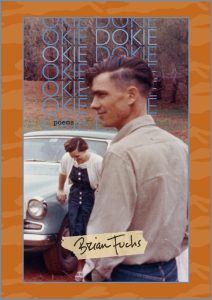
Amazon Paperback

Amazon Kindle

If you don’t already know what’s up, here’s a little backstory.  I’ve been writing since I was a child.  My first poem that I remember was written in October 1988 when I was 9 years old.  When I was 12, my teacher accused me of plagiarism because she didn’t think a child could write.  I don’t say that to congratulate myself at all.  I’m not even sure if that was worth all the aggravation.  It has been lost to time.  It was titled Paige and it was about the life of a woman who never finds happiness.  But I imagine the actual poem would seem completely juvenile now.

I started writing in earnest in college and since 1997 I have written consistently.  While I veer off into other projects, like short stories or novels, I find poetry that I always return to poetry and enjoy writing it.  Over the years, I’ve developed my own style.  That is a good thing.  The problem is that I also haven’t had serious critique of my work since I graduated from college, so I don’t actually know how my work is seen by others.  I’m amazed that I’ve managed to spend the better part of 20 years unwilling to share my work for fear of rejection.  And I really should have managed that sooner!

When I lost Mom last year, the first thing I did was crawled into a metaphorical hole for 9 months.  I wanted to disappear because I didn’t understand how one can live without his mama, and I’m not too proud to say it.  It also brought a few things into focus.  One of those things was letting go of the expectations and opinions of others.  Now, I mean of me as a person, not my work.  That is a lesson that has been taught to me my entire life, but sometimes things need to cook for a while.

So, now I’ve got a book.  I worked diligently over the summer to get it done.  My garden is sad and neglected, my roommate is sad and neglected, and my family… well, they are too busy to have noticed, but if they had I imagine they would feel sad and neglected.  For this first collection of poems (because I don’t want it to be the last!), I wanted to focus on a few things: 1. Poems with very specific references to people.  It’s not that I won’t write that way in the future, but I wanted to give people the words I had written for them before getting into other subjects.  2. Epitaphs.  I’ve lost a lot of people and I often have things to say about that.  I’d like to get through a lot of those I’ve had lying around, but there are many more.  3. My very favorite poems I’ve written… that aren’t too scandalous.  I get it, family will buy this first book. They will even hang on for a second, but by the third they won’t be too fussed about it.  So, I have actually created a plan where my third book is where I completely let my hair down.  That does mean I have to do at least 2 more books, but it also sounds like I’m censoring myself.  In a way I am, but I’m not completely either.  I want my prudish great aunt to be able to have something she will never read, but that won’t make her blush too much if she decides to open it up.

Last thing I will say about it, I decided to make notes on each poem.  Rather than include them in the actual printed book, they can be found here… in the writing tab, or at this link.

Notes

Written 21 September 2019 in Payne County, Oklahoma.

Brian Fuchs, “1975” from Okie Dokie (Scissortail Press, 2019)

Published in Social Distances (Scissortail Press, 2020)

Quentin Clingerman Has Died

The winds are picking up
blowing trash into my yard
and announcing a storm that will
fall apart before it arrives.
The worn out flags and crosses
still look as majestic as they did,
but I’m opening by insides
and filling my pages with secrets.
I’m waiting for critiques
by entrenched folks who think
too much about the sex lives
of other people, of my sex life.
I want to reveal myself again,
try to make people see my words
and my techniques and stop worrying
about who I’ve kissed or
who I haven’t, but wanted to.
I want to edit volumes of poetry
about God and America and guns,
poems filled with the lies we tell ourselves
and enjoy them because the author
knew how to write the words beautifully.
I don’t want to read the judgement.
It starts to rain and I’m surprised;
I thought the rain would miss us.

Notes

Written 21 September 2019 in Payne County, Oklahoma.

Brian Fuchs, “Quentin Clingerman Has Died” from Okie Dokie (Scissortail Press, 2019)

The Rain

I’m still waiting outside for rain,
hoping for sudden downpours from cloudless skies.
I’m wondering if she’ll join me when the first drops
start to fall and the birds fall silent.
She’s been delayed, I’ve told myself again,
or the rain hasn’t been enough.
It has never been enough
I’ve summoned more and more rain,
for over a year I’ve coaxed it from the air,
the ground sometimes swelling, saturated and marshy.

Brush Creek has filled to overflowing,
washing out parts of the road and clearing out
the debris of our distractions.
It has not been enough.
The Cimarron & Arkansas Rivers have been flooded,
swallowing homes and memories,
lives lost and inconvenienced.
Still she has not arrived.
I continue my incantations, calling for more clouds,
more rain — great hurricanes that try to find me,
creeping along the coasts, tied to the oceans.
Florida, Georgia, Louisiana, The Bahamas, Puerto Rico,
they may all need to be sacrificed in my efforts,
and it will be worth the loss because I will
no longer feel like I am alone.
I am listening for those first signs, the drips on the tin roof
and I am ready to throw open the windows,
clench my fists, and try to push my dreams into reality.
I know she will join me if I keep trying,
and we will sit together on the covered porch,
resuming what should still be.

Notes

Written 5 September 2019 in Payne County, Oklahoma.

Brian Fuchs, “The Rain” from Okie Dokie (Scissortail Press, 2019)

Cercis canadensis

When we had tried
putting ourselves together again
we’d used the wrong parts,
made effigies of ourselves
with the piles of distorted junk,
left behind scraps of a once-full life.
We went through the motions of people
spoke like them, practicing their accents,
but did not understand our own words.
We got the phrases wrong,
the tones, the memories.
Periodically, we’d erupt into full color
flowers growing from every part
and our days seemed alive with joy.
But we would catch ourselves lost in time,
eyes fixed on a long-abandoned walker,
a long-absent bed,
a long-neglected garden,
at the things we find so important now
and the flowers would fall from our bodies.
I gave up on trying to find the parts
of myself I missed most,
stopped looking for who I had been before. I’ve been more comfortable with discomfort,
waiting for others to finally leave the safety
of their beds, the safety of their tears.
And we’ve started to share ourselves again,
imagining Spring, redbuds flushed fuchsia,
grief removed from our shoulders,
sadness washed from our faces
by the showers of April and storms of May.
We will remember how to be happy
and how to be sad and how to be,
and we’ll see the long-forgotten remnants
and we will understand who we are.

Notes

Written 19 April 2019 in Payne County, Oklahoma. Rewritten 5 September 2019 in Payne County, Oklahoma.

Brian Fuchs, “Cercis canadensis” from Okie Dokie (Scissortail Press, 2019)


Cercis canadensis

When we had tried
putting ourselves together again
we’d used the wrong parts,
made effigies of ourselves
with the piles of distorted junk,
left behind scraps of a once-full life.
We went through the motions of people
spoke like them, practicing their accents,
but did not understand our own words.
We got the phrases wrong,
the tones, the memories.
Periodically, we’d erupt into full color
flowers growing from every part
and our days seemed alive with joy.
But we would catch ourselves lost in time,
eyes fixed on a long-abandoned walker,
a long-absent bed,
a long-neglected garden,
at the things we find so important now
and the flowers would fall from our bodies.
I gave up on trying to find the parts
of myself I missed most,
stopped looking for who I had been before.
I’ve been more comfortable with discomfort,
waiting for others to finally leave the safety
of their beds, the safety of their tears.
And we’ve started to share ourselves again,
imagining Spring, redbuds flushed fuchsia,
grief removed from our shoulders,
sadness washed from our faces
by the showers of April and storms of May.
We will remember how to be happy
and how to be sad and how to be,
and we’ll see the long-forgotten remnants
and we will understand who we are.

This has been a difficult week for me.  On the 28th, I lost my kitty Franz who was born in my living room 16 years ago.  He has been a part of so many moments in my life.  I’m not sure how to express how much he has meant to me, but I can tell you that his absence is very much noticeable.  I miss him.  I miss him waking me up in the morning, cuddling with me while I watch TV, and greeting me when I walk in the door.  I feel guilty that I couldn’t keep him alive, and the whole week has felt like such a blur.

I was 22 when Franz came into my life.  I really feel like my adult life has been defined by him.  And yes, his mama is still with us.  Molly is 6 months older, and she seems to have not really noticed that Franz is gone.  And I’m glad to have her — I don’t mean to take away from her impact on my life, but they had such different personalities.  Franz was a sweetheart.  He was timid and gentle.   Molly more or less tolerates me.  She is independent and self-determined.  And she always gets her way.  I’m trying to think of a creative way to memorialize Franz.  He deserved to live forever, and I want to keep him a part of my life forever.

Highlights from Tumblr

Dale

I sought the council of trees, Dale’s name lingering in my head,
hoping to glean wisdom from the aged assembly,
hoping to hear God through the woody branches.
I studied the structure of oak leaves, how each attached to a branch;
watched sunlight fall through the new growth on cedars;
made note of the greenbriar’s leafy fingers wrapping around the trunks of pecans.
The world was still and hot and dotted with tiny white butterflies
emerging from the thickets to enjoy a field of nectar-filled flowers in the afternoon sun.
My mind had been typically cluttered, with family dramas,
thirteen years of grief, first loves, comedy routines,
and parts of a jingle from a TV commercial I remembered from childhood.
Sitting in the surrounding quiet, I waited for the ancient botanical knowledge,
letting those thoughts drop away, heavy and viscous,
and leaving behind a calm in which I could almost hear the butterflies landing on petals.
The wind came gently then, in small bursts that the oaks seem to enjoy,
allowing the trees to flit thousands of leaves about merrily.
A rustle, a calm and relaxing rustle accompanied by silent mimics,
of a host of lesser plants vying for the favor of the post oaks,
standing as the monarchs of this dry woodland.
A slightly stronger breeze, a creaking sound as older specimens swayed,
some long dead, the bony outer branches moaning hauntingly in the current.
The tranquility was broken, butterflies scattered unceremoniously into the air,
having been blown off their perches by a strong wind that moved through the grasses,
flattening it in waves as it moved across the expanses.
When the wind reached the sentinels of trees standing bravely against it,
they found themselves unprepared and leaves and branches erupted into chaos.
Dale had died.
He had been my namesake, the hero and villain of his own stories,
his name lingered, attached to mine as a reminder of who he no longer was
and as a reminder of who he had been capable of being,
a reminder of who we all had been, of what we wanted to say we had been.
And now he was gone. As the gust moved on in the distance,
stillness returned to the trees and I still faced them, waiting for answers.
We were all there, waiting for different pieces, prostrating ourselves before them.
The instructions were lost, the knowledge never passed on,
the person whose position had been placed so highly seeming to fade
with great distances, separated by different trees, grasses, weeds.
His name lingered, attached to mine as a reminder that we should hold on,
hold him up as he fell, his wings revealed to be a mirage.
It was not always enough, we were not always enough,
and we allowed Dale to slip into humanness.
The trees had again become silent. The distances now as close as they would ever be,
as far somehow as they had felt before when inscribed books would
arrive by mail, wrapped in symbols of birthdays or holidays or plainly
when a book had piqued Dale’s desire to share it with me,
a boy he barely knew, but to whom his name was attached.
And there were songs and great conversations, which are things
of which plants know little. And things that had defined him
so importantly that it felt proper to discuss them now, with God or the trees.
The heat had started to intensify; beads of sweat formed on my neck and face.
Still I waited, knowing that lives had become altered, knowing that we had reached
both the beginning and the end of everything.
And I thought about whittled walking sticks, carefully crafted from the new growth.
His name lingered in my mind, attached to the trees, I now realized, a part of it.
The presence of butterflies had increased in my focused state;
they now seemed to be everywhere, clustered on flowers
and dancing through the space between the trees.
I turned and went back to the house, knowing and not knowing,
melding now with the air and grass, with the trees.
And I thought about Dale, his name lingering there, attached to mine,
attached to the moment and those memories,
attached to the wings of hundreds of tiny butterflies
And I smiled because I had known him.

Notes

Brian Fuchs, “Dale” from Okie Dokie (Scissortail Press, 2019)

Written 25 July 2015 in Payne County, Oklahoma.

Semiprecious

Turquoise makes me sad
because my grandmother is dead.

Notes

Written 15 July 2004 in Tulsa, Oklahoma.

Brian Fuchs, “Semiprecious” from Scissor-tailed Flycatcher (Scissortail Press, 2020)

Bonita

She looks perfect,
her familiar red dress matches
beautifully with the soft pink lining,
the red heart draped around her neck,
as if she’d just come in
from church for a nap
on a lazy Sunday afternoon.
She is calm, peaceful.
Tears stream down Papa’s face;
his wife and best friend,
the mother of his children
and the strong woman
to whom he devoted a life,
lies quietly, still the girl he married
only fifty-three years ago.
‘She really is a beautiful lady.’

Notes

Written 12 March 2002 in Stillwater, Oklahoma.

Brian Fuchs, “Bonita” from Scissor-tailed Flycatcher (Scissortail Press, 2020)

Original Version:

Bonita
on viewing my Mimi’s body

She looks perfect,
her familiar red dress matched
beautifully with the soft pink lining,
the red heart draped around her neck.
As if she’d just come in
from church for a nap –
a lazy Sunday afternoon,
she lay resting — calm, peaceful.
Tears stream down my grandpa’s
too often stoic face.
His wife — the woman he
devoted his entire life to –
his best friend.
“She really is a beautiful lady.”