In Defense of Fragrance

I recently read an article about the recent boom in the fragrance market.  In the article, the author posited that this rise was at least partially due to Covid-19 and how people in isolation had forgotten the natural smell of other people, so a market rose up to meet the demand of people not wanting to contribute to those odors.  She also touched on the classist and potentially racist associations with scent.  While it was all very interesting, I think I have a different take on it.  

Granted, my own family has a long association with pleasant fragrances.  My great grandparents’ homes were the last I can remember that smelled neutral, except for the bottles of perfume in the bathrooms.  By my grandparents’ generation, potpourri and air fresheners had taken over their homes.  But that is not because some of those things didn’t exist before.  Potpourri & incense have been used since antiquity to scent homes.  But my great grandparents were all farmers, practical and poor people for whom these things would have been a luxury.  When I recently inherited a few of my great grandma Daugherty’s things, I was even surprised to find that she had a few Alfred Hitchcock novels and an apricot scented candle in an apricot shaped pot.  This kind of frivolity goes against my perceptions.  The candle had never been burned, and I can imagine my grandma just lifting the lid and getting a little treat of apricot fragrance to lift her spirits.  And although she was poor, she wore perfume.

In my grandparents’ homes, everything smelled “nice.”  There was lemon scented all-purpose cleaner, pine scented floor cleaner, scented fabric softener, and even sometimes a pot of spices on the stove, the scent wafting out into the house.  Neither home had scented candles regularly, but there was scent.  My grandpa’s bathroom smelled strongly of Old Spice and Irish Spring, my grandma’s of Tabu and lotion and the gentle scent of soap from the bowl of rose shaped pieces arranged in a bowl on the counter.

The home I grew up in had its own strong scents.  My mom loved scented candles, and she’d light them when she came home from work, so when we arrived from school there would be one in the main bathroom, one in the kitchen, and one in her bedroom.  There were different scents in the rooms, all seasonally appropriate, and as you walked from room to room, the gradients changed and it would all make the house feel all the more cozy.  She too would sometimes have spices going instead of a kitchen candle, and while she had potpourri throughout the house, it was rarely strong enough to contribute.  We did not have laundry scents; my dad’s sensitive skin required unscented products.  But my parents both wore perfumes: my mom had a selection of various options and my dad primarily wore Brüt, then Aspen, the Le Mâle.  Our shoes weren’t allowed in the house, and my mom would spray them with Brüt on the porch.

In the 1990s, Bath & Body Works opened and my mom’s fragrances became those offered in their lotions and body sprays, which largely replaced the need for as much perfume.  She would smell like Pearberry, Coconut Lime Verbena, or “Gingham.”  I have two brothers, and as each of us started puberty, the Brüt we shared was replaced with scents that were more individualized.  My grandma chose mine, giving me a bottle of Tommy by Tommy Hilfiger, which is how I smelled though high school and college.  My older brother received Abercrombie & Fitch’s Woods, but I don’t remember what he used before that.  I also don’t remember my younger brother’s fragrance preference, but knowing him he likely used what my dad and my grandpa used.

Our cars were not exempt from scent either, with various forms of air fresheners being utilized, from little trees to pots under the seats to little gel packs that slipped onto the vents.  At church and school, the restrooms dispensed bits of air freshener on a timer, in every department store a melange of perfumes had created an ever-changing distinct character.

In the article I read suggested a recent and new obsession with ridding ourselves of the natural smells of being human, linking that concept to racism.  I worry about that suggestion, as it implies that unpleasant body odor is linked to non-White people around the world.  It ignores the millennia of history of added scent in cultures around the world.  

The modern concepts of perfume are closely tied to the Middle East.  While perfumes and incense were common in Ancient Greek & Roman cultures, it was the introduction of Arabic notes in the Islamic period in Spain that really brought these perfumes to Europe.  There is even question about whether Europeans had lost the practice in the interim.  

In South Asian cultures, scent has always been important, dating back to the Indus River Valley Civilization.  Ayurvedic practices have linked India with many scents, like patchouli, jasmine, and sandalwood.  For many, incense is synonymous with the region. 

A friend of my mom’s does have some of her racism tied to scent, but while she associates things like patchouli and sandalwood with people she sees as “inferior,” she also doesn’t understand that many of the fragrance notes that are common in our lives are from the people she is so hateful toward.  There’s a conversation there about fragrance, but it isn’t about a cultures lack of personal fragrance.

Indigenous Americans used perfumes and incense for a variety of personal and ceremonial purposes.  Some of the plants that have been used for thousands of years in the Americas have found their way into all areas of fragrance.  Tobacco in particular is a staple of the perfume industry.  Vanilla and cacao were brought to Europe by Spanish Conquistadors, while the Spanish introduced the distillation of oils and their own fragrance practices to indigenous Mexicans and Central Americans.  

Across Africa, various ingredients have historically been used in a variety of ways to incorporate scent.  Oud, tonka bean, ylang-ylang, frangipani, vanilla, citrus, myrrh, frankincense, and spices have millennia-old roots.  These fragrances were used for weddings, ceremonies, to scent clothes or hair, and as perfume for well-being.   

So, why the rise in the fragrance industry?  I’m not sure it can be blamed on Covid-19.  At least where I live, there was no extended period of isolation for folks.  The risks were largely ignored.  I think the same thing has happened to fragrance that happens to many things.  A traditional thing is turned into a luxury item, popularized as an expensive thing, and then when it becomes cheaper and cheaper to produce, it becomes affordable and obtainable more widely, while the association with luxury remains as a cultural artifact.  That fades with time.  As fashions reaches the working class, its appeal starts to fade for those who benefit from it remaining a luxury.  Carpet was a luxury when first introduced, but by the time it became affordable it was seen as cheap.  Wine has gone through it.  Recently, Business Insider decried that caviar could lose its luxury status, as if that was what mattered about the product.  The implication in their article was that it only has value if it isn’t widely available to ordinary people.  That’s what perfume has gone through.  What was once cultural and easily used by everyone was turned into a symbol, and that symbol is crumbling as fragrances become increasingly inexpensive.  Now, anyone can get a decent bottle of perfume for under $40.  The ideas we all still have of this being a product of the elite is something that will change over time.

What to do about those who have sensitivities to fragrances?  That’s a discussion to have for sure!  I personally don’t care for the use of products that infuse so much scent into our clothes.  Perfume on the skin dissipates over time more quickly than those products.  Certainly a home where candles are regularly used has a more permanent aroma than one that does not, but both can feel overpowering if the linen closet is filled with items that have been scented with laundry detergent, fabric softener, fragrance beads, closet sachets.  I think scenting responsibly is something we can all learn.  I know that I overspray fragrances on my own skin when I am going to be home for the day, or at the park.  But when I intend to be around others, I spray pretty sparingly.  And other people are not doing that.  Maybe it gets into American selfishness, I’m not sure.  I also think people who have sensitivities, allergies, or aversions shouldn’t feel like there is some sort of inherent virtue to smelling a specific way.  A person who wears nothing smells different from someone wearing floral perfume.  It’s not better or worse.  It’s different.  I think it can be difficult to work on those issues when other people genuinely enjoy a perfume and compliment it.  That creates the perception of a good vs bad way to smell, but is the answer to tell people they aren’t allowed to smell how they choose?  Or worse, should we stop complimenting one another?  It’s important to recognize people’s health issues, but it can be a difficult discussion.  I don’t think demonizing the use of perfume does what it was meant to do.

I always get nervous about Eurocentric discussions of other cultures.  I find the discussion of practices in non-European cultures as being strictly or largely ceremonial or religious to be incredibly problematic.  I don’t think we would use that sort of language when talking about an 18th century French woman and her use of perfumes.  To be fair, the use of daily perfume could be considered ceremonial, but when historians talk about the cultural practices of groups they do not belong to, it often feels like non-European cultures lack a sense of self.  They don’t exist as persons, but as extensions of their archaic religious beliefs, or as accessories to their nobility.  Some European history does some of that as well, but the people aren’t described as a collective that is unable to do or think in individual ways.  In these narratives, Europeans are real people; non-Europeans are not.  

To be generous, the author suggesting the link between the fragrance industry and racism could be viewing it through the lens of the entire beauty industry.  With fragrance a part of beauty standards, it could go hand in hand with the discussions on that topic.  But I don’t think it works as well in isolation.  

This all gets under my skin, and I suppose even writing these thoughts down could be seen as doing some of the same things I criticize.  

As White people, I think it is so hard to fully understand the depths of our internalized racism.  I know I have my own racist ideas. I am sometimes shocked when I discover a bias I have that I just didn’t work on or realize consciously until a news story or article brings it up and I am jolted into the realization of my own bigotry.  There isn’t always a malicious teaching of these notions, but the permeate everything anyway.  If someone attended school in the United States and didn’t come away with some amount of racism, they are lying.  It’s baked into our myths about ourselves.

I think the suggestion that the use of fragrance is some sort of Colonizer practice meant to rid the world of body odor’s from those we sough to oppress is to center Europeans as the ones from whom pleasant body fragrance was derived.  It ignores the cultural roots of fragrance around the world, both as ceremonial and as personal.  I think there are some ways we can discuss how body odor is tied to culture, but I don’t think the blame lies with pleasant scents. 

Of course, maybe I don’t know what I’m talking about.  These are just the thoughts sparked by reading an article.  I feel a bit of bias as someone who enjoys scented candles in my home and perfume on my body.  


My Parfumo Profile: https://www.parfumo.com/Users/brianfuchs

My Fragrantica Profile: https://www.fragrantica.com/member/2531788

My Full Fragrance List: https://brianfuchs.com/lists/fragrances/

I couldn’t get him to respond, so I don’t even know if he had a nice day.  I hope so.  He needs more nice days in his life.  He was going to Cattleman’s for dinner.  That was his plan.  After going back and forth for a long time, I actually decided to go with him.  I am also trying to get out of my own way, but since I never could reach him I still don’t know what’s going on.  

Brent came to hang out between photo shoots during the day.  It’s a stark contrast.  Brent is easy to be around.  There isn’t some deeper meaning to it; he brought some dinner with him, ate it, and then took a nap in the library for an hour before leaving.  It’s how I expect family to be.  Both him and Brad are welcome in my house in that exact way, as if they are supposed to be there.  And it is how I expect to be in there houses.  But sometimes Brad makes it awkward with guilt trips and weird tours of things he is doing.  And it all just reminds me of how Dad used his children as substitutes for friends.  Have friends as friends.  Family should be able to relax around you.

I’m just frustrated because Brad is genuinely fun to be around, but it’s hard to get to that point when everything is so dramatic.  I wish he could just calm down, then maybe it would make sense to stop by and hang out for an afternoon.  Regardless, I hope he had a pleasant day.  Happy 44th to him!

Notes

Written 26 August 2018 in Payne County, Oklahoma.

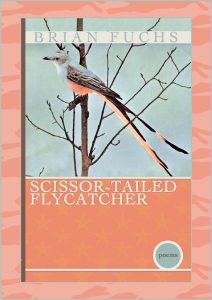
Brian Fuchs, “Luctus Herbarium” from Scissor-tailed Flycatcher (Scissortail Press, 2020)


Notes

Written 7 February 2020 in Payne County, Oklahoma.

Brian Fuchs, “Making Circles in Darkness” from Scissor-tailed Flycatcher (Scissortail Press, 2020)


Notes

Written on or before 9 March 1998 in Claremore, Oklahoma. 

Brian Fuchs, “little SUPERHEROES” from Scissor-tailed Flycatcher (Scissortail Press, 2020)


Written 13 August 1998 in Claremore, Oklahoma & 23 February 2020 in Payne County, Oklahoma.

Brian Fuchs, “Zinnia elegans” from Scissor-tailed Flycatcher (Scissortail Press, 2020)

Notes


for Ann & LaDonna

Notes

Brian Fuchs, “The Transformation of Gaia’s Daughters” from Scissor-tailed Flycatcher (Scissortail Press, 2020)

Also appeared in Social Distances (Scissortail Press, 2020)


Notes

Written 19 February 2020 in Payne County, Oklahoma.

Brian Fuchs, “Watermelon Seed” from Scissor-tailed Flycatcher (Scissortail Press, 2020)


Campsis radicans

That house still haunts me;
the absences I feel are extreme.
Brad has kept the trumpet vines,
electric and intense like himself.
He pulled the irises that were once
lining the paths and taking breath
away from visitors as they passed.
The enormous black-purple blooms,
now towering only in our memory.
He inherited too much and not enough,
spending time and money adjusting,
spreading out and stamping his energy
onto the places that had been our center.
He’s added alcohol to the room where
my grandma’s last moments began,
highlighting the permanence of it all.
Where there was once an annual
display of daisies and cleomes,
a chainlink box sits, overgrown with
those intense trumpet vines.
The garden is all wild and unkempt,
like he’s trying to preserve something
that cannot be contained or suppressed.
Life spills out from our dark spots.
The house was full of undue pressures,
now settled into a gritty beauty.
The roots will continue to grow,
the trumpet vines will spread,
and one day my nephew’s children
will wipe tears from their eyes when
they visit a house that meant so much.
And they’ll talk about the intensity
and how much they’d give to have it back.

Notes

Written 20 February 2020 in Payne County, Oklahoma.

Brian Fuchs, “Campsis radicans” from Scissor-tailed Flycatcher (Scissortail Press, 2020)

In a lot of ways, it feels like things are starting to make sense for me.  And it a lot of other ways, it feels like things are as chaotic as always.  Everyone seems just a little frustrated, but I’m not sure most of them can articulate why.  I know I can’t.

I finished Okie Dokie last month, and I have done a couple of edits to it since.  I hope I’m at a point where I can leave it alone now.  My copies come in the mail Saturday, and I’ll really know then.  I’m both excited and terrified to have my writing available for others.  That was always the goal, but I’m just so nervous about these things.  I hope others can appreciate my point of view and I’m looking forward to getting feedback, even if that feedback is negative.  Constructive criticism is always welcome.  I actually just assume that if someone doesn’t like something I’ve written, then that is just a preference they have and does not reflect on my writing in any real way.  If the consensus is negative, then I’m just writing the wrong things for current audiences.  I will have to wait and see.  The really difficult thing will be critiques by those I admire or grammatical errors pointed out by those I don’t.

I’ve started working on my next book, which will be similar to Okie Dokie in that it will contain selections of poetry from the past twenty years, as well as a few new poems to pull the book together.  I’ll have one or two more like that before relegating unpublished poetry to a “remnants” book of some sort in the future.  I have some things I’ve written that I really love, but I’m not sure how to make them work in any of these projects.  I do want a story to emerge from the collection, even if only loosely.  Okie Dokie was about myself and about how I see the world around me.  The second book will be about family and the places from which they came.  The third book is about friendship and love.  If I need fourth or fifth, I’ll do another about myself and then a last one about family, as those are the two subjects I’ve written the most about.  I’m also not limiting my writing.  I have other things I want to write and those things will fall into the projects that make the most sense for them.

For October, I’m enjoying some spooky stories and songs throughout the month, and I am of course bothering family with those things.  I miss sharing things with people.  I find everyone becoming increasingly isolated, and not just in my own family.  I’ll post some of those things on here during the month.

It’s finally out.  And I can finally get some sleep!  Here are the links to my book on Amazon.  I think it looks so much better in paperback, but there is a Kindle version available.

Amazon Paperback

Amazon Kindle

If you don’t already know what’s up, here’s a little backstory.  I’ve been writing since I was a child.  My first poem that I remember was written in October 1988 when I was 9 years old.  When I was 12, my teacher accused me of plagiarism because she didn’t think a child could write.  I don’t say that to congratulate myself at all.  I’m not even sure if that was worth all the aggravation.  It has been lost to time.  It was titled Paige and it was about the life of a woman who never finds happiness.  But I imagine the actual poem would seem completely juvenile now.

I started writing in earnest in college and since 1997 I have written consistently.  While I veer off into other projects, like short stories or novels, I find poetry that I always return to poetry and enjoy writing it.  Over the years, I’ve developed my own style.  That is a good thing.  The problem is that I also haven’t had serious critique of my work since I graduated from college, so I don’t actually know how my work is seen by others.  I’m amazed that I’ve managed to spend the better part of 20 years unwilling to share my work for fear of rejection.  And I really should have managed that sooner!

When I lost Mom last year, the first thing I did was crawled into a metaphorical hole for 9 months.  I wanted to disappear because I didn’t understand how one can live without his mama, and I’m not too proud to say it.  It also brought a few things into focus.  One of those things was letting go of the expectations and opinions of others.  Now, I mean of me as a person, not my work.  That is a lesson that has been taught to me my entire life, but sometimes things need to cook for a while.

So, now I’ve got a book.  I worked diligently over the summer to get it done.  My garden is sad and neglected, my roommate is sad and neglected, and my family… well, they are too busy to have noticed, but if they had I imagine they would feel sad and neglected.  For this first collection of poems (because I don’t want it to be the last!), I wanted to focus on a few things: 1. Poems with very specific references to people.  It’s not that I won’t write that way in the future, but I wanted to give people the words I had written for them before getting into other subjects.  2. Epitaphs.  I’ve lost a lot of people and I often have things to say about that.  I’d like to get through a lot of those I’ve had lying around, but there are many more.  3. My very favorite poems I’ve written… that aren’t too scandalous.  I get it, family will buy this first book. They will even hang on for a second, but by the third they won’t be too fussed about it.  So, I have actually created a plan where my third book is where I completely let my hair down.  That does mean I have to do at least 2 more books, but it also sounds like I’m censoring myself.  In a way I am, but I’m not completely either.  I want my prudish great aunt to be able to have something she will never read, but that won’t make her blush too much if she decides to open it up.

Last thing I will say about it, I decided to make notes on each poem.  Rather than include them in the actual printed book, they can be found here… in the writing tab, or at this link.

Notes

Written 21 September 2019 in Payne County, Oklahoma.

Brian Fuchs, “1975” from Okie Dokie (Scissortail Press, 2019)

Published in Social Distances (Scissortail Press, 2020)

Triticum aestivum

Soon enough we’ll be old and nostalgic.
You’ll talk about the prices of wheat and corn
like you grew up on a farm
instead of being a spectator at the rodeo.
I won’t understand the language of agriculture,
but I won’t care because you’ll remind me of mom.

Notes

Written 20 September 2019 in Payne County, Oklahoma

Brian Fuchs, “Triticum aestivum” from Okie Dokie (Scissortail Press, 2019)

Pieces of Dissected Butterflies

I left Tulsa when my friends had died
and we were all set adrift, angry and lost,
wondering if staying meant more of us would die.
I tried to go to Dallas, to a life I wanted.
They boys swarm thickly there,
and I still wonder if my days would have been
spent in the beds of strangers if I’d gone there.
I’ve always longed for the beds of strangers,
to feel taken for granted and awkward.

In moving, I detoured, finding myself in Anchorage,
near the place where my dad spent his youth,
carried on winds I rode for too long, or just long enough.
I was not qualified for life in Alaska,
not qualified for the men who had gone there.
But I was determined to find myself,
or to find Dad in the places where his friends still lived.
His youth was left in an Alaska that no longer exists,
so my mind found new reasons to keep me there.

I found the spaces I understood,
the pockets of the city that seemed familiar,
bookstores filled with other refugees,
of lives that had started to drift.
My mind invented the things I didn’t know
and the people around me became gods.
I didn’t question that, and I formed a religion.
Their lives were spent being perfect
in ways I could never spend my own life.
They are still gods; I pray to them in darkness,
my soul crying out to be acknowledged.

On cold mornings, I liked to price books,
scanning their barcodes and attaching a sticker.
I would think about my friends,
wonder about the shapes of their bodies,
and worry that they could hear my thoughts.
I’d worry that I was saying the thoughts aloud,
and I’d wait for Kevin to go upstairs to inject his insulin
so I could stop thinking about his waist.
I’m still thinking about his waist.
The decade I’ve had to reflect has made me more curious
and sometimes I worry that he can still hear my thoughts.

I have been dissecting butterflies,
stained glass wings pulled apart
by unwieldy spinning steel fingers
as I think about beauty and conformity,
praying to my gods, mindlessly offering
the insects as a tribute.
I didn’t intend this massacre
and in the lawn lie the tiny lifeless parts.
In the hot sun of the places of my youth,
I don’t have new shapes to fill my mind,
new boys to think about.
I dwell on the boys of my past.

I’m reaching back, feeling myself grasping
for people I can’t always recognize,
the names apparitions in my mind.
Some of the gods’ faces have merged & morphed.
I’m taking the ones I wanted the most,
or the ones I wanted to be the most,
and placing their pieces where I can sort them
and try to hold onto them in my mind.
I’m still thinking about waists and hips and shoulders,
still wondering about the firmness of skin.

They haven’t seen me wondering,
their lives have pulled them toward much happier places,
some growing beautifully in Alaska,
others found scattered by the winds
that had first deposited them near me.
The butterflies are whispering secrets,
understandably warning each other about me.
In new cities and states, in their new lives,
they think about the times we spent together
and I go on thinking about their bodies.

Notes

Written 12 September 2019 in Payne County, Oklahoma.

Brian Fuchs, “Pieces of Dissected Butterflies” from Okie Dokie (Scissortail Press, 2019)

The Rain

I’m still waiting outside for rain,
hoping for sudden downpours from cloudless skies.
I’m wondering if she’ll join me when the first drops
start to fall and the birds fall silent.
She’s been delayed, I’ve told myself again,
or the rain hasn’t been enough.
It has never been enough
I’ve summoned more and more rain,
for over a year I’ve coaxed it from the air,
the ground sometimes swelling, saturated and marshy.

Brush Creek has filled to overflowing,
washing out parts of the road and clearing out
the debris of our distractions.
It has not been enough.
The Cimarron & Arkansas Rivers have been flooded,
swallowing homes and memories,
lives lost and inconvenienced.
Still she has not arrived.
I continue my incantations, calling for more clouds,
more rain — great hurricanes that try to find me,
creeping along the coasts, tied to the oceans.
Florida, Georgia, Louisiana, The Bahamas, Puerto Rico,
they may all need to be sacrificed in my efforts,
and it will be worth the loss because I will
no longer feel like I am alone.
I am listening for those first signs, the drips on the tin roof
and I am ready to throw open the windows,
clench my fists, and try to push my dreams into reality.
I know she will join me if I keep trying,
and we will sit together on the covered porch,
resuming what should still be.

Notes

Written 5 September 2019 in Payne County, Oklahoma.

Brian Fuchs, “The Rain” from Okie Dokie (Scissortail Press, 2019)