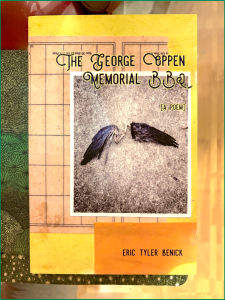
The George Oppen Memorial BBQ
A Poem
Eric Tyler Benick
2019, Poetry

⭐︎🟡⭐︎🟡⭐︎🟡⭐︎🟡⭐︎🟡⭐︎🟡⭐︎

26 September 2025, 7:39 am

My least favorite of my traits is how often I second guess myself.  I don’t allow my instincts to be correct.  It’s always a mistake and one that I suppose I will never allow myself to internalize.  I want to do better; I want to create in the ways that I create naturally, freely, thoughtlessly.

This poem is a reminder to freely open and let the words flow on their own.

I fell in love with the Eric Tyler Benick in the interview that follows the poem.  He writes the way I write.  He is inspired in the ways I am inspired.  He makes me want to be.  I wasn’t familiar with all of his references, but the joy I found in the work has encouraged me to look up George Oppen and add him to my reading list.  I’m very excited about it.

There is always space / in a poem for love / when it is exact.

I really appreciate when a book makes me want to be a better writer. This poem is gold, but even better part of this book is his answers to the interview questions at the back. The author makes me want to try harder, to be more confident in my own words, to continue to peel back and expose the content of my mind.

⭐︎🟡⭐︎🟡⭐︎🟡⭐︎🟡⭐︎🟡⭐︎🟡⭐︎

Started Reading: 26 SEP 2025
Finished Reading: 26 SEP 2025Continue Reading
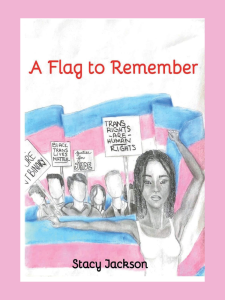
A Flag To Remember
Stacy Jackson
2019, Poetry

⭐︎🏳️‍⚧️⭐︎🏳️‍⚧️⭐︎🏳️‍⚧️⭐︎🏳️‍⚧️⭐︎🏳️‍⚧️⭐︎🏳️‍⚧️⭐︎

I want to be clear about my intentions with the way I am making the notes on poetry books.  I am not reviewing the books in a classical sense.  My intention is to write my thoughts about the work as I read it.  This is just my ideas and things i might alter or change, and maybe some critique of the work.  It is not intended to overly criticize the author or their work.  I wouldn’t spend time reading an entire book if I didn’t appreciate the work.  That said, I’m giving the books a score based on my own gut reaction to the work.  It’s just my opinion and should be taken with a grain of salt.

⭐︎🏳️‍⚧️⭐︎🏳️‍⚧️⭐︎🏳️‍⚧️⭐︎🏳️‍⚧️⭐︎🏳️‍⚧️⭐︎🏳️‍⚧️⭐︎

23 September 2025, 7:42am

“A Flag To Remember”

I think it can be difficult to write poetry for a cause, even when that cause is important to the writer.  I have struggled with it in my own work, and have increasingly avoided topical or cause-oriented poetry.  In this case, because of the nature of the collection, or what I believe to be its nature, we need something to act as the gates we walk through into the author’s world.  I like this as the opening poem.  It’s a declaration, but I hope it’s also an indication of what to expect.  I think the poem could be tightened up just a bit, and there are some grammatical issues.  I’ve read a lot of self-published poetry, and these are pretty common across those poet’s work.  I think it’s a minor (and easily solved) issue.  I probably won’t mention it throughout, unless there is something egregious.  Good start.

“The Undecided”

Hmm…This is a brief poem, presumably about those whose gender is only defined as a part of cultural norms, but which would otherwise remain nebulous.  Maybe it is nebulous to those individuals still, even though there is pressure to put oneself into the boxes built by our societies.  My only critique of the writing would be that not every poem needs a rhyme.  I suspect now that there will be a heavy emphasis on rhyme, but that’s a talent few possess.  I certainly don’t.  I think if the author wants to be fully honest, she might try not forcing the poetry to rhyme.

“Penchant For Hoodies”

Storytelling.  I could see this whole situation, but it was told is only seven lines.  “Smuggled with goosebumps” is a great line.  It tells me a lot about the speaker.

Title suggestion: “Hoodies”

“An Ordinary Poem”

This little poem is so close to breaking free and becoming something.  I am usually okay with referencing a classic or clichéd poem, but I think maybe this could have started with just the classic lines and then the poem could start to become unraveled until we get to “We know people change / We know people change to.”  Those two lines in particular feel like the start of something else, like a cycle of repetitions interspersed with examples from the author’s life where people didn’t change.  That would start to sound like a chant of hope in a world that doesn’t deserve hope.  Promising, but ultimately flat.

“When you’re rejected by your mother and your father, you’re always looking for someone to replace that love.”

“The Butterfly who is Always Fearless”

I don’t have a lot to say about this.  There are some confusing lines, but it is either a poem to the author herself or to a sibling, so I fear that crucial context is missing and having work like this double checked by someone is good.  They can tell you where there might be some confusion.  I think it does a good job of making me want to know more about who this person is.  I wanted to explore some of those details.

Title suggestion: “Fearless Like A Butterfly”

⭐︎🏳️‍⚧️⭐︎🏳️‍⚧️⭐︎🏳️‍⚧️⭐︎🏳️‍⚧️⭐︎🏳️‍⚧️⭐︎🏳️‍⚧️⭐︎Continue Reading

Here are some websites that can help you if you need a little assist in your poetry writing. Remember: there are no actual rules, but sometimes rules and limits help spark creativity. And it can be a lot of fun to play with some of the aspects of poetry writing to see what sorts of things you come up with.

  1. List of 168 Poetic Forms for Poets – This is a fantastic list by Robert Lee Brewer of various poetic forms, from haiku to acrostic. I’ve found it helpful when I’m not feeling particularly poetic to tackle one of these forms. The structure becomes the important thing. Maybe you’ll find out that you really hate writing sonnets, but you might fall in love with seadnas.
  2. Syllable Counter – I love using this tool, but it can be a little tricky. I use it to broadly get a poem to have consistency, but if the syllables are important you’ll still want to count them yourself. It doesn’t get everything perfectly correct, especially with contractions. It’s nice to start with though. Line lengths can be misleading.
  3. Rhyme Zone – I honestly don’t do a lot of rhyming, particularly at the ends of lines. I do use this site quite a bit though. It’s great when playing with a rhyme scheme in a poetic form you are playing with or to find some rhyming words to scatter throughout a poem to give a nice flow. I’ve been fighting against rhyming for a long time, but I think I was failing to see how I could use it in newer ways and now I play with it more often.
  4. Thesaurus.com – Feeling stuck? Try for a new word. I use this often and primarily early on in writing. I’m wary of synonyms. It’s rare that two words would have the exact same usage in a language. They generally would reduce down to one or each of the words has nuances that could be explored on their own… and that’s the route I tend to take. I have an idea and I look at related words that might pull me in a direction I didn’t expect.
  5. Wiktionary – Honestly, there are a million and one online dictionaries. I like this one because it is simple, ad free, and includes translations in multiple languages. It also is very comprehensive. I think people misuse dictionaries all the time. It is worth saying, a dictionary is NOT a list of “correct” uses of a word, but a record of how words are used within a language. It can be helpful to know that a niche usage has not yet been widely used enough to be recorded, or that it has become archaic. That isn’t a reason to not use a word, but it is good to know. Looking up a word will show it’s common usage, as we all know, but there isn’t much use in being pedantic about dictionary definitions. Language is fluid. (Sorry, I saw a soapbox and climbed up on it!)
  6. Wikipedia Random Article – I love choosing a random Wikipedia article and writing about it. It can be a poem or a blog post or whatever, but it is a challenge. There are so many things I know nothing about, but that doesn’t mean I can’t be inspired by something I learn about them. If I’m writing poems, I tend to skip athletes or modern celebrities (I find it hard to be inspired in those cases), but rarely is anything else a complete dead end.
  7. Artnet – One of my major inspirations in art. I love to pull up a piece of art I love and sit with it for days and let it influence my writing. Sometimes nothing comes of it, but often it feels like it becomes a part of the process. There are a lot of places to look for art to enjoy, including most museums’ websites. If you want to use the work in a publication, scour Wikimedia Commons for images. There’s so much beautiful work in the public domain to inspire you. Make sure you always check the image rights before using work. The art on Artnet is copyrighted. Please don’t steal art.

Watermelon Seed

“Un enfant,
C’est le dernier poète
D’un monde qui s’entête
A vouloir devenir grand
Et ça demande si les nuages ont des ailes
Et ça s’inquiète d’une neige tombée
Et ça s’endort, de l’or sous les paupières
Et ça se doute qu’il n’y a plus de fées”

Three stones were dropped in the creek
where the dragonflies kept them company,
the prehistoric nymphs feeding on their umbilicals.
We had trouble finding our way back to that place,
but were rewarded for doing so with watermelon,
which we let drip down our hands and arms
in the intense heat of an Oklahoma summer.
The gemstones were kept fixed in her eyes,
projecting sad and murky images from her heart.
I was too young to feel the distance, but her hands
recoiled when she saw that I had the same stone
skin she’d thrown into that creek so long ago.
The dragonflies still fed nearby, emerged for
their brief adult lives to witness our return.
There is a shed still bursting with private musings
and with his attempts to understand the pain,
of loss and of rejection and of mistakes made.
I’ve grown apart, my hands unable to find hers
and my eyes now filled with gemstones.
Chasms have opened where creeks used to be,
and stones have spilled out in all directions.
Unspoken words and indifference hang low,
clouds that block the sun and offer cooling shade.
When the watermelon has been eaten, you spit
out the seeds, which sometimes grow into new
plants that put on the beautiful refreshing fruit.
Sometimes, those seeds rot and turn to dust.
I am still a child, ignorant and stupid.
I’m standing in the grocery store, broasted chicken
in my hands for my grandma’s dinner, dumbfounded.
She looked past me, the gemstones in her eyes
blinding her from seeing me, even though I could
see the glint of recognition on her face as she silently
passed by. That was the last time I saw her.
Dust.

Notes

Written 19 February 2020 in Payne County, Oklahoma.

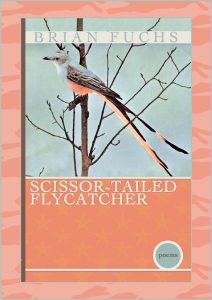
Brian Fuchs, “Watermelon Seed” from Scissor-tailed Flycatcher (Scissortail Press, 2020)

Eight Minutes in May

I’m just a yokel,
nothin’ in my noggin ‘cept dust
while old fires burn,
when souls cry out
to finally be heard,
when hearts have all exploded
over the same pavement
where their necks were pressed
and lives snuffed out.
The police are suiting up for combat,
firing up the tanks,
readying for war,
and I’m still standing in place,
slack-jawed,
shocked,
tears filling my face.
I feel my neck pressed
on the pavement,
imagination squeezing out my life,
filling my pores with a rage
I didn’t know was possible.
Only imagination,
no knee holding me down.
Only imagination,
no onlookers witnessing my death.
They did this
You did this.
We did this.
I did this.
My legs are frozen;
the march goes forward,
tear gas rushing through me.
People are rising,
beautiful and triumphant.
People are lifting their voices,
earnest and finally
at the end of their rope.
I’m projecting through space,
climbing my family tree,
finding ancestors
and preparing the tree
where they deserve to dangle,
where their necks should feel
that rough jute rope
as my ghost hands grip,
slip the noose and let their
useless lives slip away,
unnoticed and unremarkable.
I’m no price to pay at all
if they’d never existed,
and beauty was left to flower
in traditions and families
who never deserved abuse.
The police are marching on our streets,
storming our homes,
taking us out before we get a good look,
before we see their monsters.
Fires are burning.
People are rising,
bodies engulfed,
effigies of collective esophagi.
No air gets through.
The nurses fight through rubber bullets,
clad in medical-grade garbage,
supplies looted and spilled.
The nurses fight,
shove tubes down our throats.
Now none of us can breathe.
Everything is burning.
Our lives are burning.
Our lives mean nothing.
The floodgates must be torn down;
let the flood of melanin
wash over everything,
drown us, the children of terrorist.
They did this
You did this.
We did this.
I did this.
I’m starting to close my mouth,
my esophagus is catching fire.
I’ll either breath the fire of my indignation
or find myself intubated,
a machine replacing my lungs.
It’s only June,
and already the very air is burning
my skin. It’s only been two weeks,
but it feels like 400 years.
The shock has faded,
rage shoots out
of my mouth in great bursts,
flame and smoke.
The police are locking arms,
demanding our submission,
demanding our allegiance,
demanding our loyalty,
blindness.
Let the pavement
‘ever be pressed to our necks
so we can
never forget.

Written 7 June 2020 in Payne County, Oklahoma.

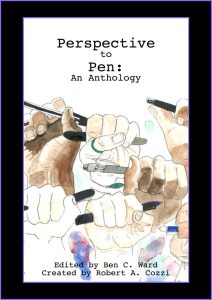
To be published in Perspective To Pen: An Anthology. Look for it in September.Continue Reading

The Transformation of Gaia’s Daughters

For Ann & LaDonna

Two chrysalises formed
separately, identically.
The prairie’s tall grasses
still grow between
everything we’ve ever known
and everything we’ll ever know.
Time has stood still for nearly two years,
and maybe our lives have been placed
in Aion’s ancient hands.
They’d formed those pupal shells
from two-seater pumpkins
borrowed from Thoreau’s own quill,
from the canvas tops of
their ancestral covered wagons,
from velvet cushions
left at their homes
for my uncle’s comfort,
and from red-lettered Bibles,
Jesus still reciting the instructions.
Outside, a chorus of children,
throngs of former students,
sing the songs they learned
when the two had been caterpillars
eating holes in the leaves,
dreaming of new plants
and of wings.
The students still wear the costumes
of philosophers and founders;
they are clutching small stones,
gold-paint chipping
from their rough forms.
The deafening joy fills the air,
heavy with heat.
Sunshine pools in one chrysalis,
vacant now in the stillness.
It glows like a stained glass lantern.
Inside the other, wings still form,
mimicking the shining pattern
projected on translucent walls.
They might have been
the Grimké sisters,
struggling toward a better world,
or they might have been
the mothers of us all,
here at the very creation,
the big bang jointly reared
in their care, set free to stretch
its infinite wings,
tempered by their brother, time.
The trees recall the cosmic story,
reveal the events in
ancient languages drawn on leaves.
It is also etched into insect wings,
in specific dialects of jellyfish,
and in the network of veins
spidering through our bodies.

27 February 2020

Notes

Brian Fuchs, “The Transformation of Gaia’s Daughters” from Scissor-tailed Flycatcher (Scissortail Press, 2020)

Also appeared in Social Distances (Scissortail Press, 2020)Continue Reading