Here are some websites that can help you if you need a little assist in your poetry writing. Remember: there are no actual rules, but sometimes rules and limits help spark creativity. And it can be a lot of fun to play with some of the aspects of poetry writing to see what sorts of things you come up with.

  1. List of 168 Poetic Forms for Poets – This is a fantastic list by Robert Lee Brewer of various poetic forms, from haiku to acrostic. I’ve found it helpful when I’m not feeling particularly poetic to tackle one of these forms. The structure becomes the important thing. Maybe you’ll find out that you really hate writing sonnets, but you might fall in love with seadnas.
  2. Syllable Counter – I love using this tool, but it can be a little tricky. I use it to broadly get a poem to have consistency, but if the syllables are important you’ll still want to count them yourself. It doesn’t get everything perfectly correct, especially with contractions. It’s nice to start with though. Line lengths can be misleading.
  3. Rhyme Zone – I honestly don’t do a lot of rhyming, particularly at the ends of lines. I do use this site quite a bit though. It’s great when playing with a rhyme scheme in a poetic form you are playing with or to find some rhyming words to scatter throughout a poem to give a nice flow. I’ve been fighting against rhyming for a long time, but I think I was failing to see how I could use it in newer ways and now I play with it more often.
  4. Thesaurus.com – Feeling stuck? Try for a new word. I use this often and primarily early on in writing. I’m wary of synonyms. It’s rare that two words would have the exact same usage in a language. They generally would reduce down to one or each of the words has nuances that could be explored on their own… and that’s the route I tend to take. I have an idea and I look at related words that might pull me in a direction I didn’t expect.
  5. Wiktionary – Honestly, there are a million and one online dictionaries. I like this one because it is simple, ad free, and includes translations in multiple languages. It also is very comprehensive. I think people misuse dictionaries all the time. It is worth saying, a dictionary is NOT a list of “correct” uses of a word, but a record of how words are used within a language. It can be helpful to know that a niche usage has not yet been widely used enough to be recorded, or that it has become archaic. That isn’t a reason to not use a word, but it is good to know. Looking up a word will show it’s common usage, as we all know, but there isn’t much use in being pedantic about dictionary definitions. Language is fluid. (Sorry, I saw a soapbox and climbed up on it!)
  6. Wikipedia Random Article – I love choosing a random Wikipedia article and writing about it. It can be a poem or a blog post or whatever, but it is a challenge. There are so many things I know nothing about, but that doesn’t mean I can’t be inspired by something I learn about them. If I’m writing poems, I tend to skip athletes or modern celebrities (I find it hard to be inspired in those cases), but rarely is anything else a complete dead end.
  7. Artnet – One of my major inspirations in art. I love to pull up a piece of art I love and sit with it for days and let it influence my writing. Sometimes nothing comes of it, but often it feels like it becomes a part of the process. There are a lot of places to look for art to enjoy, including most museums’ websites. If you want to use the work in a publication, scour Wikimedia Commons for images. There’s so much beautiful work in the public domain to inspire you. Make sure you always check the image rights before using work. The art on Artnet is copyrighted. Please don’t steal art.

Notes

Written 26 August 2018 in Payne County, Oklahoma.

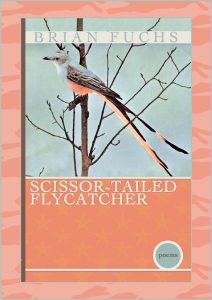
Brian Fuchs, “Luctus Herbarium” from Scissor-tailed Flycatcher (Scissortail Press, 2020)


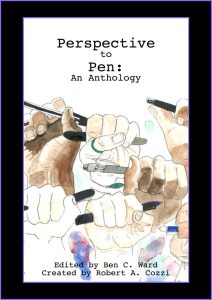
PERSPECTIVE TO PEN : AN ANTHOLOGY

Coming soon!  Check back for details. Until then, check out the poets below.

Notes

Written 19 May 2008 in Anchorage, Alaska.

Brian Fuchs, “Oil Man” from Okie Dokie (Scissortail Press, 2019)


Posted 21 September 2020

Notes

Written 17 September 2019 in Payne County, Oklahoma

Brian Fuchs, “Okie Dokie” from Okie Dokie (Scissortail Press, 2019)


Posted 16 September 2020


Notes

Written 7 September 2019 in Payne County, Oklahoma.

Brian Fuchs, “The Ravens Became Crows” from Okie Dokie (Scissortail Press, 2019)


Posted 14 September 2020


Notes

Written 1 December 2012 &  22 April 2013 in Anchorage, Alaska.

Brian Fuchs, “Novels” from Okie Dokie (Scissortail Press, 2020)


Posted 8 September 2020

This is how this poem appears in the book Okie Dokie. I’m considering rewriting it, or maybe I’ll just write something new to express these thoughts. We’ll see.

Notes

Written 22 August 2008 in Anchorage, Alaska & 8 September 2019 in Payne County, Oklahoma.

Brian Fuchs, “Mambo Italiano” from Okie Dokie (Scissortail Press, 2019)


Posted 6 September 2020


Notes

Written 29 January 2000 in Tulsa, Oklahoma.

Brian Fuchs, “Gossip” from Scissor-tailed Flycatcher (Scissortail Press, 2020)


Posted 2 September 2020


Notes

Written 25 August 1998 in Claremore, Oklahoma.

Brian Fuchs, “Sweetwater, Oklahoma” from Okie Dokie (Scissortail Press, 2019)


Posted 1 September 2020

Notes

Written 1 October 2018 in Payne County, Oklahoma.

Brian Fuchs, “Duncan, Oklahoma” from Okie Dokie (Scissortail Press, 2019)


Posted 29 August 2020

Notes

Written 7 February 2020 in Payne County, Oklahoma.

Brian Fuchs, “Making Circles in Darkness” from Scissor-tailed Flycatcher (Scissortail Press, 2020)


Notes

Written 7 February 2020 in Payne County, Oklahoma.

Brian Fuchs, “Scissor-tailed Flycatcher” from Scissor-tailed Flycatcher (Scissortail Press, 2020)


Notes

Written 5 December 2019 & 27 January 2020 Payne County, Oklahoma

Brian Fuchs, “Stardust” from Scissor-tailed Flycatcher (Scissortail Press, 2020)