Blackjack Oak

Quercus marilandica ashei

Just outside my bedroom window is a rugged Blackjack Oak.  She isn’t fancy or flashy; neither is she demanding.  She takes care of herself and has a pioneering look about her.

When my parents moved to this property in 2006, most of the native trees were cleared from the areas where they would be living, being replaced with more pleasing fruit trees, crapemyrtles, and one Bradford pear.  Along with a few other trees, they did leave one small oak tree.  That tree offered a shaded spot to sit and enjoy the property, while being a fairly compact plant.  It has not stayed that way.

I moved into this place in 2015.  At that time, the once diminutive oak had become a little more of a presence.  The branches had arched and reached the house, occasionally scraping against the siding.  Ultimately it needed to be trimmed a little, but it’s increased size had created even more of a shaded area, some of its lower branches now no longer putting on leaves.  She had started looking a little bit raggedy.  It made me wonder about how long lived blackjack oaks are, worrying that she had only a limited time left and that I would need to think about  what to do when a replacement or removal was needed.

Blackjack oaks are a type of red oak common from New Jersey to Eastern Kansas and as far south as Georgia and Central Texas.  They are small and hardy trees, happily growing is poor soils and dry areas.  They don’t represent the prettiest of trees, consisting of crooked and twisted branches, many of which stop putting on leaves when those above them block the light.  It gives them a distinctive half-dead appearance that my oak now suffers from, but it does not indicate any sort of problem with the tree itself.  It does have a tendency to droop the leafless branches, making it hard to walk under and requiring annual pruning, but it’s a manageable problem.
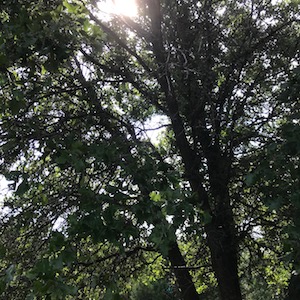
These trees are slower growing, but longer lived oaks, especially the western subspecies in Northern Texas, Oklahoma, and Kansas.  These individuals make up a significant percentage of The Cross Timbers, the oak savannah that bisects Oklahoma, separating the heavily wooded East from the arid West.  It’s a forest made up of post oaks, blackjack oaks, and eastern redcedars.  Blackjack oaks can live for more than 200 years, averaging about 80 years.  My fears of needing to replace my tree are unfounded.

No, this isn’t the world’s most beautiful tree.  It’s leaves even feel like they haven’t fully formed, as if they can quite figure out how to evolve into something clear.  The acorns are tiny, barely worth talking about.  The limbs are crooked and bare, at least the lower ones.  They don’t have the lush growth of most of the other trees that surround the house.  However, the tree is home to many birds and those tiny acorns are enjoyed by squirrels and even brazen deer who venture up to the house to graze on them along with the crabapples that grow next to the oak.  And it provides much of my house with shade, having expanded from a shady spot in the center of the yard to a defining feature of the property.

This tree has its issues, but I love her and I’m glad she’s here.

{{this one really made me think, Jess.}}

hate (‘hAt): 1 a : intense hostility and aversion usually deriving from fear, anger, or sense of injury b : extreme dislike or antipathy.

That doesn’t seem to cover it for me. To hate something or someone takes a lot of energy and isn’t so casual as it is often used. I often use the word hate when I actually mean dislike (sometimes, I even say “I hate” when I really mean “I love but am afraid of what that means”). Hate, like its antithesis love, is a very complicated idea. It is a decision one makes — to actively withhold understanding, compassion, and love from another person or thought.

I’m fairly certain that to “hate” something other than a person or thought is pointless — and in fact, I’m not sure if it is possible. I strongly dislike things (dried cherries, artichokes, hot pink paisley, sandpaper), but I think it is impossible for me to hate them. Hate, unfortunately, is more rational than that. It is a notion based on a set of rules one has formed for themselves. Hate is a common factor in the lives of many people. Although I know I have been hated for being me, I don’t know if I have myself ever truly hated another person. Maybe I have, but it seems like I would remember something so strong.

There are quite a few organizations founded on hatred. These groups promote using this energy to alienate fellow human beings based on factors beyond the control of both parties. This is often cited as a “Christian view,” which makes me ill. To understand someone who lives with hate, it is important to understand that these types of groups exist. It is also important to know what these groups are saying. It is for these reasons — and these reasons only — that I have included a list of links to hate groups. This is the world we live in.

They say it takes all kinds of people, but I would argue that it only takes a lot of different kinds. Some, like these, may contribute so little to humanity as to be unnecessary. I felt so dirty looking these up.

Ku Klux Klan: many individual groups promoting white supremacy, anti-Semitism, racism, anti-Catholicism, homophobia, and nativism.
Americans For Truth: a “Christian” promoting hatred of gays and lesbians.
God Hates Fags: an extremist “Christian” group. This groups has staged protests during funerals, parades, weddings, & other ceremonies. They refer to the organization as “The Westboro Baptist Church.” I have attended events that have been picketed by these people. It makes me sick to think about them.
New Black Panthers: anti-white, anti-Semitic black racist hate group.
Institute for Historical Review: Holocaust denial group.
Traditional Values Coalition: Yet another “Christian” group that chooses to overlook Jesus’ teachings on hate. Keep in mind the lack of teachings on gays, those who this group tries to ostracize.

The Southern Poverty Law Center has been an invaluable resource in researching hate. This is a well-known civil rights law firm, which lists hate groups in America. The only problem I found was that some of the groups listed, while historically affiliated with groups promoting discrimination, no longer have a culture of hate. Sometimes, it is important to forgive past crimes of organizations doing good works today.

To make this less difficult, here is a list of anti-hate sites:

Gay & Lesbian Alliance Against Defamation (GLAAD):
hatecrime.org
hatewatch
Deconstructing Hate Sites: article on a Canadian site — worth checking out.
Anti-Defamation League (ADL)
list of anti-hate resources

Beyond these individual sites, most religious groups discourage hate. The Bible certainly does not promote hatred. It is generally a safe assumption that your church will take care of you, regardless of personal differences. If you aren’t finding a loving environment, try one of the many churches across the country who welcome all people to worship. There are so many differences between us all; I won’t try to list the churches here.

I’m glad this one was chosen. It took me quite a few days to finish it and was taxing on my brain, but satisfying now that it is finished. Hatred is such a strong feature of the society we live in today, which is extremely sad.

“We hold these truths to be self-evident, that all men are created equal, that they are endowed by their Creator with certain unalienable Rights, that among these are Life, Liberty, and the Pursuit of Happiness.”
— Thomas Jefferson

“Owe nothing to anyone except to love one another; for he who loves his neighbor has fulfilled {the} law.”
— Romans 13:8 (NIV)

Featured Image Art: Lyubov Popova, untitled (1922)