1975

I’m sizing him up and putting him
in the him-shaped space left
so long before I was born.
I didn’t call him anything,
but sometimes he is everything
and there are nights when I sit alone
with the stars and wonder
if I make him proud.

21 September 2019

Notes

Written 21 September 2019 in Payne County, Oklahoma.

Brian Fuchs, “1975” from Okie Dokie (Scissortail Press, 2019)Continue Reading

Welcome To My Oklahoma Family

I was looking for something fun to blog about in 2019 and I thought getting into my family’s history might be interesting. I’ve always been interested in the stories that make up our family, and I am particularly interested in the real lives of the folks without a strong an obvious record. I want to know the things I can never know. What sorts of things did my 4th great grandma think about? Was my 6th great uncle happy? What were the sounds and smells of the house of the young families? It’s unfortunate that legal documents form the understanding of the vast majority of our families. I long for journals or diaries, and maybe more of those will be discovered. Until then, I have only the facts and I will try to present as much as I can to try and help understand the various branches of my family.

I’ve been careful to avoid the words ancestry and genealogy until now, but after this explanation, I will use them. I consider myself a family historian and not a genealogist. I find DNA an interesting part of studying one’s own story, but it isn’t the complete story. Who I share genetics with in a lot of cases have less to do with who I am and who my family has been than close friends and communities, or even pets. There are more ways of facing what a family is than simply tracing one’s ancestry. And I’m also not saying that isn’t valid. If you are only interested in that, go for it. Do your thing. I am not trying to prove a pedigree or show how I am related to anyone in particular, so I’m going to look at the whole. I will definitely look at ancestry and trace my family lines, but I just won’t stop there or be defined by what that is.Continue Reading

Dempsey, Oklahoma

Squash vines coiled
in and around, spilling &
tumbling over each other,
exploding with fruit,
filled with more water
than this place had seen
since May.
Those vines grew wild
alongside bindweed
in the garden that once
fed a whole family,
the jars lined up in the
dugout cellar —
apricots, potatoes, beans.
We used to play in those
places as they turned to ruins,
our historic homeland.
We’d take watermelon rind,
or cantaloupe halves out
for the overheated cows,
leave the fruit near the salt lick.
Our socks would be filled
with sand burs,
our teeth with dust,
and often my mouth would
still show the traces of chocolate
from a clandestine visit
at my grandma’s parents’ house.
The cows were traded in,
eventually the whole lot
retired to the comfort of town,
to the neighbors
with their cat stories,
and a garden bursting
with cucumbers,
a mowed lawn,
tiger-lilies.
I’d miss Dempsey then,
resigned to sit in hushed rooms,
watching my grandma’s mom
eat cornbread & milk.
She’d tell me stories,
talk about her daddy,
but I always wondered
about the cows
and about the apricot trees.

Written 29 January 2000 in Tulsa, Oklahoma & 23 February 2020 in Payne County, Oklahoma.

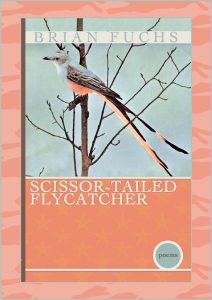
Brian Fuchs, “Dempsey, Oklahoma” from Scissor-tailed Flycatcher (Scissortail Press, 2020)

NotesContinue Reading

Crepemyrtle (Lagerstroemia)

When I moved to Alaska in 2005 I was struck by those things that were different from my life in Oklahoma.  After getting through that first winter, it became apparent that it wasn’t just the conifer trees that provided a striking contrast to the landscapes of the places I consider home.  The perennials that popped up in the gardens of the area were exotic to me.  They were plants I had known about, but had no experience with.  Columbine, dahlia, lobelia, rhubarb, bleeding hearts, raspberries, wild roses, poppies.  It was a fascinating experience to be surrounded by these new plants, as well as by the old familiar dandelions and lilacs.

I was in Alaska for a number of years and loved those summer months and the beautiful flowers of the area.  What I didn’t expect was how much I would fall in love with the plants of Oklahoma when I returned for vacation.

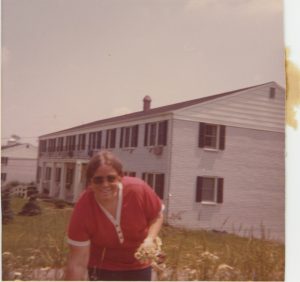
I was born in Tulsa, Oklahoma on 5 August 1979 and I lived in the state until 2005 when I left for Alaska.  My uncle is a landscape architect, my grandpa was a professor of agronomy and a consultant on soils.  He spent hours daily working on his flowerbeds and vegetable garden on his one acre lot, an oasis of green in the middle of ordinary yards.  Plants were a part of our DNA.  All parts of my family had been farmers, growing broom corn and cotton.  It had never been my world and I barely paid attention to the things growing around me.  I was aware of the various plants in the landscape, but I didn’t know much about those plants.

What I was most struck with on coming back to Oklahoma on a vacation in 2007 was how amazing crepemyrtles are.  They’ve long been a favorite, especially of my grandpa who had them planted heavily around his house and as a backdrop/transition between the trees and flowers in the flowerbeds.  It felt like I was discovering these plants for the first time.

In 2013, I loved back to Oklahoma and these crepemyrtles felt like a focus of my thoughts when I was at my parents house or at a business.  They are one of the most commonly used plants in Oklahoma, and it’s pretty easy to see why.

Crepemyrtles are native to southeast Asia, with some hybrids being crossed with a taller species from Japan.  They have been a common ornamental plant in America since before the revolution, with both George Washington and Thomas Jefferson’s gardens having at least one specimen plant.  They quickly became a staple in the South, but as they are not generally cold hardy past zone 6 or 7, they were not a part of the gardens of the North and as a result they do not feature in very many of the early seed or nursery catalogs.  When they do start popping up, it is clear that several cultivars have been established from the original pink flowering tree.  You see white, pink, purple, and red listed in those early catalogs.  The purples were what we now refer to as lavender and the red were dark pink.  It took a long time to achieve a true red crepemyrtle.Continue Reading

Blackjack Oak

Quercus marilandica ashei

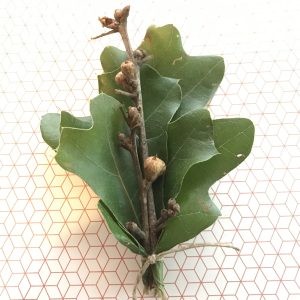
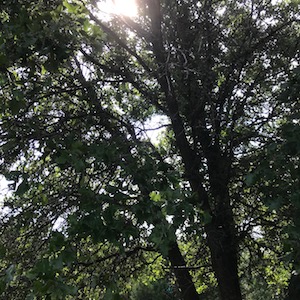
Just outside my bedroom window is a rugged Blackjack Oak.  She isn’t fancy or flashy; neither is she demanding.  She takes care of herself and has a pioneering look about her.

When my parents moved to this property in 2006, most of the native trees were cleared from the areas where they would be living, being replaced with more pleasing fruit trees, crapemyrtles, and one Bradford pear.  Along with a few other trees, they did leave one small oak tree.  That tree offered a shaded spot to sit and enjoy the property, while being a fairly compact plant.  It has not stayed that way.

I moved into this place in 2015.  At that time, the once diminutive oak had become a little more of a presence.  The branches had arched and reached the house, occasionally scraping against the siding.  Ultimately it needed to be trimmed a little, but it’s increased size had created even more of a shaded area, some of its lower branches now no longer putting on leaves.  She had started looking a little bit raggedy.  It made me wonder about how long lived blackjack oaks are, worrying that she had only a limited time left and that I would need to think about  what to do when a replacement or removal was needed.

Blackjack oaks are a type of red oak common from New Jersey to Eastern Kansas and as far south as Georgia and Central Texas.  They are small and hardy trees, happily growing is poor soils and dry areas.  They don’t represent the prettiest of trees, consisting of crooked and twisted branches, many of which stop putting on leaves when those above them block the light.  It gives them a distinctive half-dead appearance that my oak now suffers from, but it does not indicate any sort of problem with the tree itself.  It does have a tendency to droop the leafless branches, making it hard to walk under and requiring annual pruning, but it’s a manageable problem.

These trees are slower growing, but longer lived oaks, especially the western subspecies in Northern Texas, Oklahoma, and Kansas.  These individuals make up a significant percentage of The Cross Timbers, the oak savannah that bisects Oklahoma, separating the heavily wooded East from the arid West.  It’s a forest made up of post oaks, blackjack oaks, and eastern redcedars.  Blackjack oaks can live for more than 200 years, averaging about 80 years.  My fears of needing to replace my tree are unfounded.
No, this isn’t the world’s most beautiful tree.  It’s leaves even feel like they haven’t fully formed, as if they can quite figure out how to evolve into something clear.  The acorns are tiny, barely worth talking about.  The limbs are crooked and bare, at least the lower ones.  They don’t have the lush growth of most of the other trees that surround the house.  However, the tree is home to many birds and those tiny acorns are enjoyed by squirrels and even brazen deer who venture up to the house to graze on them along with the crabapples that grow next to the oak.  And it provides much of my house with shade, having expanded from a shady spot in the center of the yard to a defining feature of the property.

This tree has its issues, but I love her and I’m glad she’s here.

I have never been very much into gardening.  I love having things growing around me, but the process of actually putting those things in the ground and taking care of them… no.  But I’ve found myself with a lot of need for distraction lately.  So, I have turned to gardening.  In the heat.  It;s keeping my brain occupied, but I also keep remembering something my brother talks about all the time: managing one’s expectations.
For years, I’ve watched my parents return from nurseries and garden centers with car loads of beautiful plants for the flowerbeds, but with no idea where they will go or who will plant them.  Inevitably, most of the plants would end up underwatered, unplanted, neglected, or planted in the wrong spots.  The whole ordeal that had started off as fun would end up a disappointment, and a source of frustration.  The expectations did not meet the reality.  The way they managed that was to try to change the reality around them, but that never worked.  Brent’s point was always that it was the expectations that were the problem.

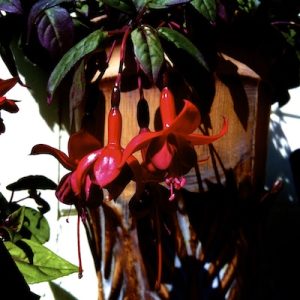
I lived for many years in Alaska.  I love the climate that promotes lots of beautiful growth, but with lots of shade and very little heat.  I would love to have a garden full of cypress trees draped above head, ferns popping out along the bases of the trees, and fuchsias in hanging pots lining the porch.  Moss would grown on the roof of the shed and everyday a light rain would keep the soils moist and the plants would grow up around me and there would be flowers in bloom all summer.  I want a beautiful deck to enjoy the cool evenings and have people over.  Unfortunately, that is not the situation I find myself in.  If I was constantly trying to make that happen, I would spend a lot of my time disappointed and convinced that gardening doesn’t work.  What I have to do is work within the framework available to me.
I want tall shade plants:  Junipers and crapemyrtles are excellent plants that grown to 10-14 feet and provide a great amount of shade.  They have the added benefit of attracting birds and butterflies.  So, I am planning a landscape that depends on these two plants primarily as shade plants.

I want lots of flowers:  Roses.  Roses in Oklahoma, well in my part of Oklahoma, require little care and bloom almost all year.  Climbing roses tied against the house give a nice shade to the inside and allow for the appreciation of blooms.  I also cannot think of a flower that comes in a greater variety of shapes and sizes.  I’ve had a lot of luck with roses, so I’ve popped them in strategically around the house.

I want plants growing on the ground that aren’t grasses:  Grasses are a pretty common xeriscape option, especially as I live on the border of two grass prairies.  I don’t care for them though.  What I do love is vinca, or periwinkle.  Vinca keeps my flowerbeds full of green leaves without having them be full of weeds and grasses.  It also helps keep my soils moist, which the other plants appreciate.

Moss growing on the roof??? Okay, I admit this one is harder to substitute.  So, I’ve decided to try Virginia Creeper.  It does grow wild here, but usually deep in the wooded areas.  If I can provide the right amount of moisture, I’m hoping I can get this creeping vine to grow up the side of the metal shed or vinyl siding on the house.  This one is going to require more effort, and I plan to start it next Spring.

Daily rain?  Now I’ve gone too far!  Brent and I have talked a lot about irrigation systems.  I’m going to invest in the right things so that next year I can have both irrigation and misting available around the house.

I want a new deck:  My back porch is rotting.  It’s time for it to go, and with Brent’s help I’d like to add on a ground level deck with steps down from the house.  It’d be a nice place to spend evenings, as the back yard gets all the evening shade.  That project is happening this fall.

When I look at my plans, they seems overly ambitious.  I worry I’ve gone too far with what I want to do.  Maybe I have.  I’m trying to keep it simple, space out my work, and achieve something more than I have now.  And I have probably set my expectations too high.

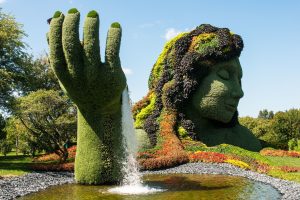
So, I’m not going to be creating a replica of the gardens of Versailles, and I won’t be building a living sculpture.  There won’t be any sidewalks with flowers arched above to take a stroll through or fountains with flamingos.  That’s okay.  It doesn’t need to be outlandish to be beautiful.  My plan will probably get pared down over time, or I will wait another year to complete parts of it.  It will be mine, and that is what I’m excited about.  I never really cared about gardening until I started getting my hands dirty.  It’s fun to transform a landscape and to see the plants take shape over time.Continue Reading

A few weeks ago, I was listening to music after spending the night helping my mom in and out of bed as she recovered from a collapsed lung.  I hadn’t left her house yet, and she came into the living room to join me.  We didn’t talk; we just sat and listened to the music as the sun came up over the trees and filled the living room with light.  It was a peaceful moment.  We talked briefly after a while, and then I went home to sleep before coming back the next night.  She stayed in the living room for the morning, watching TV and visiting with my dad.  If I had known then that it was the last time I would spend time with her in her living room, I would have stayed all day.

My days are like that right now.  Everything is about Mom.  The roses she and I ordered came in yesterday, a week and a half after she passed.  On her desk sit the art project she was working on, four 6×6 canvases featuring her with her grandkids.  On her doors hang the wreaths she had ordered for summer; they arrived the week she went to the ER, one being only taken out of its box when we were getting the house ready for visitors.  I’ve caught family members talking about the pain she was in, which she was.  I’ve heard them hint at how she seemed to have lost some of her spirit, which she had.  But I don’t want anyone to think for a moment that she had ever given up on living.  Nobody loved life more than she did.
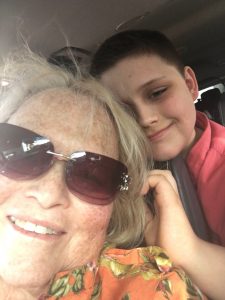
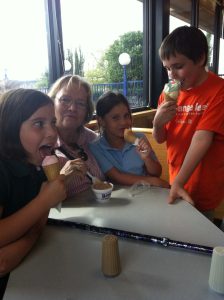
Mom’s life had become about pain and struggling through the many surgeries she had over the past ten years.  I’ve lost count; she had lost count.  But never did a surgery keep her down.  She fought through it because she did not want to be an ‘old person’ and never meant to end up spending so much of her life in bed recovering.  These recoveries were temporary, and she spent her time either getting ready to fight after a surgery or working on getting back to her life.  Being stuck in bed made her feel left out at times, and it was frustrating for her to not be able to join her sister, friends, and other family on various outings and vacations.  She wished she could go to church every Sunday, as her church family was so much a part of who she had always been.  She wanted to be healthy enough to stay with her granddaughters more often, but did not have the ability lately.  But most people didn’t know any of these feelings.  Mom did not complain about her plight to people.  She didn’t want others to ever feel bad for enjoying their own lives, even if she couldn’t be a part of it.

ER visits had become so routine, so when she was rushed to the hospital on May 18 it didn’t even phase me.  I thought to myself that I hoped she stayed through the weekend; the stays in the hospital were often good for her and gave me peace of mind that someone was checking her out.  I also felt relieved that I would get a little extra sleep over the weekend.  Then they called me from the hospital to say she was being transferred to Oklahoma City.  Dad didn’t seem to remember what the doctors had told him, and Mom and I shouted at one another through his speaker.  She told me it was her colon and they needed to do surgery.  I have no idea what I said to her, but it was definitely not the right thing.  There is no way it could have been.  It was the last time we would talk to one another.  How could I have known, and what words would we have used.  She was aware the next day as she slipped from up, and could nod/shake her head.  I was able to talk to her then, but it wasn’t a conversation.

This doesn’t feel real.  I’ve passed the part when I think I might finally wake up, but now I keep thinking she will come home from a trip she’s been on.  But at the same time, I’m empty.  My whole world has been consumed by this growing emptiness, and mostly life seems pointless.  It’s raw of course, but it is hard to see what meaning I’ll be able to find in life.
I’m babbling.

I’ve been spending a lot of time on my front porch, listening to birds in the morning and watching fireflies in the evenings.  The birds don’t seem to know that the color has gone from the world.  The fireflies still light up the night, even though life is so fleeting.  I’m not sure what to think about it all, or even if I’m thinking about anything at all.  Every time I start slipping into despair, it starts to rain and I can’t help but find joy in storms.  Joy seems inappropriate.  I have moments when I laugh or smile and think to myself that I’m being disrespectful.  That’s such a backward thought.  Mom loved life, saw the good it it always, and wouldn’t want anyone to despair.

This was not a part of my plan.  I never imagined I would lose my mom in my 30s;  it feels stupid.  I was ready to watch movies with her, to laugh with her, and to enjoy the nature around us with her well into my 60s.  I deserved that.  She deserved that.  And now I have to figure out what I’m going to do with my life.

Mom’s final moments were spent surrounded by family.  She understood what was happening, and knew she was not going to make it.  It was so sudden, so the fact that everyone could get there was a miracle.  We cried, we sang songs, we prayed.  The room was so filled with love and life, I cannot think of a more fitting situation for her to passing.  We were singing I Can Only Imagine though our tears when the nurse came in and nodded her head.  I felt like I had been shot in the stomach and we continued on.  Brent and Dad were each holding her hands and they felt her relax and slip away.  Sobbing followed, and family trickled out to the waiting room.  I sat in the chair in the corner of the room and wanted to stay there forever.  Once everything had been gathered, my brother and I finally left the room, leaving her by herself.  It made me numb.  It’s typically not fair to a person to remember that person for one day in their life.  People tend to dwell on a person’s death and not on their life.  I’m sure I’ll do that for a while, but if I’m going to have to focus on her last day, I will at least have those beautiful final moments to focus on.

It’s true: Mom won’t be in pain anymore.  She didn’t want to give up on life, but she doesn’t have to fight through so much pain.  That’s going to comfort me one day, but today is not that day.

This weekend, my nephew Conner and I will plant the roses Mom and I had picked out.  And I’ll makes sure they are planted where she wanted them.  And I will just try my best to get from one day to the next.  I’m going to be sad for a long time, but there are things to be done.

SaveSave

SaveSave