Skyline & McElroy

These spaces were once open wide;
we explored the details for hours.
They seem to darken and cower;
now they shrink, wither, and divide.

Free, we stretched our wings fearlessly.
We never thought we’d have bad luck
even after Christine was struck
and Rusty was rushed urgently,

tire and concrete in his face,
to the E.R. for doctors’ care.
We’d still head on bikes anywhere
while those two recovered en brace.

Oh joy! to feel that wind rushing,
to ride down hills foolheartedly,
to find the paths left secretly,
to forget near tragic crushing.

Now, Gayane’s final act is all
the excitement I dare to take.
The shrinking neighborhoods forsake
my inner child — they’ve turned small.

Notes

Written 15 February 2020 in Payne County, Oklahoma.

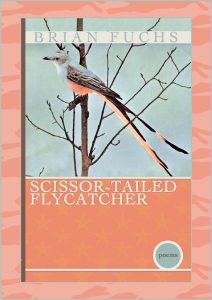
Brian Fuchs, “Skyline & McElroy” from Scissor-tailed Flycatcher (Scissortail Press, 2020)

New Kids on the Block

If the spaces under the highway
had been a passage to a great
underground city, I’d still be there
living among the mole people,
still listening to your sister’s cassettes.

It was always over as soon as it started,
and I longed for you for years after.
The gas station stopped selling gas;
it’s just as well. I don’t drive that way
anymore and I don’t want the salty chips
we used to get before spending afternoons
listening to music at your house.

You’ve grown too great for me to see
and I’ve started shrinking into the cracks,
barely leaving a mark behind to find.
I’ll see you at the next protest
on the steps of the state capital.
I wonder if I’ll still be visible by then.

Notes

Written 15 February 2020 in Payne County, Oklahoma.

Brian Fuchs, “New Kids on the Block” from Scissor-tailed Flycatcher (Scissortail Press, 2020)Continue Reading

Riley

There’s a rabbit hutch
still waiting for us, unmolested
behind a stranger’s house
on the walk home.
The rabbits are still there;
let’s return to tell them stories
and sing Shenandoah.

Written 15 February 2020 in Payne County, Oklahoma

Brian Fuchs, “Riley” from Scissor-tailed Flycatcher (Scissortail Press, 2020)Continue Reading

The Rain

I’m still waiting outside for rain,
hoping for sudden downpours from cloudless skies.
I’m wondering if she’ll join me when the first drops
start to fall and the birds fall silent.
She’s been delayed, I’ve told myself again,
or the rain hasn’t been enough.
It has never been enough
I’ve summoned more and more rain,
for over a year I’ve coaxed it from the air,
the ground sometimes swelling, saturated and marshy.

Brush Creek has filled to overflowing,
washing out parts of the road and clearing out
the debris of our distractions.
It has not been enough.
The Cimarron & Arkansas Rivers have been flooded,
swallowing homes and memories,
lives lost and inconvenienced.
Still she has not arrived.
I continue my incantations, calling for more clouds,
more rain — great hurricanes that try to find me,
creeping along the coasts, tied to the oceans.
Florida, Georgia, Louisiana, The Bahamas, Puerto Rico,
they may all need to be sacrificed in my efforts,
and it will be worth the loss because I will
no longer feel like I am alone.
I am listening for those first signs, the drips on the tin roof
and I am ready to throw open the windows,
clench my fists, and try to push my dreams into reality.
I know she will join me if I keep trying,
and we will sit together on the covered porch,
resuming what should still be.

Notes

Written 5 September 2019 in Payne County, Oklahoma.

Brian Fuchs, “The Rain” from Okie Dokie (Scissortail Press, 2019)Continue Reading

Luctus Herbarium

I’m counting the blooms,
tagging and cataloguing each one,
memorializing the specimens in photos.
I’m waiting for patterns,
counting petals and leaves to make sense of the passing months.
Routines form in my distractions, order.
This must be a sign.
On hot days like this, I sit in the heat,
water hose set to mist.
I watch the tiny drops of water float by,
dancing in the shifting breeze
while I clutch the trigger tightly.
I switch the settings,
long streams shoot into the sky,
pattering like hard rain on the metal roof of the porch.
I pulse the trigger,
tight, loose, tight, loose.
I’m wet from the water dripping down my arm,
and by the drifts of mist.
The hot sun dries my clothes,
nozzle retired to the floor of the porch.
Thoreau wanted to live simply and deliberately,
to test himself against nature,
to love it, to record it, tame it or be tamed by it.
I just want to get through the day,
to bury my head in my collection of information.
I can’t index my life in values and harvests;
my gardens are not for sale,
nor are they planted with very useful.
Maybe they should be.
Maybe…
Soon I’m returning to my work,
counting the dead blooms as I prune
and noting which ones wilted first.
So many flowers remain beautiful without petals;
that seems important enough to note, so I do.
I’m still slightly damp,
enough to forget about Mom’s absence,
but she is even more present
in the sorted flora, the journals of growth,
in the fountains of sun-warmed water.

26 August 2018

Written 26 August 2018 in Payne County, Oklahoma.
Brian Fuchs, “Luctus Herbarium” from Scissor-tailed Flycatcher (Scissortail Press, 2020)
Blackjack Oak

Quercus marilandica ashei

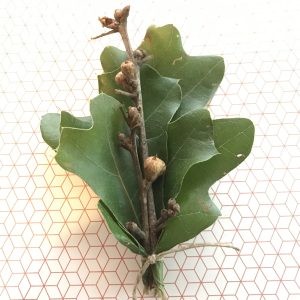
Just outside my bedroom window is a rugged Blackjack Oak.  She isn’t fancy or flashy; neither is she demanding.  She takes care of herself and has a pioneering look about her.

When my parents moved to this property in 2006, most of the native trees were cleared from the areas where they would be living, being replaced with more pleasing fruit trees, crapemyrtles, and one Bradford pear.  Along with a few other trees, they did leave one small oak tree.  That tree offered a shaded spot to sit and enjoy the property, while being a fairly compact plant.  It has not stayed that way.

I moved into this place in 2015.  At that time, the once diminutive oak had become a little more of a presence.  The branches had arched and reached the house, occasionally scraping against the siding.  Ultimately it needed to be trimmed a little, but it’s increased size had created even more of a shaded area, some of its lower branches now no longer putting on leaves.  She had started looking a little bit raggedy.  It made me wonder about how long lived blackjack oaks are, worrying that she had only a limited time left and that I would need to think about  what to do when a replacement or removal was needed.

Blackjack oaks are a type of red oak common from New Jersey to Eastern Kansas and as far south as Georgia and Central Texas.  They are small and hardy trees, happily growing is poor soils and dry areas.  They don’t represent the prettiest of trees, consisting of crooked and twisted branches, many of which stop putting on leaves when those above them block the light.  It gives them a distinctive half-dead appearance that my oak now suffers from, but it does not indicate any sort of problem with the tree itself.  It does have a tendency to droop the leafless branches, making it hard to walk under and requiring annual pruning, but it’s a manageable problem.

These trees are slower growing, but longer lived oaks, especially the western subspecies in Northern Texas, Oklahoma, and Kansas.  These individuals make up a significant percentage of The Cross Timbers, the oak savannah that bisects Oklahoma, separating the heavily wooded East from the arid West.  It’s a forest made up of post oaks, blackjack oaks, and eastern redcedars.  Blackjack oaks can live for more than 200 years, averaging about 80 years.  My fears of needing to replace my tree are unfounded.

No, this isn’t the world’s most beautiful tree.  It’s leaves even feel like they haven’t fully formed, as if they can quite figure out how to evolve into something clear.  The acorns are tiny, barely worth talking about.  The limbs are crooked and bare, at least the lower ones.  They don’t have the lush growth of most of the other trees that surround the house.  However, the tree is home to many birds and those tiny acorns are enjoyed by squirrels and even brazen deer who venture up to the house to graze on them along with the crabapples that grow next to the oak.  And it provides much of my house with shade, having expanded from a shady spot in the center of the yard to a defining feature of the property.

This tree has its issues, but I love her and I’m glad she’s here.

I have never been very much into gardening.  I love having things growing around me, but the process of actually putting those things in the ground and taking care of them… no.  But I’ve found myself with a lot of need for distraction lately.  So, I have turned to gardening.  In the heat.  It;s keeping my brain occupied, but I also keep remembering something my brother talks about all the time: managing one’s expectations.
For years, I’ve watched my parents return from nurseries and garden centers with car loads of beautiful plants for the flowerbeds, but with no idea where they will go or who will plant them.  Inevitably, most of the plants would end up underwatered, unplanted, neglected, or planted in the wrong spots.  The whole ordeal that had started off as fun would end up a disappointment, and a source of frustration.  The expectations did not meet the reality.  The way they managed that was to try to change the reality around them, but that never worked.  Brent’s point was always that it was the expectations that were the problem.

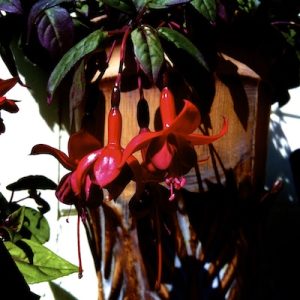
I lived for many years in Alaska.  I love the climate that promotes lots of beautiful growth, but with lots of shade and very little heat.  I would love to have a garden full of cypress trees draped above head, ferns popping out along the bases of the trees, and fuchsias in hanging pots lining the porch.  Moss would grown on the roof of the shed and everyday a light rain would keep the soils moist and the plants would grow up around me and there would be flowers in bloom all summer.  I want a beautiful deck to enjoy the cool evenings and have people over.  Unfortunately, that is not the situation I find myself in.  If I was constantly trying to make that happen, I would spend a lot of my time disappointed and convinced that gardening doesn’t work.  What I have to do is work within the framework available to me.

I want tall shade plants:  Junipers and crapemyrtles are excellent plants that grown to 10-14 feet and provide a great amount of shade.  They have the added benefit of attracting birds and butterflies.  So, I am planning a landscape that depends on these two plants primarily as shade plants.

I want lots of flowers:  Roses.  Roses in Oklahoma, well in my part of Oklahoma, require little care and bloom almost all year.  Climbing roses tied against the house give a nice shade to the inside and allow for the appreciation of blooms.  I also cannot think of a flower that comes in a greater variety of shapes and sizes.  I’ve had a lot of luck with roses, so I’ve popped them in strategically around the house.

I want plants growing on the ground that aren’t grasses:  Grasses are a pretty common xeriscape option, especially as I live on the border of two grass prairies.  I don’t care for them though.  What I do love is vinca, or periwinkle.  Vinca keeps my flowerbeds full of green leaves without having them be full of weeds and grasses.  It also helps keep my soils moist, which the other plants appreciate.

Moss growing on the roof??? Okay, I admit this one is harder to substitute.  So, I’ve decided to try Virginia Creeper.  It does grow wild here, but usually deep in the wooded areas.  If I can provide the right amount of moisture, I’m hoping I can get this creeping vine to grow up the side of the metal shed or vinyl siding on the house.  This one is going to require more effort, and I plan to start it next Spring.

Daily rain?  Now I’ve gone too far!  Brent and I have talked a lot about irrigation systems.  I’m going to invest in the right things so that next year I can have both irrigation and misting available around the house.

I want a new deck:  My back porch is rotting.  It’s time for it to go, and with Brent’s help I’d like to add on a ground level deck with steps down from the house.  It’d be a nice place to spend evenings, as the back yard gets all the evening shade.  That project is happening this fall.

When I look at my plans, they seems overly ambitious.  I worry I’ve gone too far with what I want to do.  Maybe I have.  I’m trying to keep it simple, space out my work, and achieve something more than I have now.  And I have probably set my expectations too high.

So, I’m not going to be creating a replica of the gardens of Versailles, and I won’t be building a living sculpture.  There won’t be any sidewalks with flowers arched above to take a stroll through or fountains with flamingos.  That’s okay.  It doesn’t need to be outlandish to be beautiful.  My plan will probably get pared down over time, or I will wait another year to complete parts of it.  It will be mine, and that is what I’m excited about.  I never really cared about gardening until I started getting my hands dirty.  It’s fun to transform a landscape and to see the plants take shape over time.Continue Reading