
“Cercis canadensis”
Cercis canadensis
When we had tried
putting ourselves together again
we’d used the wrong parts,
made effigies of ourselves
with the piles of distorted junk,
left behind scraps of a once-full life.
We went through the motions of people
spoke like them, practicing their accents,
but did not understand our own words.
We got the phrases wrong,
the tones, the memories.
Periodically, we’d erupt into full color
flowers growing from every part
and our days seemed alive with joy.
But we would catch ourselves lost in time,
eyes fixed on a long-abandoned walker,
a long-absent bed,
a long-neglected garden,
at the things we find so important now
and the flowers would fall from our bodies.
I gave up on trying to find the parts
of myself I missed most,
stopped looking for who I had been before.I’ve been more comfortable with discomfort,
waiting for others to finally leave the safety
of their beds, the safety of their tears.
And we’ve started to share ourselves again,
imagining Spring, redbuds flushed fuchsia,
grief removed from our shoulders,
sadness washed from our faces
by the showers of April and storms of May.
We will remember how to be happy
and how to be sad and how to be,
and we’ll see the long-forgotten remnants
and we will understand who we are.
Written 19 April 2019 in Payne County, Oklahoma. Rewritten 5 September 2019 in Payne County, Oklahoma.
Brian Fuchs, “Cercis canadensis” from Okie Dokie (Scissortail Press, 2019)
Cercis canadensis
When we had tried
putting ourselves together again
we’d used the wrong parts,
made effigies of ourselves
with the piles of distorted junk,
left behind scraps of a once-full life.
We went through the motions of people
spoke like them, practicing their accents,
but did not understand our own words.
We got the phrases wrong,
the tones, the memories.
Periodically, we’d erupt into full color
flowers growing from every part
and our days seemed alive with joy.
But we would catch ourselves lost in time,
eyes fixed on a long-abandoned walker,
a long-absent bed,
a long-neglected garden,
at the things we find so important now
and the flowers would fall from our bodies.
I gave up on trying to find the parts
of myself I missed most,
stopped looking for who I had been before.
I’ve been more comfortable with discomfort,
waiting for others to finally leave the safety
of their beds, the safety of their tears.
And we’ve started to share ourselves again,
imagining Spring, redbuds flushed fuchsia,
grief removed from our shoulders,
sadness washed from our faces
by the showers of April and storms of May.
We will remember how to be happy
and how to be sad and how to be,
and we’ll see the long-forgotten remnants
and we will understand who we are.
“David Eugene, look at me when I’m thinking about you!”
David Eugene, look at me when I’m thinking about you!
I’m a disciple, a child of your narcissism.
an inadequate acolyte of your worst impulses,
treasonous and suspicious, even in my reverence.
Love is wrapped in sarcasm, in mocking and making-fun.
I pray these are truths, and that you are as transparent as you seem.
I only see the Davids for who they are,
blind to who they want me to see, who they wish they were.
I only see you for who you are,
but I feel the person you want me to be
growing cynically inside.
Oh David, do you not recognize the idolatry in my loyalty?
Does my face not give away my desire to be looking at my own face
when I am looking at you?
The tears stay close, pooling in eyelids, fighting their impulse
to race down my cheek toward knowing I am fully myself,
and not who I am trying to be.
I am trying to be bold in the ways you expect,
no longer cowering in the corners where you found me.
I remember the safety of home, and the emptiness.
I felt safe in my denial, but I am liberated by your sacred teachings.
I grovel, prostrate myself before you,
foolishly and joyously feeding your need for attention.
David, you have shown me that you are more important than I am.
You are more than I am. You are existence.
I meant to steal the hearts of those around you,
meant to show them how much I had learned at your feet.
They exist, you exist, and I have revealed myself to be fragments.
You have reassured me, patted my head like a Lhasa apso,
my head cocked to one side as I attentively await praise.
Oh David, I have not been enough!
The fragments have betrayed me and revealed that I am not whole.
I’ve tried holding them together with glues and tape,
but the picture never seems real;
the other congregants have moved on, my failings insurmountable.
They have found me lacking and are uncomfortable in my presence.
Selfishness is a difficult lesson to learn; I am trying.
I’m still dwelling on my heartache, trying to release it,
unchaining my tongue and allowing bravery to escape,
to become the person I see in you, David,
or to at least to become someone whole, beautiful and brazen,
someone rewarded with love, sex, warmth.
I humbly bow, giving thanks for even a chance
to be blessed by your acceptance.
Brian Fuchs, “David Eugene, look at me when I’m thinking about you” from Okie Dokie (Scissortail Press, 2019)
Written 17 March 2008 in Anchorage, Alaska & 7 September 2018 in Payne County, Oklahoma.
«Quercus shumardii»
Quercus shumardii
for Papa
A great tree has uprooted,
exposing the branching mass
caked in the red soil of the Western Plains.
What was parched had been made rich and loamy
by the giants that fell before,
pioneering specimens that germinated and made
a home under the endless horizon of Oklahoma.
The water that made those plants flourish
had come from England and Ireland,
from Galilee and Missouri.
The roots of those ancestors fed the saplings
of the new generation.
Entwined, two young trees grew close together,
feeding on one another,
strengthening each other’s roots.
Acorns became a thicket and then a forest,
spreading out in all directions.
The flaming red soil has changed over time,
fertilized, nurtured, enriched.
The acorns have been found scattered,
rooting in Texas and Colorado,
in Alaska and Kentucky.
A tradition of strength and serenity
tested in new soils, clays and sands,
ultisols, entisols, crider and port silt loam.
Lightning took out the second tree,
ripped away what had been life,
forcing the survivor to stretch out new branches
to cover the fallen companion,
to show strength in the face of tragedy,
to learn to love when love seemed to disappear.
The branches, sprawling out massively,
became only sparsely covered with leaves, but
never lost their majesty, their humility, kindness, dignity.
Now the great tree has joined its long-fallen partner,
stretched at the base among those it had given life to,
cradled by the thick trunks of trees
that have become mighty themselves.
They stretch impressively toward Heaven,
mimicking the once proud figures
now so apparently absent in the canopy.
The sun can once again burst through,
but this is no longer the harsh and arid place
it was when ancestors first arrived.
In the clearing a small field of flowers
will spring up in memorial,
attracting the beauty of birds and insects
until new saplings join the congregation.
That great tree is now one of the ancestors,
enriching the soils for future generations.
6.7.2014
Brian Fuchs, “Quercus shumardii” from Okie Dokie (Scissortail Press, 2019)
Written 7 June 2014 in Glencoe, Oklahoma

HANDOUTS FROM FUNERAL (Poem included as “The Tree”)
Posted 7 June 2014
“Bea”
Bea
The swan lands, awkwardly gliding
into water among strangers, among friends.
On the far horizon, the ponds edges
kiss coy stars, lurking in the dusk.
The swan gracefully turns her long neck;
her eyelids close softly — contentedly.
A world escapes behind veils of thin skin;
the murmur of voices fades to silence.
Gently, the elegant bird tucks her beak
under her wing and lets peace take her.
4.26.2009
Written 26 April 2009 in Anchorage, Alaska.
Brian Fuchs, “Bea” from Okie Dokie (Scissortail Press, 2019)

“All Growed Up”

Written 13 September 2008 in Anchorage, Alaska.
Brian Fuchs, “All Growed Up” from Okie Dokie (Scissortail Press, 2019)

________
Original Version
29! Did I just realize that?!?
All Growed Up
The icons are all dead or broken,
ushered off in wheelchairs and caskets of immoral expense to paradises
surrounded by wildness.
My childhood crumbles without the support of the ones I admired and by the weight of my guilts and follies.
That time of heroes is so distant — it no longer even feels like a dream,
no longer feels like a memory.
The blurred fragments of the Sues, the Mikes, the D’Jeilas… they are fading into emptiness,
leaving me with a search for new people to look up to, if anyone.
I miss the me who was in that time, but celebrate his death.
The me of now is an improvement, a focused replica of an aimless child.
The slate has been cleaned and readied for the new icons to place on pedestals.
Soon, I’ll break out of the thin shell of fear that remains and emerge as a fully complete person.
My wings itch to stretch out and let me fly.
9.13.2008
“Meeting with Tlāloc”

Written 22 July 2008 in Anchorage, Alaska.
Brian Fuchs, “Meeting with Tlāloc” from Okie Dokie (Scissortail Press, 2019)

__________
Original Version
untitled
Life’s all pauses and breaks;
my feet don’t seem so eager anymore to get to those places
I’ve always kept close to my heart and deep in my dreams.
There’s something soothing about stasis,
something unnerving as well.
I’m peering through cracks and holes of a life that is always shifting,
searching for someone who might be peering back at me
from the other side… of what?
The winds are picking up and I can feel change creeping over the horizon.
Storm’s comin’ and I’ve not gotten ready for it this time,
thought I’d enjoy more of this part of life,
thought there’d be more,
thought I could find comfort in being alone.
Blow me into bits; create something new and magical,
something more than I’ve ever been.
Grasping for hands to hold, I realize that there is only me.
7.22.2008
“Ham”
Ham
Mimi made me a ham,
glazed with honey and smelling sweetly,
a surprise so I wouldn’t have to eat turkey.
The aroma greeted us as we entered,
lingering and melding with others,
bread and cranberries and pumpkin.
We were all gathered, talking over each other
about the small dramas that consume us,
catching up after months apart.
Mimi would fuss over the details,
direct whoever was around to place spoons
or get the rolls out of the oven.
I’d stand nervously waiting.
Papa would call us to settle and bow heads,
and he’d give thanks for the bounty and
say words about our health and Jesus.
Amens would follow, and the kids would
converge to be first to go through
a carefully laid out buffet line. I’d wait,
and my mom and I would exchange a look,
her giving me the permission I needed.
I’d get to the end of the line and pile turkey
onto my plate, skipping the ham,
a particular favorite of others.
Mimi eventually would sit down,
time finally for her to enjoy the company.
I wouldn’t say anything, avoiding conflict,
hoping she hadn’t noticed me
at the kids’ table in the adjacent room.
But she would notice, and she would apologize
and she and I would laugh about it.
She would make a mental note about
Brian not liking ham, a note she would lose.
The next time we’d gather,
the next time Mimi spent days cooking,
organizing everyone’s particular tastes,
I’d arrive again to the smell of a ham,
cooked especially for me, and I’d smile.
I still don’t eat ham,
but nobody makes it for me anymore.
Brian Fuchs, “Ham” from Okie Dokie (Scissortail Press, 2019)
Written 26 April 2008 in Anchorage, Alaska & 11 September 2019 in Payne County, Oklahoma.

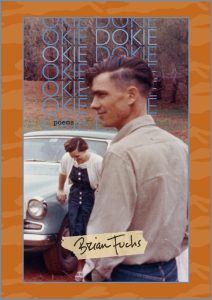
Featured Image Art (right side): photo of Christine Tucker, my Mimi, & myself
–––––––––––––––
Original version:
Ham
If I had liked ham
maybe I wouldn’t have
disappointed at least one person.
She’d reveal the surprise,
glazed with honey and smelling sweetly,
the scent lingering from outside.
But it wasn’t me and I’d wrinkle
my forehead, politely thank her,
and eat my turkey, the ham meeting
with praise from enough
for my neglect to not seem to matter.
She’d notice, apologize, and make
a mental note that Brian doesn’t like ham,
a mental note she’d promptly lose.
And for the next gathering
requiring food preparation,
we’d repeat the game.
I still don’t like ham,
but nobody makes it for me anymore.
4.26.2008


