The Rain

I’m still waiting outside for rain,
hoping for sudden downpours from cloudless skies.
I’m wondering if she’ll join me when the first drops
start to fall and the birds fall silent.
She’s been delayed, I’ve told myself again,
or the rain hasn’t been enough.
It has never been enough
I’ve summoned more and more rain,
for over a year I’ve coaxed it from the air,
the ground sometimes swelling, saturated and marshy.

Brush Creek has filled to overflowing,
washing out parts of the road and clearing out
the debris of our distractions.
It has not been enough.
The Cimarron & Arkansas Rivers have been flooded,
swallowing homes and memories,
lives lost and inconvenienced.
Still she has not arrived.
I continue my incantations, calling for more clouds,
more rain — great hurricanes that try to find me,
creeping along the coasts, tied to the oceans.
Florida, Georgia, Louisiana, The Bahamas, Puerto Rico,
they may all need to be sacrificed in my efforts,
and it will be worth the loss because I will
no longer feel like I am alone.
I am listening for those first signs, the drips on the tin roof
and I am ready to throw open the windows,
clench my fists, and try to push my dreams into reality.
I know she will join me if I keep trying,
and we will sit together on the covered porch,
resuming what should still be.

Notes

Written 5 September 2019 in Payne County, Oklahoma.

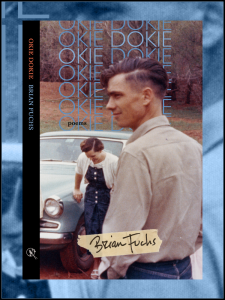
Brian Fuchs, “The Rain” from Okie Dokie (Scissortail Press, 2019)

Cercis canadensis

When we had tried
putting ourselves together again
we’d used the wrong parts,
made effigies of ourselves
with the piles of distorted junk,
left behind scraps of a once-full life.
We went through the motions of people
spoke like them, practicing their accents,
but did not understand our own words.
We got the phrases wrong,
the tones, the memories.
Periodically, we’d erupt into full color
flowers growing from every part
and our days seemed alive with joy.
But we would catch ourselves lost in time,
eyes fixed on a long-abandoned walker,
a long-absent bed,
a long-neglected garden,
at the things we find so important now
and the flowers would fall from our bodies.
I gave up on trying to find the parts
of myself I missed most,
stopped looking for who I had been before. I’ve been more comfortable with discomfort,
waiting for others to finally leave the safety
of their beds, the safety of their tears.
And we’ve started to share ourselves again,
imagining Spring, redbuds flushed fuchsia,
grief removed from our shoulders,
sadness washed from our faces
by the showers of April and storms of May.
We will remember how to be happy
and how to be sad and how to be,
and we’ll see the long-forgotten remnants
and we will understand who we are.

Notes

Written 19 April 2019 in Payne County, Oklahoma. Rewritten 5 September 2019 in Payne County, Oklahoma.

Brian Fuchs, “Cercis canadensis” from Okie Dokie (Scissortail Press, 2019)


Cercis canadensis

When we had tried
putting ourselves together again
we’d used the wrong parts,
made effigies of ourselves
with the piles of distorted junk,
left behind scraps of a once-full life.
We went through the motions of people
spoke like them, practicing their accents,
but did not understand our own words.
We got the phrases wrong,
the tones, the memories.
Periodically, we’d erupt into full color
flowers growing from every part
and our days seemed alive with joy.
But we would catch ourselves lost in time,
eyes fixed on a long-abandoned walker,
a long-absent bed,
a long-neglected garden,
at the things we find so important now
and the flowers would fall from our bodies.
I gave up on trying to find the parts
of myself I missed most,
stopped looking for who I had been before.
I’ve been more comfortable with discomfort,
waiting for others to finally leave the safety
of their beds, the safety of their tears.
And we’ve started to share ourselves again,
imagining Spring, redbuds flushed fuchsia,
grief removed from our shoulders,
sadness washed from our faces
by the showers of April and storms of May.
We will remember how to be happy
and how to be sad and how to be,
and we’ll see the long-forgotten remnants
and we will understand who we are.

Dempsey, Oklahoma

Squash vines coiled
in and around, spilling &
tumbling over each other,
exploding with fruit,
filled with more water
than this place had seen
since May.
Those vines grew wild
alongside bindweed
in the garden that once
fed a whole family,
the jars lined up in the
dugout cellar —
apricots, potatoes, beans.
We used to play in those
places as they turned to ruins,
our historic homeland.
We’d take watermelon rind,
or cantaloupe halves out
for the overheated cows,
leave the fruit near the salt lick.
Our socks would be filled
with sand burs,
our teeth with dust,
and often my mouth would
still show the traces of chocolate
from a clandestine visit
at my grandma’s parents’ house.
The cows were traded in,
eventually the whole lot
retired to the comfort of town,
to the neighbors
with their cat stories,
and a garden bursting
with cucumbers,
a mowed lawn,
tiger-lilies.
I’d miss Dempsey then,
resigned to sit in hushed rooms,
watching my grandma’s mom
eat cornbread & milk.
She’d tell me stories,
talk about her daddy,
but I always wondered
about the cows
and about the apricot trees.

Written 29 January 2000 in Tulsa, Oklahoma & 23 February 2020 in Payne County, Oklahoma.

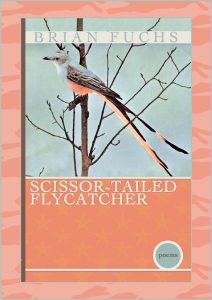
Brian Fuchs, “Dempsey, Oklahoma” from Scissor-tailed Flycatcher (Scissortail Press, 2020)

Notes

Original Version:

thirteen

Dust and saltlicks and fuzzy caterpillars. I loved the farm. I often complained about the heat or stickerweed or the heat — such incredible heat. I was secretly relieved and secretly upset when G, with her parents moved into town. Where in town was the garden full of overripe squash and where in town were the cows, anxious for discarded watermelon or cantaloupe rind for dessert. They moved to be close to a hospital — to make certain they would have a place near for death. Poor G, it broke her heart, and us kids would sit around making all kinds of noise and she wanted to cry. Cry now, G, cry. Were off making noises in our own places — we’re grown now. We know you need a little peace — we will be quiet now.

1.29.2000

part of the chapbook Studies In Loneliness

David Eugene, look at me when I’m thinking about you!

I’m a disciple, a child of your narcissism.
an inadequate acolyte of your worst impulses,
treasonous and suspicious, even in my reverence.
Love is wrapped in sarcasm, in mocking and making-fun.
I pray these are truths, and that you are as transparent as you seem.

I only see the Davids for who they are,
blind to who they want me to see, who they wish they were.
I only see you for who you are,
but I feel the person you want me to be
growing cynically inside.
Oh David, do you not recognize the idolatry in my loyalty?
Does my face not give away my desire to be looking at my own face
when I am looking at you?

The tears stay close, pooling in eyelids, fighting their impulse
to race down my cheek toward knowing I am fully myself,
and not who I am trying to be.
I am trying to be bold in the ways you expect,
no longer cowering in the corners where you found me.
I remember the safety of home, and the emptiness.
I felt safe in my denial, but I am liberated by your sacred teachings.

I grovel, prostrate myself before you,
foolishly and joyously feeding your need for attention.
David, you have shown me that you are more important than I am.
You are more than I am. You are existence.
I meant to steal the hearts of those around you,
meant to show them how much I had learned at your feet.
They exist, you exist, and I have revealed myself to be fragments.
You have reassured me, patted my head like a Lhasa apso,
my head cocked to one side as I attentively await praise.

Oh David, I have not been enough!
The fragments have betrayed me and revealed that I am not whole.
I’ve tried holding them together with glues and tape,
but the picture never seems real;
the other congregants have moved on, my failings insurmountable.
They have found me lacking and are uncomfortable in my presence.
Selfishness is a difficult lesson to learn; I am trying.

I’m still dwelling on my heartache, trying to release it,
unchaining my tongue and allowing bravery to escape,
to become the person I see in you, David,
or to at least to become someone whole, beautiful and brazen,
someone rewarded with love, sex, warmth.
I humbly bow, giving thanks for even a chance
to be blessed by your acceptance.

Notes

Brian Fuchs, “David Eugene, look at me when I’m thinking about you” from Okie Dokie (Scissortail Press, 2019)

Written 17 March 2008 in Anchorage, Alaska & 7 September 2018 in Payne County, Oklahoma.


Original version posted 17 March 2008

I’ve recently done several things with my books — first, I ordered a few books I’ve been interested in reading (in spite of the dozens of books I have and have not yet read).  Also, I rearranged the books in the house to have rough categories.  I am hoping that makes finding a particular book I want to read easier to find, which is should.  Lastly, I unpacked two boxes of books I had stored away for a while and I intend to unpack all books from boxes over the coming weeks.  I’ve always had a large number of books, but it’s time to purge a few of those.  Purging is always a nice feeling, so I’m not anticipating any problems exactly.  If pushed, I could let go of at least half of the books I currently have out on shelves, so I shouldn’t even be terribly pressed for space.

Here are a few books I’m excited to start reading.  Some of these are new to me & some are books I’ve had for years and I just haven’t gotten around to reading yet.

Memoirs

These are some newer memoirs I’ve been excited to get into.  Even though I rarely keep up with celebrities, I do enjoy a good celebrity memoir.  Jim Grimsley is one of my favorite authors, and I’m very excited that he has released a memoir.  The subject is pretty heavy, but necessarily so.

Fiction

I have such an extremely long list of fiction books I want to read, but these are sort of queued up as the next ones on the list.  I have read books by Graham Rawle and Bob Smith before, but the other authors are all new to me.  I hope for some good things.

Novels by Raymond Queneau

I’ve really enjoyed the Raymond Queneau books I have read in the past, and I have a few others to try.

Poetry

Since I’ve been working on my own poetry, I’ve been into reading poetry more than normal.  I’ve read some pretty interesting stuff so far; these are the next three on my list

This has been a wonderful week.  Once again, Justin and Conner were impressive workers and we made some excellent progress with the yard.  We did get a little rain this week, but nothing like we had been getting.  This next week looks warm and dry, which is both good and bad.  I also won’t be at all surprised if there is unexpected rain.  Why not!?

I’ve started to assemble things with the goal of creating a book of my poetry.  It’s really crazy that I have never done that, but it’s going to happen this year.  I’m trying to decide if I want to do short books focused on a theme, or if I should just chuck everything in together and have a slightly longer book.  I can see the value in both.

Senator John McCain died.  Whatever one thinks of his politics, I think we can agree that he deserves our respect as a veteran and POW.  I also really do believe he always fought for what he thought was right.  I didn’t always agree with what he thought was right, but what I’ve seen in the past decade has been the rise of Republican obstructionism, senators and congressmen who are no longer striving to move us forward as a country.  Instead, they try to gum up the machine, fight to keep people down, and cheat to retain power.  They are unAmerican.  I’m reminded of McCain’s town hall during which a woman asked about Obama, disparaging him.  McCain, being a fundamentally good person, defended his colleague.  It was about advancing their ideas, not about tearing one another down.  That election would include some less honorable moments, and arguably was the unintentionally handing of the Republican party that John McCain was a member of to the Tea Party obstructionists like his running mate.  He had a long career and was a well-loved patriot; my thoughts and prayers are with his family at this time.

This has been the third week in a row when I lacked focus on the blog, but I’ve got plenty to write about.  I just need to get with it!

Gertrude Stein (1874-1946)

A few days ago, while organizing paperwork and whatnot, I came across my writing journals from college.  It’s interesting to revisit oneself after 20 years.  It felt familiar, but not so much that I recognized the author.  I could remember writing the words, but the fact that I had done so struck me as bizarre.  For the most part, I didn’t like the person who had written those poems and fragments and notes.  He seemed silly, immature, and at times overly serious.  I wish I could go back and tell him the things I have learned on my journey.

That said, I haven’t been writing much lately.  I haven’t even journaled this summer for obvious reasons.  But I’m very much feeling the words gathering into lines in my head, and I am eager to write more poetry.  I’d been in a dry spell on poetry, but mostly that was due to the lack of quiet I had been dealing with.  Quiet seems easier to achieve recently.  That should help.

When I was studying literature, it was easy to fall for specific authors who I just connected with.  It wasn’t always clear why those connections happened, but it was this that introduced me to Galway Kinnell, Sylvia Plath, Frank O’Hara, Geoffrey Chaucer, & Tim O’Brien.  I latched on to these, and to others, quickly and they helped guide the type of writer I would be.  I was also discovering contemporary authors at that time in my life and their words would guide me as well — Jim Grimsley, Bob Smith, Gary Reed.  Gertrude Stein was one of the authors I discovered in class, having been aware of her for most of my life.  It’s odd how little one can know about someone who has such a well-known name.

Gertrude Stein wrote in several different styles, but all of it was filled with her characteristic repetition and rhythm.  I was especially interested in added that to my own work, and I gave it a try many times.  It’s something that still comes up.  A nod to Stein is a very common practice for me, and I thank her for being one of my muses.

Armadillo

I squish through
henbit and moist soil
under moonlight, slowly
taking the usual path,
intriguing cats who think
they might soon be fed
and startling an armadillo
digging for grubs or worms
in the yard, ensuring that
it will continue being soft
and moist.
She’s a frequent visitor,
nearly at times earning
a name, an honor not
even given to the cats I feed.
The distance increases,
nightly pulling, stretching.
The air is cold and heavy,
the armadillo a distraction
from the fear and frustration
I find myself falling toward.
I’m anxious to see Mom,
the path has turned to gravel
and the house seems further
than it was last night,
when the armadillo was on
the other side of the yard,
making a racket through
last year’s dry leaves
still undisturbed where
they fell, spilling out
around the trunks of trees.
One day, the nights
will be for sleeping
and everyone will be whole.

Notes

Written April 2018 in Payne County, Oklahoma.

Brian Fuchs, “Armadillo” from Scissor-tailed Flycatcher (Scissortail Press, 2020)

I want to comment on my journals I kept when I was a child.  This came about as the 20th anniversary of my trip to France approaches and I would really like to update my thoughts and give some back story.  I was 16 at the time of the trip, an age during which I felt extremely self conscious.  Although I expected my journal to remain private, I still left out things I didn’t want others to know.  I wish I could take that trip again.

I should start by pointing out that i haven’t read my childhood journals in a long time.  In the case of the one I kept in Junior High & High School, I haven’t read them since I wrote them.  I have no idea what I had to say, but I’m going to put it out there anyway.

1

Jan. 2 1990

New Years

New Years is sharing,

caring,giving, and loving,

growing, seeing, living,

and moving on.

•Fuchs•

!Happy!

!New Year!

Brian F

2

Dec. 16, 1990

What is Christmas?

Christmas is loving and

caring,

It’s for being with

family and friends.

Christmas is kids

in the snow and puppies

by the fireplace.

It’s for Daddys with

the news paper,

For Mommys sewing

by the fire

Christmas…………….

The best time of the year!

•Fuchs•

Merry Christmas

Brian F

3

Nov. 28, 1990

Weather

Weather, Weather Every-

where,

You find it in the air.

Rain, snow, sleet, sun,

Some are gloomy some

are fun,

Hardy, soft, or inbetween,

Comes down hard and mean.

Now thats weather all

about,

and thats no doubt!

•Fuchs•

Brian F

4

Nov. 29, 1990

A Friend

A friend is what you

make of one,

Not what you want

from one.

•Fuchs•

F. F. L.

r   o  i

i   r   f

e      e

n

d

s

Brian F

Okay, that was mildly embarrassing.  I was 10 when I wrote the first one and 11 for the rest.  What I find the most interesting is that the journal I used was inscribed to me by my dad on November 7, 1988.  I have clearly ripped out some pages, which is unfortunate.  Seeing what I had to write at 9 would have been very interesting.  These poems were clearly written elsewhere and transcribed into this journal at a later date.  I had only recently discovered poetry, so it isn’t surprising that I was trying to write it.  My first poem was written in October 1988.

Fall Leaves

Fall winds swish around leaves of red,

orange, and yellow

The cool sand is nice, you see birds,

the grass feels good

Squirrels and birds gather food, it is

nice to walk around

Pumpkins decorations are neat and

fantastic

Jack-O-Lanterns are now on our porch,

fall has arrived.

Brian Fuchs

I was 9 when I wrote that and it somehow has more to it that the ones I wrote later.  Fall Leaves was written for class, so that could explain why my effort was greater as well.  As for the others, New Years seems to say nothing at all.  What is Christmas? is interesting.  It neither matches my life experience or that of the general population.  It speaks to an idealized Victorian era Christmas that I remember being rather popular in the late 1980s and early 1990s.  Weather is clearly an attempt at rhyming, which I wasn’t terribly great at then and which I don’t attempt now.  Finally, the very short A Friend.  I had several books of proverbs as a kid.  This was almost certainly my attempt at writing my own proverb.

These poems as a whole say very little of my life in 1990.  They don’t have much to say at all really.

Dale

I sought the council of trees, Dale’s name lingering in my head,
hoping to glean wisdom from the aged assembly,
hoping to hear God through the woody branches.
I studied the structure of oak leaves, how each attached to a branch;
watched sunlight fall through the new growth on cedars;
made note of the greenbriar’s leafy fingers wrapping around the trunks of pecans.
The world was still and hot and dotted with tiny white butterflies
emerging from the thickets to enjoy a field of nectar-filled flowers in the afternoon sun.
My mind had been typically cluttered, with family dramas,
thirteen years of grief, first loves, comedy routines,
and parts of a jingle from a TV commercial I remembered from childhood.
Sitting in the surrounding quiet, I waited for the ancient botanical knowledge,
letting those thoughts drop away, heavy and viscous,
and leaving behind a calm in which I could almost hear the butterflies landing on petals.
The wind came gently then, in small bursts that the oaks seem to enjoy,
allowing the trees to flit thousands of leaves about merrily.
A rustle, a calm and relaxing rustle accompanied by silent mimics,
of a host of lesser plants vying for the favor of the post oaks,
standing as the monarchs of this dry woodland.
A slightly stronger breeze, a creaking sound as older specimens swayed,
some long dead, the bony outer branches moaning hauntingly in the current.
The tranquility was broken, butterflies scattered unceremoniously into the air,
having been blown off their perches by a strong wind that moved through the grasses,
flattening it in waves as it moved across the expanses.
When the wind reached the sentinels of trees standing bravely against it,
they found themselves unprepared and leaves and branches erupted into chaos.
Dale had died.
He had been my namesake, the hero and villain of his own stories,
his name lingered, attached to mine as a reminder of who he no longer was
and as a reminder of who he had been capable of being,
a reminder of who we all had been, of what we wanted to say we had been.
And now he was gone. As the gust moved on in the distance,
stillness returned to the trees and I still faced them, waiting for answers.
We were all there, waiting for different pieces, prostrating ourselves before them.
The instructions were lost, the knowledge never passed on,
the person whose position had been placed so highly seeming to fade
with great distances, separated by different trees, grasses, weeds.
His name lingered, attached to mine as a reminder that we should hold on,
hold him up as he fell, his wings revealed to be a mirage.
It was not always enough, we were not always enough,
and we allowed Dale to slip into humanness.
The trees had again become silent. The distances now as close as they would ever be,
as far somehow as they had felt before when inscribed books would
arrive by mail, wrapped in symbols of birthdays or holidays or plainly
when a book had piqued Dale’s desire to share it with me,
a boy he barely knew, but to whom his name was attached.
And there were songs and great conversations, which are things
of which plants know little. And things that had defined him
so importantly that it felt proper to discuss them now, with God or the trees.
The heat had started to intensify; beads of sweat formed on my neck and face.
Still I waited, knowing that lives had become altered, knowing that we had reached
both the beginning and the end of everything.
And I thought about whittled walking sticks, carefully crafted from the new growth.
His name lingered in my mind, attached to the trees, I now realized, a part of it.
The presence of butterflies had increased in my focused state;
they now seemed to be everywhere, clustered on flowers
and dancing through the space between the trees.
I turned and went back to the house, knowing and not knowing,
melding now with the air and grass, with the trees.
And I thought about Dale, his name lingering there, attached to mine,
attached to the moment and those memories,
attached to the wings of hundreds of tiny butterflies
And I smiled because I had known him.

Notes

Brian Fuchs, “Dale” from Okie Dokie (Scissortail Press, 2019)

Written 25 July 2015 in Payne County, Oklahoma.

Quercus shumardii

for Papa

A great tree has uprooted,
exposing the branching mass
caked in the red soil of the Western Plains.
What was parched had been made rich and loamy
by the giants that fell before,
pioneering specimens that germinated and made
a home under the endless horizon of Oklahoma.
The water that made those plants flourish
had come from England and Ireland,
from Galilee and Missouri.
The roots of those ancestors fed the saplings
of the new generation.
Entwined, two young trees grew close together,
feeding on one another,
strengthening each other’s roots.
Acorns became a thicket and then a forest,
spreading out in all directions.
The flaming red soil has changed over time,
fertilized, nurtured, enriched.
The acorns have been found scattered,
rooting in Texas and Colorado,
in Alaska and Kentucky.
A tradition of strength and serenity
tested in new soils, clays and sands,
ultisols, entisols, crider and port silt loam.
Lightning took out the second tree,
ripped away what had been life,
forcing the survivor to stretch out new branches
to cover the fallen companion,
to show strength in the face of tragedy,
to learn to love when love seemed to disappear.
The branches, sprawling out massively,
became only sparsely covered with leaves, but
never lost their majesty, their humility, kindness, dignity.
Now the great tree has joined its long-fallen partner,
stretched at the base among those it had given life to,
cradled by the thick trunks of trees
that have become mighty themselves.
They stretch impressively toward Heaven,
mimicking the once proud figures
now so apparently absent in the canopy.
The sun can once again burst through,
but this is no longer the harsh and arid place
it was when ancestors first arrived.
In the clearing a small field of flowers
will spring up in memorial,
attracting the beauty of birds and insects
until new saplings join the congregation.
That great tree is now one of the ancestors,
enriching the soils for future generations.

6.7.2014

Notes

Brian Fuchs, “Quercus shumardii” from Okie Dokie (Scissortail Press, 2019)

Written 7 June 2014 in Glencoe, Oklahoma

HANDOUTS FROM FUNERAL (Poem included as “The Tree”)

Posted 7 June 2014

Meeting Skylar & Wesleyan at the Grey Gardens Disco

Secrets feel more like friends than flesh,

written on the tightly rolled scrolls and tied loosely with a scrap of string.
These are the days when life is slipping past so quickly that I cannot seem to find a way back to it, a way to engage. I want to write my own secrets on tiny scrolls, but their contents would drive away even those I’m barely clinging to and they’d slip further into the torrent
away from me.

Time has been cruel, much more than I could have expected.

Mine will be the story that goes untold, unrecorded, unremembered.
Inaction fuels inaction and so I do not move, do not move, do not move. There are lives happening, I’ve been told, beyond the threshold I’m so afraid to cross. The moments I should’ve had hold me back, keep me wondering, force me into the safety of my empty bed
where the quiet loneliness can comfort me.

After the house has filled with leaves and dust and snow,

beyond the carefully orchestrated solitude, celebrations go on without me.
The most beautiful hear the music within themselves, gaily swinging auburn hair and laughing at their own unfunny puns. Merriment and giddiness come on like migraines and I find myself waving a flag and dancing joyously, still unable to coax myself from my home.
Happiness feels so foreign.

Ugliness greets me in every mirror, an old addictive friend

and the voids I’ve created have grown to feel comfortable on my miserable soul.
I’ve failed to learn the steps, and I am terrified that the dance will go on with out me. I look at the hollowness of the collected things around me, dismayed that I’ve become this me. This is the me that will keep happiness in its place
far away.

Nothing excuses knowing about leopard print,

a secret that seems to have allowed me to let go of ill-advised longings.
How incredibly sad it is to not find me so alluring that you can see past my plentiful flaws. I have known for quite some time that if I live my life alone, dying before I know love, that it is not me who is to blame, although I understand the temptation. It is others
who fail to see how happy I would make them.

Could these children have caused my empty world’s destruction?

set in motion events that will cause this tomb around me to collapse.
It’s too soon to know, but I welcome the crumbling. My stacks of nonsense are poised to fall into a blissful abyss. Oh, what exquisite joy I know I will feel when the rooms are all empty and there is just me to fill the space.
And someone to help me fill it, I hope.

Hope, indeed. It is all that keeps me from dropping into the crevasse myself,

cementing my loneliness forever with my inability to change.
I’ve begun to remember who I used to be and have found people who make me hate myself less and less every moment. But not even their patience can be endless, so if I am not to miss out on the Brian I’ve been trying to become again, I need to ask fast
and meet my friends for a drink.

Notes

Written 2 December 2012 in Anchorage, Alaska.

Brian Fuchs, “Meeting Skylar & Wesleyan at the Grey Gardens Disco” from Okie Dokie (Scissortail Press, 2019)

Formatting on WordPress ended up looking a little off, but this was as close as I could get it.  The first lines of the stanzas shouldn’t be separated, but indenting a line requires making a new paragraph.  If I figure out how to change that, I will.

12:07 am 4.14.12

There is a plane going by and it could be you. I’ve been somewhat obsessively thinking about you all day. It was stupid of me to not insist on spending more time with you, but I so often felt like I was a piece of a life you’d left.

Notes

Written 14 April 2012 in Anchorage, Alaska.

Brian Fuchs, “12:07 am 4.14.12” from Okie Dokie (Scissortail Press, 2019)

Earthquake Season

The whole world started ripping apart from skies and ground,
shaking those Okies into a frantic state.
Run into the path of tornados,
sink into the cracked ground,
nothing is there to save you.
The politicians and tigers are waiting to eat you.

Notes

Written 11 November 2011 in Anchorage, Alaska.

Brian Fuchs, “Earthquake Season” from Scissor-tailed Flycatcher (Scissortail Press, 2020)

Daniel Naranjo

I itch for the subtle way joy emerges
from your face – overcome with yourself,
with yourself.
It’s lovely. You’re lovely.
You aren’t so familiar, aren’t so unfamiliar.
In the long months between,
everything misses you.
My senses feel achy and empty without
your enchanting aura of smoke and wine.
I smile, thinking of that laugh,
you know the one,
that erupts accidentally when you’ve
amused yourself.
God, I love that laugh.
You blew in on winds you could’ve
ridden forever, resigned to not settle,
loving the feel of the dust
whipping through your pores,
hair, teeth.
You seem reluctant,
you seem reluctant,
reluctant. Or is that me?
I decided to write you a poem,
a poem of you, the you I know of,
the you who is only a slight version of you.
It took four years to say
things about your loveliness,
about the smoke and the wine,
about Oregon and Alaska,
about loving your laugh.
It wasn’t just joy, was it?
I detected some shame,
loved that shame, if that’s what it was,
wanted to live in that feeling.
I’ll remember that face,
remembering how much I love you,
and I’ll exist for a few seconds
in that moment, that feeling,
inside a space you created.
I believe in horses and you,
I believe in me and you,
I believe in you
and you.

Notes

Written 25 October 2011 in Anchorage, Alaska.

Brian Fuchs, “Daniel Naranjo” from Okie Dokie (Scissortail Press, 2019)