Perspective to Pen
2020-09-22

PERSPECTIVE TO PEN : AN ANTHOLOGY
Coming soon! Check back for details. Until then, check out the poets below.Continue Reading

PERSPECTIVE TO PEN : AN ANTHOLOGY
Coming soon! Check back for details. Until then, check out the poets below.Continue Reading
 Watermelon Seed
“Un enfant,
C’est le dernier poète
D’un monde qui s’entête
A vouloir devenir grand
Et ça demande si les nuages ont des ailes
Et ça s’inquiète d’une neige tombée
Et ça s’endort, de l’or sous les paupières
Et ça se doute qu’il n’y a plus de fées”
Three stones were dropped in the creek
where the dragonflies kept them company,
the prehistoric nymphs feeding on their umbilicals.
We had trouble finding our way back to that place,
but were rewarded for doing so with watermelon,
which we let drip down our hands and arms
in the intense heat of an Oklahoma summer.
The gemstones were kept fixed in her eyes,
projecting sad and murky images from her heart.
I was too young to feel the distance, but her hands
recoiled when she saw that I had the same stone
skin she’d thrown into that creek so long ago.
The dragonflies still fed nearby, emerged for
their brief adult lives to witness our return.
There is a shed still bursting with private musings
and with his attempts to understand the pain,
of loss and of rejection and of mistakes made.
I’ve grown apart, my hands unable to find hers
and my eyes now filled with gemstones.
Chasms have opened where creeks used to be,
and stones have spilled out in all directions.
Unspoken words and indifference hang low,
clouds that block the sun and offer cooling shade.
When the watermelon has been eaten, you spit
out the seeds, which sometimes grow into new
plants that put on the beautiful refreshing fruit.
Sometimes, those seeds rot and turn to dust.
I am still a child, ignorant and stupid.
I’m standing in the grocery store, broasted chicken
in my hands for my grandma’s dinner, dumbfounded.
She looked past me, the gemstones in her eyes
blinding her from seeing me, even though I could
see the glint of recognition on her face as she silently
passed by. That was the last time I saw her.
Dust.
Written 19 February 2020 in Payne County, Oklahoma.
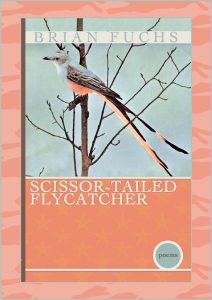
Brian Fuchs, “Watermelon Seed” from Scissor-tailed Flycatcher (Scissortail Press, 2020)
 Eight Minutes in May
I’m just a yokel,
nothin’ in my noggin ‘cept dust
while old fires burn,
when souls cry out
to finally be heard,
when hearts have all exploded
over the same pavement
where their necks were pressed
and lives snuffed out.
The police are suiting up for combat,
firing up the tanks,
readying for war,
and I’m still standing in place,
slack-jawed,
shocked,
tears filling my face.
I feel my neck pressed
on the pavement,
imagination squeezing out my life,
filling my pores with a rage
I didn’t know was possible.
Only imagination,
no knee holding me down.
Only imagination,
no onlookers witnessing my death.
They did this
You did this.
We did this.
I did this.
My legs are frozen;
the march goes forward,
tear gas rushing through me.
People are rising,
beautiful and triumphant.
People are lifting their voices,
earnest and finally
at the end of their rope.
I’m projecting through space,
climbing my family tree,
finding ancestors
and preparing the tree
where they deserve to dangle,
where their necks should feel
that rough jute rope
as my ghost hands grip,
slip the noose and let their
useless lives slip away,
unnoticed and unremarkable.
I’m no price to pay at all
if they’d never existed,
and beauty was left to flower
in traditions and families
who never deserved abuse.
The police are marching on our streets,
storming our homes,
taking us out before we get a good look,
before we see their monsters.
Fires are burning.
People are rising,
bodies engulfed,
effigies of collective esophagi.
No air gets through.
The nurses fight through rubber bullets,
clad in medical-grade garbage,
supplies looted and spilled.
The nurses fight,
shove tubes down our throats.
Now none of us can breathe.
Everything is burning.
Our lives are burning.
Our lives mean nothing.
The floodgates must be torn down;
let the flood of melanin
wash over everything,
drown us, the children of terrorist.
They did this
You did this.
We did this.
I did this.
I’m starting to close my mouth,
my esophagus is catching fire.
I’ll either breath the fire of my indignation
or find myself intubated,
a machine replacing my lungs.
It’s only June,
and already the very air is burning
my skin. It’s only been two weeks,
but it feels like 400 years.
The shock has faded,
rage shoots out
of my mouth in great bursts,
flame and smoke.
The police are locking arms,
demanding our submission,
demanding our allegiance,
demanding our loyalty,
blindness.
Let the pavement
‘ever be pressed to our necks
so we can
never forget.
Written 7 June 2020 in Payne County, Oklahoma.
To be published in Perspective To Pen: An Anthology. Look for it in September.Continue Reading
The Transformation of Gaia’s DaughtersFor Ann & LaDonna
Two chrysalises formed
separately, identically.
The prairie’s tall grasses
still grow between
everything we’ve ever known
and everything we’ll ever know.
Time has stood still for nearly two years,
and maybe our lives have been placed
in Aion’s ancient hands.
They’d formed those pupal shells
from two-seater pumpkins
borrowed from Thoreau’s own quill,
from the canvas tops of
their ancestral covered wagons,
from velvet cushions
left at their homes
for my uncle’s comfort,
and from red-lettered Bibles,
Jesus still reciting the instructions.
Outside, a chorus of children,
throngs of former students,
sing the songs they learned
when the two had been caterpillars
eating holes in the leaves,
dreaming of new plants
and of wings.
The students still wear the costumes
of philosophers and founders;
they are clutching small stones,
gold-paint chipping
from their rough forms.
The deafening joy fills the air,
heavy with heat.
Sunshine pools in one chrysalis,
vacant now in the stillness.
It glows like a stained glass lantern.
Inside the other, wings still form,
mimicking the shining pattern
projected on translucent walls.
They might have been
the Grimké sisters,
struggling toward a better world,
or they might have been
the mothers of us all,
here at the very creation,
the big bang jointly reared
in their care, set free to stretch
its infinite wings,
tempered by their brother, time.
The trees recall the cosmic story,
reveal the events in
ancient languages drawn on leaves.
It is also etched into insect wings,
in specific dialects of jellyfish,
and in the network of veins
spidering through our bodies.
27 February 2020
Brian Fuchs, “The Transformation of Gaia’s Daughters” from Scissor-tailed Flycatcher (Scissortail Press, 2020)
Also appeared in Social Distances (Scissortail Press, 2020)Continue Reading
Campsis radicansThat house still haunts me;
the absences I feel are extreme.
Brad has kept the trumpet vines,
electric and intense like himself.
He pulled the irises that were once
lining the paths and taking breath
away from visitors as they passed.
The enormous black-purple blooms,
now towering only in our memory.
He inherited too much and not enough,
spending time and money adjusting,
spreading out and stamping his energy
onto the places that had been our center.
He’s added alcohol to the room where
my grandma’s last moments began,
highlighting the permanence of it all.
Where there was once an annual
display of daisies and cleomes,
a chainlink box sits, overgrown with
those intense trumpet vines.
The garden is all wild and unkempt,
like he’s trying to preserve something
that cannot be contained or suppressed.
Life spills out from our dark spots.
The house was full of undue pressures,
now settled into a gritty beauty.
The roots will continue to grow,
the trumpet vines will spread,
and one day my nephew’s children
will wipe tears from their eyes when
they visit a house that meant so much.
And they’ll talk about the intensity
and how much they’d give to have it back.
Written 20 February 2020 in Payne County, Oklahoma.
Brian Fuchs, “Campsis radicans” from Scissor-tailed Flycatcher (Scissortail Press, 2020)
Stillwater, Oklahoma4. PROMISES
I’ve seen life’s simplicity and it made me smile.
I’ve watched the horses in their fields on the town’s edge,
visited cattle lounging in shade in July.
I’ve waved at the farmers on their tractors, thanked them.
I’ve laughed at the new goats frolicking and climbing.
I’ve seen your fuchsia redbuds in bloom, buds bursting.
I’ve seen joyful petals pushing out of branches,
the promise of Spring and potential of April.
I’ve chased butterflies, paused to follow scissortails,
I’ve danced with grackles with their long velvet feathers.
I’ve felt the sun on my back, warm and oppressive.
I’ve wondered in late Summer if the heat would leave,
felt the scorched grass and falling leaves of September.
I’ve found joy in the heat, remembering Autumn.
I’ve daydreamed about the promise and chill it brings.
Written 19 February 2020
Brian Fuchs, “Stillwater, Oklahoma” from Scissor-tailed Flycatcher (Scissortail Press, 2020)
Stillwater, Oklahoma3. THROWING SPHERES: A MIRRORED CLOGYRNACH
My boyhood never depended
on throwing spheres like all men did.
I so often mused
if I had confused
dead with bruised
God forbid
Days in parks,
I’d explore
searching woodland floors
for seed pods and more.
Imagined tree friends, their rough bark
I’d so much missed since our last lark.
“that scattered belt of forest land, about forty miles in width, which stretches across the country from north to south, from the Arkansas to the Red River, separating the upper from the lower prairies, and commonly called the “Cross Timber.” — Washington Irving
Written 19 February 2020
Brian Fuchs, “Stillwater, Oklahoma” from Scissor-tailed Flycatcher (Scissortail Press, 2020)