Saturday 1 June 1996

As I went to work I realized the excitement and joy of the opportunity I have made possible for myself.  I am going to France!  I will be allowed to remain in another country for a time of two weeks!  Chessie starts today.  I hope she works out. If she does we’ll share hours at work.  I just don’t know what to think.  Tomorrow we will be going to Tulsa.  Brad is going for a week.  I will be going to the airport with Ann Monday morning.  Wow!!  My first plane, my first out-of-country experience and the first time I’ve gone East of Arkansas.  I just cannot wait.

» 27 August 2007

In truth, this was not an opportunity that I had created for myself.  Far from it.  This opportunity was made possible by the generosity of my Mimi and Papa, as well as sizable donations from my parents.  I had worked for a year and saved almost nothing.  It was not me who got me there, but my family who realized that I really wanted to go.

I did know what to think about sharing my job with the new girl who was starting.  I didn’t like it.  I felt liked I had worked really hard to be important to the Villa, where I worked, and didn’t appreciate having someone come in to “help,” as it just seemed like she was cutting my paychecks in half, which she did. In the end, she did not work out and I worked alone until I left for college over a year later.  Interesting side note:  my one and only date with a girl was with Chessie.  We went to the fair in September of the same year.  It was actually a lot of fun.

» 27 February 2016

I’m so excited to revisit this journal after twenty years.  I cannot believe it’s been so long!  Recently, I was driving my nephew home from my parents’ house and it dawned on me that he is only two years younger than I was when I went to France.  That seems so untrue and amazing that I hardly knew what to do with that information.  It was during that talk that we discussed the concept of memory.  He was asking me about the concept of time seeming to go by when one is older.  I thought about that and hypothesized that perhaps what is at play is how our memories can stick to us, how things that happened decades ago can seem so clear still, as though those things might’ve happened yesterday.  The older we get, the more of those memories we have and it all just starts to feel compressed as if life hadn’t been as long as it was.

I remember 1996.  I remember it like I remember last month.  I remember my feelings, my desires, my motivations, and my philosophies.  I remember my secrets.  I remember spending lunches with my friends buying CDs at the local music store, and how much I loved my time washing dishes at my job because it gave me time to drift away into my own thoughts.  I remember the feeling of being caught between loving my family whose company I truly valued and needing very much not to be around them.  I remember spending too much time with my friends.  And I remember not being all that adventurous or daring, a trait I have always attributed to being very cerebral and lost in my own head.  I did not have a wild side; it never seemed to develop, which has been disappointing at various points during my life, but ultimately, I’ve been satisfied with being grounded.

In my teens, I romanticized everything, and often wondered if others were doing that as well.  At fifteen or sixteen, I didn’t have those words for my friends, didn’t understand the value of an open heart, and so I’d wonder about how people see the world for a long time.  It wasn’t until I had nephews and nieces that I got to see other people who were experiencing the world in ways that seemed so familiar.  My oldest nephew, the one with whom I discussed memory, has a tendency to romanticize his world.  It’s nice to see things through rose-colored glasses — I still try to wear them as often as possible — but he will experience a fair amount of disappointment when the world reveals itself for what it really is, a feeling that nobody can prepare him for.

Favim.com-9757France stood as a fantasy world, somehow existing in our modern world as both very much a part of the 1930s, 1960s, and somewhat 1980s.  To my sixteen year old eyes, it seemed not lost in time, but purposely wrapped in the past, a land joyously refusing to become something it did not want to be.  I loved that about it and could not have cared less about how unlikely my notions of French life might be.  I wanted so much for it to be that land I had invented.

The opportunity to go to France had been presented in 1994 in French class.  I was only too eager to join the group, assuming that others in my class would go as well… friends.  I looked forward to it from the moment I saw the green light in the eyes of my parents and grandparents.  I was told I’d have to pay for half, which motivated me to get a job in 1995, but my youth would ultimately stand in the way of acting responsibly and saving money.  I never really did.  The trip should’ve been called off, but perhaps the adults in my life realized the size of this opportunity.  Perhaps they knew its impact would last well beyond the two weeks we would be gone.  Perhaps they knew that I had in fact worked hard at my job, in spite of my lack of ability to save the money, ultimately deciding to reward me for that.  I’m not sure.  What I do know is that I was allowed to go.  I was not prepared, not mature enough, but I was going anyway.

Sunday 2 June 1996

1_9cd8580cbcd0e41e8765f55eb60c4e3cI am at Ann’s.  This morning we did not go to church but rather we went to Stroud.  There I bought some new headphones, a CD, a get-well card for Mme Wright, and some stuff at the toy store.  I got a Limber Louie, a marionette of an unusual looking bird.  The sides control his feet so that he can appear to walk.  I am having a hard time stopping my thoughts of what France will be like.  I have absolutely no IDEA!  Becky and Brad are going to a work camp where they paint houses.  I also bought some Furr Balls lil’ stuffed toys with rubber faces.  I have had quite a day and can’t wait — think, tomorrow I’ll be on a plane to Paris.  Wow!

» 27 August 2007

Yep, spent a bunch of money BEFORE going to Europe.  I honestly had no idea how dumb that would end up being.  Blue and furry Louie lived in a box for years.  I eventually lost him and now do not know where he ended up.  I do not miss him.

» 27 February 2016

Sometimes things can happen in life and the impact can seem like it will be quite small, but it turns out the be huge.  Shortly before leaving on our trip, the French teacher and our chaperone Mme Wright suffered a brain aneurysm.  She would recover, but was unable to go with us to France.  The parents met and decided to let us go without her.  Money had already been paid — nonrefundable at that point — and most of those going were already eighteen.  I was the youngest at sixteen.  We weren’t going to be left to our own.  We would meet up with another group on our way and their teacher agreed to keep an eye on us.  That group was always going to be with us during the entire two weeks.

Kids should be educated on money and saving in school.  It should come up throughout the twelve years of school and be a mandatory part of the curriculum.  Add to that other everyday skills such as interviewing for jobs, interacting with others in public, how to wait in lines patiently, cooking, cleaning, how to apply for a loan, how to pay back loans.  These are all very important life skills we forget to teach kids.  I always had the things I wanted.  Sure, I remember my mom and dad telling me I couldn’t have this or that, but I never felt like I wanted for anything.  It was a cushy, middle-class life.  Understanding money didn’t play much of a roll at that time in my life.

I was facing a major opportunity, an event so pivotal to my life that I would carry it with me forever.  It would inform my future relationships, jobs, and where I would choose to live.  It would be the thing I would revert to for comfort or when I wanted to remember a certain kind of emotional pain.  And it would take as much money as I could hold onto to keep me going for the two weeks.  Still, I thought it appropriate to buy toys at an outlet mall the day before I left.  I had been doing a lot of fighting to keep the little kid part of me from going forward with me in life, and this is just one example of where I failed.  As setbacks go, it probably seems somewhat inconsequential, but it seems like an important part of understanding who I was in that moment, who I had been until then, and who I ultimately was to become as a result of the trip.

SaveSave

I want to comment on my journals I kept when I was a child.  This came about as the 20th anniversary of my trip to France approaches and I would really like to update my thoughts and give some back story.  I was 16 at the time of the trip, an age during which I felt extremely self conscious.  Although I expected my journal to remain private, I still left out things I didn’t want others to know.  I wish I could take that trip again.

I should start by pointing out that i haven’t read my childhood journals in a long time.  In the case of the one I kept in Junior High & High School, I haven’t read them since I wrote them.  I have no idea what I had to say, but I’m going to put it out there anyway.

1

Jan. 2 1990

New Years

New Years is sharing,

caring,giving, and loving,

growing, seeing, living,

and moving on.

•Fuchs•

!Happy!

!New Year!

Brian F

2

Dec. 16, 1990

What is Christmas?

Christmas is loving and

caring,

It’s for being with

family and friends.

Christmas is kids

in the snow and puppies

by the fireplace.

It’s for Daddys with

the news paper,

For Mommys sewing

by the fire

Christmas…………….

The best time of the year!

•Fuchs•

Merry Christmas

Brian F

3

Nov. 28, 1990

Weather

Weather, Weather Every-

where,

You find it in the air.

Rain, snow, sleet, sun,

Some are gloomy some

are fun,

Hardy, soft, or inbetween,

Comes down hard and mean.

Now thats weather all

about,

and thats no doubt!

•Fuchs•

Brian F

4

Nov. 29, 1990

A Friend

A friend is what you

make of one,

Not what you want

from one.

•Fuchs•

F. F. L.

r   o  i

i   r   f

e      e

n

d

s

Brian F

Okay, that was mildly embarrassing.  I was 10 when I wrote the first one and 11 for the rest.  What I find the most interesting is that the journal I used was inscribed to me by my dad on November 7, 1988.  I have clearly ripped out some pages, which is unfortunate.  Seeing what I had to write at 9 would have been very interesting.  These poems were clearly written elsewhere and transcribed into this journal at a later date.  I had only recently discovered poetry, so it isn’t surprising that I was trying to write it.  My first poem was written in October 1988.

Fall Leaves

Fall winds swish around leaves of red,

orange, and yellow

The cool sand is nice, you see birds,

the grass feels good

Squirrels and birds gather food, it is

nice to walk around

Pumpkins decorations are neat and

fantastic

Jack-O-Lanterns are now on our porch,

fall has arrived.

Brian Fuchs

I was 9 when I wrote that and it somehow has more to it that the ones I wrote later.  Fall Leaves was written for class, so that could explain why my effort was greater as well.  As for the others, New Years seems to say nothing at all.  What is Christmas? is interesting.  It neither matches my life experience or that of the general population.  It speaks to an idealized Victorian era Christmas that I remember being rather popular in the late 1980s and early 1990s.  Weather is clearly an attempt at rhyming, which I wasn’t terribly great at then and which I don’t attempt now.  Finally, the very short A Friend.  I had several books of proverbs as a kid.  This was almost certainly my attempt at writing my own proverb.

These poems as a whole say very little of my life in 1990.  They don’t have much to say at all really.

I’ve been thinkinHomeg about the concept of ‘home’ for a while now.  What is it that give our spaces that feeling that makes us feel good being there.  It isn’t uncommon for an apartment to feel distinctly not homey, particularly ones first apartment after leaving the house where parents and siblings still reside.  It makes tempting the idea that it is the people that make for a feeling of ‘home.’  But it seems equally common for an apartment to feel like the place where that person will spend the rest of their life.  And that happens to folks who live alone.  So, is it the people at all?

I love being with my family.  There was always something about returning for a visit to my childhood home that had a fantastic mix of nostalgia, comfort, and distance.  In 2005, I moved far enough away that visiting required planning and money; my visits to my hometown were reduced to about once every two years.  By my first visit, my parents had sold my childhood home and moved to the country into a brand new manufactured home while they planned out their dream home.  There was no way, I thought, to feel at home in a mobile home sat in the trees just outside of town.

I was wrong.  While it wasn’t the same, the feeling was.  I was in a house that had only even existed for about a year, but it was filled with familiar furniture and my parents.  For me, that ruled out the structure and the location.  What seemed to be at play was the combination of the people, the memories I carried with me, and the stuff in the house.  Had my parents simultaneously discovered their mutual love for Victorian furnishings, throwing out the carefully cultivated collection of things in the house, I think the space would have felt as cold as I expected it to.  These objects brought with them the stories that define us as a family.

“I always want objects in my home that have a connection to me or something I’ve loved.  It’s still stuff, but it’s stuff that has meaning.” Nate Berkus makes a great point, and one I’d like to explore in depth for myself.  When I had one of those cold apartments, just out of high school, it was filled with items I can barely remember, mass produced and cheap things.  The only items I even clearly recall are items that had a story, even if the item wasn’t old.  The dresser my dad painted for me for my new place, the sofa he reupholstered, and that is about it.  It would take me years to collect items of meaning, to be given things once belonging to grandparents and parents, and to have the maturity to honor those things and treat them with the respect they had earned.

Six months ago, I moved into the mobile home where my parents spent years hoping to build their dream home.  They settled into their new house over the summer, leaving vacant a space that had surprised me, on a land that is peaceful and beautiful.  I’m honored to live here in this space that has become a part of the story, where my nephews spent so much of their childhood, where birthdays were celebrated, where holidays with family were enjoyed, and where my parents lived and loved and convalesced.

Many of the stories are lost; it had been incumbent on me to ask the necessary questions and carry on the mythologies and lessons of my family, but I have failed to do so.  But I’d still like to explore what meanings these artifacts have for my life, for the lives of my family members, to recall the world in which they came to us and present them to the world.

This is the first entry in a series about my things.

Dale

I sought the council of trees, Dale’s name lingering in my head,
hoping to glean wisdom from the aged assembly,
hoping to hear God through the woody branches.
I studied the structure of oak leaves, how each attached to a branch;
watched sunlight fall through the new growth on cedars;
made note of the greenbriar’s leafy fingers wrapping around the trunks of pecans.
The world was still and hot and dotted with tiny white butterflies
emerging from the thickets to enjoy a field of nectar-filled flowers in the afternoon sun.
My mind had been typically cluttered, with family dramas,
thirteen years of grief, first loves, comedy routines,
and parts of a jingle from a TV commercial I remembered from childhood.
Sitting in the surrounding quiet, I waited for the ancient botanical knowledge,
letting those thoughts drop away, heavy and viscous,
and leaving behind a calm in which I could almost hear the butterflies landing on petals.
The wind came gently then, in small bursts that the oaks seem to enjoy,
allowing the trees to flit thousands of leaves about merrily.
A rustle, a calm and relaxing rustle accompanied by silent mimics,
of a host of lesser plants vying for the favor of the post oaks,
standing as the monarchs of this dry woodland.
A slightly stronger breeze, a creaking sound as older specimens swayed,
some long dead, the bony outer branches moaning hauntingly in the current.
The tranquility was broken, butterflies scattered unceremoniously into the air,
having been blown off their perches by a strong wind that moved through the grasses,
flattening it in waves as it moved across the expanses.
When the wind reached the sentinels of trees standing bravely against it,
they found themselves unprepared and leaves and branches erupted into chaos.
Dale had died.
He had been my namesake, the hero and villain of his own stories,
his name lingered, attached to mine as a reminder of who he no longer was
and as a reminder of who he had been capable of being,
a reminder of who we all had been, of what we wanted to say we had been.
And now he was gone. As the gust moved on in the distance,
stillness returned to the trees and I still faced them, waiting for answers.
We were all there, waiting for different pieces, prostrating ourselves before them.
The instructions were lost, the knowledge never passed on,
the person whose position had been placed so highly seeming to fade
with great distances, separated by different trees, grasses, weeds.
His name lingered, attached to mine as a reminder that we should hold on,
hold him up as he fell, his wings revealed to be a mirage.
It was not always enough, we were not always enough,
and we allowed Dale to slip into humanness.
The trees had again become silent. The distances now as close as they would ever be,
as far somehow as they had felt before when inscribed books would
arrive by mail, wrapped in symbols of birthdays or holidays or plainly
when a book had piqued Dale’s desire to share it with me,
a boy he barely knew, but to whom his name was attached.
And there were songs and great conversations, which are things
of which plants know little. And things that had defined him
so importantly that it felt proper to discuss them now, with God or the trees.
The heat had started to intensify; beads of sweat formed on my neck and face.
Still I waited, knowing that lives had become altered, knowing that we had reached
both the beginning and the end of everything.
And I thought about whittled walking sticks, carefully crafted from the new growth.
His name lingered in my mind, attached to the trees, I now realized, a part of it.
The presence of butterflies had increased in my focused state;
they now seemed to be everywhere, clustered on flowers
and dancing through the space between the trees.
I turned and went back to the house, knowing and not knowing,
melding now with the air and grass, with the trees.
And I thought about Dale, his name lingering there, attached to mine,
attached to the moment and those memories,
attached to the wings of hundreds of tiny butterflies
And I smiled because I had known him.

Notes

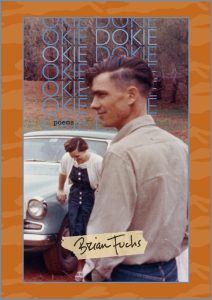
Brian Fuchs, “Dale” from Okie Dokie (Scissortail Press, 2019)
Written 25 July 2015 in Payne County, Oklahoma.

Quercus shumardii

for Papa

A great tree has uprooted,
exposing the branching mass
caked in the red soil of the Western Plains.
What was parched had been made rich and loamy
by the giants that fell before,
pioneering specimens that germinated and made
a home under the endless horizon of Oklahoma.
The water that made those plants flourish
had come from England and Ireland,
from Galilee and Missouri.
The roots of those ancestors fed the saplings
of the new generation.
Entwined, two young trees grew close together,
feeding on one another,
strengthening each other’s roots.
Acorns became a thicket and then a forest,
spreading out in all directions.
The flaming red soil has changed over time,
fertilized, nurtured, enriched.
The acorns have been found scattered,
rooting in Texas and Colorado,
in Alaska and Kentucky.
A tradition of strength and serenity
tested in new soils, clays and sands,
ultisols, entisols, crider and port silt loam.
Lightning took out the second tree,
ripped away what had been life,
forcing the survivor to stretch out new branches
to cover the fallen companion,
to show strength in the face of tragedy,
to learn to love when love seemed to disappear.
The branches, sprawling out massively,
became only sparsely covered with leaves, but
never lost their majesty, their humility, kindness, dignity.
Now the great tree has joined its long-fallen partner,
stretched at the base among those it had given life to,
cradled by the thick trunks of trees
that have become mighty themselves.
They stretch impressively toward Heaven,
mimicking the once proud figures
now so apparently absent in the canopy.
The sun can once again burst through,
but this is no longer the harsh and arid place
it was when ancestors first arrived.
In the clearing a small field of flowers
will spring up in memorial,
attracting the beauty of birds and insects
until new saplings join the congregation.
That great tree is now one of the ancestors,
enriching the soils for future generations.

6.7.2014

Notes

Brian Fuchs, “Quercus shumardii” from Okie Dokie (Scissortail Press, 2019)

Written 7 June 2014 in Glencoe, Oklahoma

HANDOUTS FROM FUNERAL (Poem included as “The Tree”)

Posted 7 June 2014

Meeting Skylar & Wesleyan at the Grey Gardens Disco

Secrets feel more like friends than flesh,

written on the tightly rolled scrolls and tied loosely with a scrap of string.
These are the days when life is slipping past so quickly that I cannot seem to find a way back to it, a way to engage. I want to write my own secrets on tiny scrolls, but their contents would drive away even those I’m barely clinging to and they’d slip further into the torrent
away from me.

Time has been cruel, much more than I could have expected.

Mine will be the story that goes untold, unrecorded, unremembered.
Inaction fuels inaction and so I do not move, do not move, do not move. There are lives happening, I’ve been told, beyond the threshold I’m so afraid to cross. The moments I should’ve had hold me back, keep me wondering, force me into the safety of my empty bed
where the quiet loneliness can comfort me.

After the house has filled with leaves and dust and snow,

beyond the carefully orchestrated solitude, celebrations go on without me.
The most beautiful hear the music within themselves, gaily swinging auburn hair and laughing at their own unfunny puns. Merriment and giddiness come on like migraines and I find myself waving a flag and dancing joyously, still unable to coax myself from my home.
Happiness feels so foreign.

Ugliness greets me in every mirror, an old addictive friend

and the voids I’ve created have grown to feel comfortable on my miserable soul.
I’ve failed to learn the steps, and I am terrified that the dance will go on with out me. I look at the hollowness of the collected things around me, dismayed that I’ve become this me. This is the me that will keep happiness in its place
far away.

Nothing excuses knowing about leopard print,

a secret that seems to have allowed me to let go of ill-advised longings.
How incredibly sad it is to not find me so alluring that you can see past my plentiful flaws. I have known for quite some time that if I live my life alone, dying before I know love, that it is not me who is to blame, although I understand the temptation. It is others
who fail to see how happy I would make them.

Could these children have caused my empty world’s destruction?

set in motion events that will cause this tomb around me to collapse.
It’s too soon to know, but I welcome the crumbling. My stacks of nonsense are poised to fall into a blissful abyss. Oh, what exquisite joy I know I will feel when the rooms are all empty and there is just me to fill the space.
And someone to help me fill it, I hope.

Hope, indeed. It is all that keeps me from dropping into the crevasse myself,

cementing my loneliness forever with my inability to change.
I’ve begun to remember who I used to be and have found people who make me hate myself less and less every moment. But not even their patience can be endless, so if I am not to miss out on the Brian I’ve been trying to become again, I need to ask fast
and meet my friends for a drink.

Notes

Written 2 December 2012 in Anchorage, Alaska.

Brian Fuchs, “Meeting Skylar & Wesleyan at the Grey Gardens Disco” from Okie Dokie (Scissortail Press, 2019)

Formatting on WordPress ended up looking a little off, but this was as close as I could get it.  The first lines of the stanzas shouldn’t be separated, but indenting a line requires making a new paragraph.  If I figure out how to change that, I will.

12:07 am 4.14.12

There is a plane going by and it could be you. I’ve been somewhat obsessively thinking about you all day. It was stupid of me to not insist on spending more time with you, but I so often felt like I was a piece of a life you’d left.

Notes

Written 14 April 2012 in Anchorage, Alaska.

Brian Fuchs, “12:07 am 4.14.12” from Okie Dokie (Scissortail Press, 2019)

Earthquake Season

The whole world started ripping apart from skies and ground,
shaking those Okies into a frantic state.
Run into the path of tornados,
sink into the cracked ground,
nothing is there to save you.
The politicians and tigers are waiting to eat you.

Notes

Written 11 November 2011 in Anchorage, Alaska.

Brian Fuchs, “Earthquake Season” from Scissor-tailed Flycatcher (Scissortail Press, 2020)

Daniel Naranjo

I itch for the subtle way joy emerges
from your face – overcome with yourself,
with yourself.
It’s lovely. You’re lovely.
You aren’t so familiar, aren’t so unfamiliar.
In the long months between,
everything misses you.
My senses feel achy and empty without
your enchanting aura of smoke and wine.
I smile, thinking of that laugh,
you know the one,
that erupts accidentally when you’ve
amused yourself.
God, I love that laugh.
You blew in on winds you could’ve
ridden forever, resigned to not settle,
loving the feel of the dust
whipping through your pores,
hair, teeth.
You seem reluctant,
you seem reluctant,
reluctant. Or is that me?
I decided to write you a poem,
a poem of you, the you I know of,
the you who is only a slight version of you.
It took four years to say
things about your loveliness,
about the smoke and the wine,
about Oregon and Alaska,
about loving your laugh.
It wasn’t just joy, was it?
I detected some shame,
loved that shame, if that’s what it was,
wanted to live in that feeling.
I’ll remember that face,
remembering how much I love you,
and I’ll exist for a few seconds
in that moment, that feeling,
inside a space you created.
I believe in horses and you,
I believe in me and you,
I believe in you
and you.

Notes

Written 25 October 2011 in Anchorage, Alaska.

Brian Fuchs, “Daniel Naranjo” from Okie Dokie (Scissortail Press, 2019)

Daniel, thoughts about a friend on his birthday (mostly unfinished)

To be an artist and troubled,
untroubled, beautiful — as beautiful as you and…

My dreams seem more vivid than they used to;
I credit you, unsure of how you are responsible.

Everything your ex-lover does reminds me of you,
reminds me of laughter, but not his, of yours,
reminds me to stop and notice nature, reminds me…

You were looking back at me through
the ceramic eyes of that white stag.
You’re in everything. I wonder if you’re real, if you…

I’m whispering secrets about you
to myself on cold nights.
I’m wondering what you’re creating — love, beauty,
magic, great catastrophes, or…?

You’re still dancing through trees in my brain,
you are plucking the commonest items,
pointing out the simple beauty, the perfection, the…

I wonder what your skin feels like.

I’m in love with who I am when I remember I know you.

1.15.2010

Geneva

a squash blossom
perfect and lovely
so often overlooked.

Notes

Written 3 January 2010 in Anchorage, Alaska.

Brian Fuchs, “Geneva” from Okie Dokie (Scissortail Press, 2019)

a story with no moral
for the sparrows in my life

Once upon a time, there were four little sparrows. Each of them had become lost, so they gave up their quests to find home and found one another. And they were very happy. They’d play together high in the trees, chirping contently. They’d eat with each other, sharing whatever they had when one of the others didn’t have enough. And they’d relax as a group, enjoying the company of friends after a long day. Two and Four were particularly close and shared a nest. These little sparrows would perform synchronized tricks in the air and had become so much as one that the other two didn’t even think of them as separate anymore. But one day, Two chirped angrily at Four, shooing his from his home. Four became so sad that One puffed out his chest and came to his aid, but that only made things worse. Two still had feelings and now they were hurt. He left his own nest reluctantly. One was hurt that Two had left, but Four was still sad and One felt his duty was to stick by his side. Through all of this, Three sat dumbstruck in his own home, waiting for the anger to pass. He didn’t want to see any of his friends sad, but he was powerless to do anything. Broken and lost, Two took shelter at Three’s house until he made a new nest for himself. One and Four had trouble understanding, but Three hoped they’d know he would still remain friends with them too.

Seahorses

We struggle for life, gasp for water
and we die, wriggling and contorting into position.
Our dried carcasses serve as amusement.
Fifty years we’ve been on display,
dust gathering in our rigid and bony structures,
souvenirs for those whose lives were more exciting.
They pull us out to reminisce about their wild youth,
our magic now stripped by time,
and they talk to each other about us and how they miss us.

Some of them forget about us,
about how we thrived in the waters before being rescued,
collected as memorials.
They don’t know about the vibrant reefs like we do,
about the others who didn’t make it or we carried back
to other grey places where they too would be forgotten.
Many of us are labeled for easy identification,
classified and sorted so onlookers can gaze at our husks
in wonderment or disgust… or a bit of both.
Our tiny bodies have become too numerous,
too many have been broken or discarded,
but most of us will fade into the dark obscurity, lost.

The new fashion has been to provide a tank,
to adopt a bit of our habitat and collect several specimens,
lives lived with names and memorialized
as members of families, temporary and disposable.
We exist as novelty, and still a part of their youth,
a part of that colorful past they will talk about one day,
sharing the photos with their children and grandchildren.
They’ll talk about us, about how much they love us,
pulling us from the drawers and boxes to prove themselves,
they’ll show videos they took of the tanks filled with water,
convinced that they are showing great love for us.
But when they are no longer beings asked to show off
their specimens, their carefully curated collections,
they’ll put us away again and go back to their real lives.

We will keep wishing that our dried bodies would stop
finding their way into souvenir shops of those who
do not want to dip into the water and experience our lives.
We don’t want to live in tanks either, playthings of people
who do not understand that our beauty has not been for them,
that our magic was meant for ourselves.

The sun is coming up on the horizon,
Christopher Street is quieter than it used to be,
and I wonder if a generation is coming
who will realize the world that was fought for,
and I wonder if they will long for the days
when they were precious trinkets of other people’s youth.

Notes

Written 1 July 2009 in Anchorage, Alaska & 5 September 2019 in Payne County, Oklahoma.

Brian Fuchs, “Seahorses” from Okie Dokie (Scissortail Press, 2019)

Original version

Seahorses

A seahorse struggles to hold life, gasping for water
as it dies, wriggling into the position it will dry into.
Agony for the sake of amusement. A carcass is worth
the smile on the face of a child who will pick at the bits
left in the bony-plated shell of now peaceful being.

We contort into positions that seem unnatural,
drying out in the forty years to hold onto life.
Our fragile bodies are thirsty and becoming rigid
as the important few decide how human we are.

America, the land of those whose voices don’t frighten
the small-minded into recruiting toddlers to fight
the great injustices of equality and tolerance.
The little hands hold the hatred in words they cannot yet read,
and the seeming importance of what they are doing shows
on bright and happy faces. They aren’t the evil they spread.

Our bodies are labeled for easy identification,
classified and sorted so the yokels will know where to direct
hate and whose livelihoods are free to destroy.
Hate never stands a chance against love;
those of us who’ve bathed ourselves in this goodness of life
are catching they eyes of the sympathetic.
Hate is sitting on rather shaky ground.

The heroes haven’t all made it through,
drying out at the hands of assassins or themselves,
future great leaders struck down in youth
by the oppression of a nation plagued with fear.
They are the fuel of our passion, the fire driving us
to keep searching for a little more to drink.

The arms are starting to open up, to take us in.
Bodies are too numerous to count, the toll is high.
War is ugly, but the fallen find great honor in victory.
None will be forgotten as we start to find our new America,
falling safely into the comfort of new friends.

Carcasses won’t be on display anymore, the animals
will have been put back into the water, into their homes.
Christopher Street will remain peaceful, the rage
we still feel fading into history. We will know only trust.
The sun of that day is just throwing light across the horizon
and perhaps our children will finally see it rise.

7.1.2009

SaveSave

Bea

The swan lands, awkwardly gliding
into water among strangers, among friends.
On the far horizon, the ponds edges
kiss coy stars, lurking in the dusk.
The swan gracefully turns her long neck;
her eyelids close softly — contentedly.
A world escapes behind veils of thin skin;
the murmur of voices fades to silence.
Gently, the elegant bird tucks her beak
under her wing and lets peace take her.

4.26.2009

Notes

Written 26 April 2009 in Anchorage, Alaska.

Brian Fuchs, “Bea” from Okie Dokie (Scissortail Press, 2019)