

Tomorrow I turn 40.  I don’t know that I’m reacting at all.  Maybe part of getting older is that these milestones mean less than they did.  That sounds right.

I’ve been thinking about the concept of legacy lately.  I recently watched a talk by an older woman who had been diagnosed with cancer and knew she would be dying soon.  She didn’t want a legacy; she was so excited to return to the Earth, to be a part of the natural world.  She talked about how beautiful that was.  That really resonated with me and I had never heard anyone talk about it like that before.  I find that I want both.

I’ve been working on my family tree for the past couple of years.  It’s fascinating to discover these people from the past, people whose existence influences my life in ways I will never understand.  They would have passed on lessons to their children, and those children to theirs, and so on.  How far back would I have to go to find the genesis of my belief in fairness, my general work ethic, and my independent spirit?  What would I find that wouldn’t be passed on?  It’s such an interesting space to live in.

I have no children.  Does that mean I will have no legacy?  I admit that it is hard to see a situation three generations from now where there are descendants of my brothers working on their own genealogy and giving much thought to their distant uncle.  But I do that for my own tree.  Some of the most interesting people I find on my own tree are those who did not have children of their own.  That is at least a little bit comforting.  And I hope they find me interesting.

That isn’t at all to write off having children of my own.  I still want that.  I’m not sure at what age it becomes a selfish pursuit, but I don’t think forty is it.  I make many excuses, but adoption is something I should really think about.

I’ll be forty tomorrow, and I’ve been talking about the loss of my youth.  I don’t actually believe that.  I think I’m trying to convince myself somehow that I have to grow up now.  Most days I feel like I’m twenty, but I have days when I feel sixty.

I thought I would be panicky, but I’m not.  I thought I would be coupled, but I’m not.  I thought I would be settled, but I’m not.  I thought I would be a lot of things.  But I am where I am.  And I’m okay with that.
Welcome To My Oklahoma Family

I was looking for something fun to blog about in 2019 and I thought getting into my family’s history might be interesting. I’ve always been interested in the stories that make up our family, and I am particularly interested in the real lives of the folks without a strong an obvious record. I want to know the things I can never know. What sorts of things did my 4th great grandma think about? Was my 6th great uncle happy? What were the sounds and smells of the house of the young families? It’s unfortunate that legal documents form the understanding of the vast majority of our families. I long for journals or diaries, and maybe more of those will be discovered. Until then, I have only the facts and I will try to present as much as I can to try and help understand the various branches of my family.

I’ve been careful to avoid the words ancestry and genealogy until now, but after this explanation, I will use them. I consider myself a family historian and not a genealogist. I find DNA an interesting part of studying one’s own story, but it isn’t the complete story. Who I share genetics with in a lot of cases have less to do with who I am and who my family has been than close friends and communities, or even pets. There are more ways of facing what a family is than simply tracing one’s ancestry. And I’m also not saying that isn’t valid. If you are only interested in that, go for it. Do your thing. I am not trying to prove a pedigree or show how I am related to anyone in particular, so I’m going to look at the whole. I will definitely look at ancestry and trace my family lines, but I just won’t stop there or be defined by what that is.

DNA

I recently got a DNA test from Ancestry.com The broad results are fairly expected. For those who don’t know, DNA tests do not show where someone comes from, but where people with similar DNA can be found today. It might sound like a minor distinction, but it can help understand why results don’t seem 100% what you might expect.

As you can see from my results, I am 69% “England, Wales & Northwestern Europe”, 28% “Ireland & Scotland”, and 3% “Sweden.” The latter two are clear, but “England, Wales & Northwestern Europe” is a large area and does not show distinctions between Germany, Denmark, England, or France. It’s a large area with a lot of countries. I do know generally speaking that my family came to the United States from Germany, Switzerland, Ireland, and England. I am the cliché American profile.

When you look at the migrations map, you will see that there too I am incredibly broadly American, having family that settled everywhere from Pennsylvania to Texas, from Wisconsin to Georgia. I’ve got family who followed Brigham Young to what would become Utah, and family that took up arms on both sides of the Civil War. There are farmers and ministers, grocers and teachers, housewives and merchants. It would be easy to look at my family and find nothing much worth mentioning, but it’s actually the fact that there aren’t a whole lot of notable figures that interests me even more. Who were these everyday folks?

I hope you’ll stick with me. Leave me comments, and if I am talking about a relative we share in common, please add your own stories and photos.

Quercus shumardii

for Papa

A great tree has uprooted,
exposing the branching mass
caked in the red soil of the Western Plains.
What was parched had been made rich and loamy
by the giants that fell before,
pioneering specimens that germinated and made
a home under the endless horizon of Oklahoma.
The water that made those plants flourish
had come from England and Ireland,
from Galilee and Missouri.
The roots of those ancestors fed the saplings
of the new generation.
Entwined, two young trees grew close together,
feeding on one another,
strengthening each other’s roots.
Acorns became a thicket and then a forest,
spreading out in all directions.
The flaming red soil has changed over time,
fertilized, nurtured, enriched.
The acorns have been found scattered,
rooting in Texas and Colorado,
in Alaska and Kentucky.
A tradition of strength and serenity
tested in new soils, clays and sands,
ultisols, entisols, crider and port silt loam.
Lightning took out the second tree,
ripped away what had been life,
forcing the survivor to stretch out new branches
to cover the fallen companion,
to show strength in the face of tragedy,
to learn to love when love seemed to disappear.
The branches, sprawling out massively,
became only sparsely covered with leaves, but
never lost their majesty, their humility, kindness, dignity.
Now the great tree has joined its long-fallen partner,
stretched at the base among those it had given life to,
cradled by the thick trunks of trees
that have become mighty themselves.
They stretch impressively toward Heaven,
mimicking the once proud figures
now so apparently absent in the canopy.
The sun can once again burst through,
but this is no longer the harsh and arid place
it was when ancestors first arrived.
In the clearing a small field of flowers
will spring up in memorial,
attracting the beauty of birds and insects
until new saplings join the congregation.
That great tree is now one of the ancestors,
enriching the soils for future generations.

6.7.2014

Notes

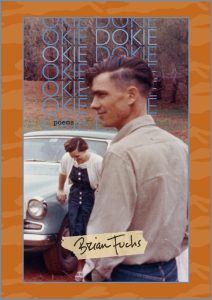
Brian Fuchs, “Quercus shumardii” from Okie Dokie (Scissortail Press, 2019)

Written 7 June 2014 in Glencoe, Oklahoma

HANDOUTS FROM FUNERAL (Poem included as “The Tree”)

Posted 7 June 2014