
Crepemyrtle (Lagerstroemia)
 Crepemyrtle (Lagerstroemia)
When I moved to Alaska in 2005 I was struck by those things that were different from my life in Oklahoma. After getting through that first winter, it became apparent that it wasn’t just the conifer trees that provided a striking contrast to the landscapes of the places I consider home. The perennials that popped up in the gardens of the area were exotic to me. They were plants I had known about, but had no experience with. Columbine, dahlia, lobelia, rhubarb, bleeding hearts, raspberries, wild roses, poppies. It was a fascinating experience to be surrounded by these new plants, as well as by the old familiar dandelions and lilacs.
I was in Alaska for a number of years and loved those summer months and the beautiful flowers of the area. What I didn’t expect was how much I would fall in love with the plants of Oklahoma when I returned for vacation.
I was born in Tulsa, Oklahoma on 5 August 1979 and I lived in the state until 2005 when I left for Alaska. My uncle is a landscape architect, my grandpa was a professor of agronomy and a consultant on soils. He spent hours daily working on his flowerbeds and vegetable garden on his one acre lot, an oasis of green in the middle of ordinary yards. Plants were a part of our DNA. All parts of my family had been farmers, growing broom corn and cotton. It had never been my world and I barely paid attention to the things growing around me. I was aware of the various plants in the landscape, but I didn’t know much about those plants.
What I was most struck with on coming back to Oklahoma on a vacation in 2007 was how amazing crepemyrtles are. They’ve long been a favorite, especially of my grandpa who had them planted heavily around his house and as a backdrop/transition between the trees and flowers in the flowerbeds. It felt like I was discovering these plants for the first time.
 In 2013, I loved back to Oklahoma and these crepemyrtles felt like a focus of my thoughts when I was at my parents house or at a business. They are one of the most commonly used plants in Oklahoma, and it’s pretty easy to see why.
Crepemyrtles are native to southeast Asia, with some hybrids being crossed with a taller species from Japan. They have been a common ornamental plant in America since before the revolution, with both George Washington and Thomas Jefferson’s gardens having at least one specimen plant. They quickly became a staple in the South, but as they are not generally cold hardy past zone 6 or 7, they were not a part of the gardens of the North and as a result they do not feature in very many of the early seed or nursery catalogs. When they do start popping up, it is clear that several cultivars have been established from the original pink flowering tree. You see white, pink, purple, and red listed in those early catalogs. The purples were what we now refer to as lavender and the red were dark pink. It took a long time to achieve a true red crepemyrtle.Continue Reading
 I have never been very much into gardening. I love having things growing around me, but the process of actually putting those things in the ground and taking care of them… no. But I’ve found myself with a lot of need for distraction lately. So, I have turned to gardening. In the heat. It;s keeping my brain occupied, but I also keep remembering something my brother talks about all the time: managing one’s expectations.
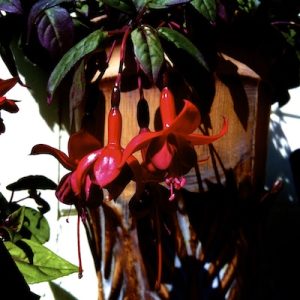 I lived for many years in Alaska. I love the climate that promotes lots of beautiful growth, but with lots of shade and very little heat. I would love to have a garden full of cypress trees draped above head, ferns popping out along the bases of the trees, and fuchsias in hanging pots lining the porch. Moss would grown on the roof of the shed and everyday a light rain would keep the soils moist and the plants would grow up around me and there would be flowers in bloom all summer. I want a beautiful deck to enjoy the cool evenings and have people over. Unfortunately, that is not the situation I find myself in. If I was constantly trying to make that happen, I would spend a lot of my time disappointed and convinced that gardening doesn’t work. What I have to do is work within the framework available to me.