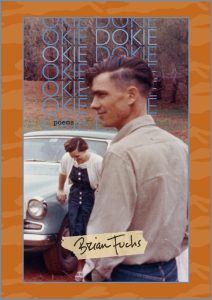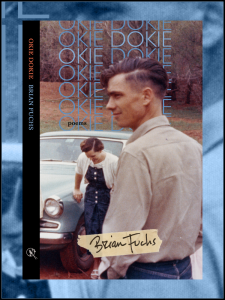
This is how this poem appears in the book Okie Dokie. I’m considering rewriting it, or maybe I’ll just write something new to express these thoughts. We’ll see.

Notes

Written 22 August 2008 in Anchorage, Alaska & 8 September 2019 in Payne County, Oklahoma.

Brian Fuchs, “Mambo Italiano” from Okie Dokie (Scissortail Press, 2019)


Posted 6 September 2020

It’s finally out.  And I can finally get some sleep!  Here are the links to my book on Amazon.  I think it looks so much better in paperback, but there is a Kindle version available.

Amazon Paperback

Amazon Kindle

If you don’t already know what’s up, here’s a little backstory.  I’ve been writing since I was a child.  My first poem that I remember was written in October 1988 when I was 9 years old.  When I was 12, my teacher accused me of plagiarism because she didn’t think a child could write.  I don’t say that to congratulate myself at all.  I’m not even sure if that was worth all the aggravation.  It has been lost to time.  It was titled Paige and it was about the life of a woman who never finds happiness.  But I imagine the actual poem would seem completely juvenile now.

I started writing in earnest in college and since 1997 I have written consistently.  While I veer off into other projects, like short stories or novels, I find poetry that I always return to poetry and enjoy writing it.  Over the years, I’ve developed my own style.  That is a good thing.  The problem is that I also haven’t had serious critique of my work since I graduated from college, so I don’t actually know how my work is seen by others.  I’m amazed that I’ve managed to spend the better part of 20 years unwilling to share my work for fear of rejection.  And I really should have managed that sooner!

When I lost Mom last year, the first thing I did was crawled into a metaphorical hole for 9 months.  I wanted to disappear because I didn’t understand how one can live without his mama, and I’m not too proud to say it.  It also brought a few things into focus.  One of those things was letting go of the expectations and opinions of others.  Now, I mean of me as a person, not my work.  That is a lesson that has been taught to me my entire life, but sometimes things need to cook for a while.

So, now I’ve got a book.  I worked diligently over the summer to get it done.  My garden is sad and neglected, my roommate is sad and neglected, and my family… well, they are too busy to have noticed, but if they had I imagine they would feel sad and neglected.  For this first collection of poems (because I don’t want it to be the last!), I wanted to focus on a few things: 1. Poems with very specific references to people.  It’s not that I won’t write that way in the future, but I wanted to give people the words I had written for them before getting into other subjects.  2. Epitaphs.  I’ve lost a lot of people and I often have things to say about that.  I’d like to get through a lot of those I’ve had lying around, but there are many more.  3. My very favorite poems I’ve written… that aren’t too scandalous.  I get it, family will buy this first book. They will even hang on for a second, but by the third they won’t be too fussed about it.  So, I have actually created a plan where my third book is where I completely let my hair down.  That does mean I have to do at least 2 more books, but it also sounds like I’m censoring myself.  In a way I am, but I’m not completely either.  I want my prudish great aunt to be able to have something she will never read, but that won’t make her blush too much if she decides to open it up.

Last thing I will say about it, I decided to make notes on each poem.  Rather than include them in the actual printed book, they can be found here… in the writing tab, or at this link.

Dale

I sought the council of trees, Dale’s name lingering in my head,
hoping to glean wisdom from the aged assembly,
hoping to hear God through the woody branches.
I studied the structure of oak leaves, how each attached to a branch;
watched sunlight fall through the new growth on cedars;
made note of the greenbriar’s leafy fingers wrapping around the trunks of pecans.
The world was still and hot and dotted with tiny white butterflies
emerging from the thickets to enjoy a field of nectar-filled flowers in the afternoon sun.
My mind had been typically cluttered, with family dramas,
thirteen years of grief, first loves, comedy routines,
and parts of a jingle from a TV commercial I remembered from childhood.
Sitting in the surrounding quiet, I waited for the ancient botanical knowledge,
letting those thoughts drop away, heavy and viscous,
and leaving behind a calm in which I could almost hear the butterflies landing on petals.
The wind came gently then, in small bursts that the oaks seem to enjoy,
allowing the trees to flit thousands of leaves about merrily.
A rustle, a calm and relaxing rustle accompanied by silent mimics,
of a host of lesser plants vying for the favor of the post oaks,
standing as the monarchs of this dry woodland.
A slightly stronger breeze, a creaking sound as older specimens swayed,
some long dead, the bony outer branches moaning hauntingly in the current.
The tranquility was broken, butterflies scattered unceremoniously into the air,
having been blown off their perches by a strong wind that moved through the grasses,
flattening it in waves as it moved across the expanses.
When the wind reached the sentinels of trees standing bravely against it,
they found themselves unprepared and leaves and branches erupted into chaos.
Dale had died.
He had been my namesake, the hero and villain of his own stories,
his name lingered, attached to mine as a reminder of who he no longer was
and as a reminder of who he had been capable of being,
a reminder of who we all had been, of what we wanted to say we had been.
And now he was gone. As the gust moved on in the distance,
stillness returned to the trees and I still faced them, waiting for answers.
We were all there, waiting for different pieces, prostrating ourselves before them.
The instructions were lost, the knowledge never passed on,
the person whose position had been placed so highly seeming to fade
with great distances, separated by different trees, grasses, weeds.
His name lingered, attached to mine as a reminder that we should hold on,
hold him up as he fell, his wings revealed to be a mirage.
It was not always enough, we were not always enough,
and we allowed Dale to slip into humanness.
The trees had again become silent. The distances now as close as they would ever be,
as far somehow as they had felt before when inscribed books would
arrive by mail, wrapped in symbols of birthdays or holidays or plainly
when a book had piqued Dale’s desire to share it with me,
a boy he barely knew, but to whom his name was attached.
And there were songs and great conversations, which are things
of which plants know little. And things that had defined him
so importantly that it felt proper to discuss them now, with God or the trees.
The heat had started to intensify; beads of sweat formed on my neck and face.
Still I waited, knowing that lives had become altered, knowing that we had reached
both the beginning and the end of everything.
And I thought about whittled walking sticks, carefully crafted from the new growth.
His name lingered in my mind, attached to the trees, I now realized, a part of it.
The presence of butterflies had increased in my focused state;
they now seemed to be everywhere, clustered on flowers
and dancing through the space between the trees.
I turned and went back to the house, knowing and not knowing,
melding now with the air and grass, with the trees.
And I thought about Dale, his name lingering there, attached to mine,
attached to the moment and those memories,
attached to the wings of hundreds of tiny butterflies
And I smiled because I had known him.

Notes

Brian Fuchs, “Dale” from Okie Dokie (Scissortail Press, 2019)

Written 25 July 2015 in Payne County, Oklahoma.