
Flags
I watched a TED talk by Roman Mars, the man behind the 99% Invisible blog. It was on the subject of city flags and I didn’t expect much from it; it had come up on YouTube’s autoplay after a video I had chosen to watch. I was eating dinner, so I just let it go. I was immediately hooked and by the end I found myself googling flags for cities where I’ve lived to see how bad they are. And mostly, they are pretty bad. I couldn’t get it off my mind, so I went to Photoshop and started to make my own. As Mars points out in his talk, people are passionate about the flag for the city where they live, and people are usually pretty terrible when it comes to great design.
The loudest voices tend to not understand why a flag like the Union Jack, for example, is so important for the identity of the United Kingdom. This was apparent during last year’s call for a change to the city flag of Provo, Utah. It had long been considered one of the worst, but the proposed change caused controversy. When opened up to the public, the types of submissions received largely failed to follow the basic principles of design, opting instead to put in some sort of agenda for the city. Flags are unifying, not political. In the end, Provo voted for and chose a fantastic new flag, one other cities should be envious of. But it was an uphill battle, which is somewhat surprising… or should be.


New Zealand is in the midst of a second referendum to change their country’s flag to something divorced from their Australian neighbors. It was bound to be controversial; the current flag was adopted in 1902. It seems, however, that the issue is more about people not really caring, and opting to vote for the status quo as a way of making that point. But the prime minister has a point. The current flag is nearly identical to Australia’s flag, and like it still has the Union Jack on it. While New Zealand is a part of the Commonwealth, most countries within it have modified their flags following independence in the 1930s and 1940s. Canada’s fantastic flag is a great example. The Union Jack persisted on the flag for a while, but by the mid-1960s, the maple leaf flag had been adopted, cementing a true identity for Canadians, removed from that of the people of the United Kingdom. They do share a queen, but they do not share a cultural identity. Their flag drives that point and gives the separate peoples something to make them special. As for New Zealand, they may choose to keep their current flag.  I personally think they should change it. The proposed change, chosen in a vote last year, is pretty great. I would’ve gone further and removed the stars, but it’s still a great looking flag.
Looking at state city flags in the United States, I found a strong tendency to stick the state or city seal in a field of color, usually blue, and call that a flag. And that looks stupid 100% of the time. A seal can be a beautiful piece of art, incorporating a surprising amount of history into a (usually) circular emblem. A flag, however, is not a history of one’s city. It is a symbolic representation of the city. It’s an icon, a place reduced to the simplest form possible. The United States flag is another great example of a former British Colonial flag that came into its own with the removal of the Union Jack. The thirteen colonies had a flag, similar to the current United States flag, but instead of stars there was the Union Jack. Changing that portion to a field of blue with a star for each state not only changed the meaning of the flag, but it retained its sense of history. It acknowledges where we came from, but makes clear that we are no longer a part of the British Empire.
 The Great Seal of the United States, which can be seen on any one dollar bill, is beautiful. It features an eagle clutching an olive branch in one talon, arrows in the other talon, thirteen stars above the eagle’s head and a banner in its beak with the motto e pluribus unum written on it. The olives, leaves, stars, and arrows all number thirteen to honor the original colonies. The reverse features a pyramid with the Eye of Providence, featuring annuit cœptis written above and novus ordo seclorum written in a banner underneath. These symbols on our seal feel very american and very much a part of who we are. The flag, however, is not that. It has no motto written across it and the name of our country does not appear at the bottom to remind us of what it is for. We don’t need that reminder, and because the flag is so simple, and fantastically so, neither does anyone else.
One of my favorite city seals is that of Tulsa, Oklahoma. It’s a really lovelypiece that must look great on letterhead, on business cards, and affixed to the city’s buildings. It says a lot about the city in a small space. But the city’s flag is exactly that seal in the middle of a white flag. It gets lost. It has no power there and just fails to generate the power it should as a symbol of a city. I’ve created my own, one I think that honors the city’s seal while becoming more of a symbol that could be adapted in a lot of ways, making way for a unifier for a city. It could be something one is proud to put on a bumper sticker or a a patch on a backpack. Business could use parts of it to mark themselves as local. It does, in my opinion, the things a flag should do.
It surprised me how much I cared about flags. Roman mars had started his TED talk with the assertion that 100% of people care about flags. I raised an eyebrow at that. I did not think I did care about flag all that much, but I really do. And I think others do as well. But I do think it’s harder than people think to create a great flag for a city. It would be nice for these flags to change and a symbol of pride become available for cities whose flags just don’t work.
I haven’t picked on Oklahoma’s state flag much. The state flag of my state is nice, and the official version from 1925 to 1941 was fantastic. “OKLAHOMA” was added to the flag in 1941, which was unnecessary. Supposedly, it was done as a literacy statement, but I’m not really sure how the name of one’s state on a flag truly promotes literacy. At this point, the lettering could go. Nobody would confuse the flag with another state’s. I might also stylize the elements a bit. I was able to draw the flag when I was a kid, but I remember it being overly intricate.
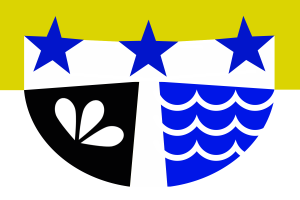
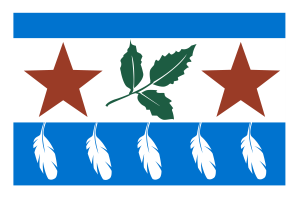
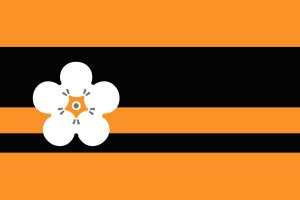
While I was tackling Tulsa’s flag, I made a whole bunch of flags. Some of them are for communities that are small enough that they have never had a flag of their own, some are redesigns. One is even for a community that doesn’t have residents year-round. All were thought through, giving consideration to the various specifics of the town or city. And I couldn’t help myself – I made some for fantasy places too. Let me know what you think.

 It was March 10, 2002 — a Sunday morning. I was at work, shelving a cart in the corner of the store where the history, biography, & social sciences sections were kept. I had paused for a moment to read the inside flap on the book. I had taken entirely too much time looking decided to place it on hold for myself so I could look at it later. I took it to the front and placed it on the employee hold shelf. Bettina announced that I had a phone call. I knew it would be my parents and it irritated me that they could never figure out to not call me before we open.
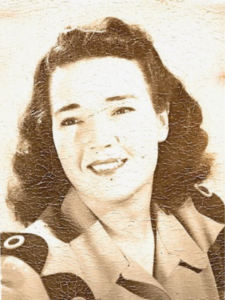 “Mimi” is my mom’s mom, Bonita Christine “Chris” Tucker. She was the matriarch of our family; the force that connected us all and kept us together. She orchestrated every event that brought us together, reminded us to connect with one another, and nagged us all mercilessly. Mimi was an extremely confident woman who knew who she was. She was totally devoted to her husband, her God, & the other members of her church. She was generous with her money and her time, but was never afraid to tell you her opinion on what you were doing. Evidently, there wasn’t enough money to be made as a writer to justify her supporting it. I cherished talking to her. I would sit with her and talk about people for hours… she knew absolutely everything going on in Stillwater. But it never seemed like gossip. Mimi was a very good-hearted person.
 That week was surreal. I still don’t remember much of it. Of course, it culminated in a beautiful funeral. I had gone back home to Tulsa to get some clothes and for the funeral I chose the shirt she had just given me for Christmas. The shirt was a gold knit with a collar. I wore khaki pants. I wouldn’t have felt right in dark colors and I really wanted to celebrate life. The funeral was made that much more difficult when I discovered that my cousins’ nanny was sitting with them and I couldn’t sit with my immediate family because of it. Furthermore, I ended up next to my mom’s friend, who had apparently not figured out that I was an adult and kept talking to me as if I were a child.
 Vacation: