The Magnolia Seed Pod

What a great walk!  The temperature was great, so I woke Justin up to go with me and to get in his own exercise.  I had him choose three non-consecutive days to do exercise, and after a lot of protesting he chose Tuesday, Thursday, & Saturday.  Yesterday, I wanted to get in a specific early morning walk, so I wasn’t available (he won’t do it on his own yet), so we started his new routine today.  He will end up having a consecutive situation this week, but then we will be on track starting next week.  

I was a little misleading to start with, knowing full well that walking up to Highway 33 and across the bridge is almost exactly one mile.  I didn’t not tell him that, but I didn’t mention how far it was, just to say it isn’t too far.  I’m trying to encourage him to get in 25 minutes at least, and that should be one mile.  This little trick doubled that at least.  I will say, as nice as that walk is, highway traffic is very loud.  

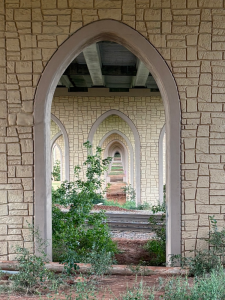
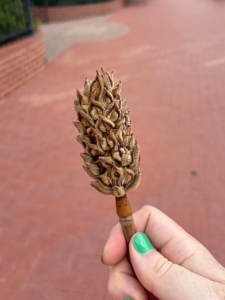
After we crossed the bridge, and after I had paused to try and get a good photo of a blue heron (I didn’t; I never do), we made our way down along the side to cross under the bridge.  I wanted to see if there was another way back across the creek nearby, and after walking a bit, I pulled out my phone to check.  No.  The next bridge a on the other side of town, so we’d have to go back up and across the way we had come.  But by that time, it seemed just as easy to go around through downtown, so we did that.  A magnolia had dropped pods on the sidewalk, and it reminded me of the magnolia I would pick flowers from on the way home from school.  I loved picking up the discarded pods in Fall and picking the flowers in Spring. 
As we turned onto Division to go up to the crosswalk, I failed to see the split level of the sidewalk and fell onto the sidewalk.  Crushed my phone’s screen protector, but it had done its job.  I was actually impressed that the fall didn’t phase me or my breathing.  It doesn’t even register on my heart rate tracked by my watch.  It just did not phase me one bit.

We made our way back across, Justin completely over me “stopping to take photos like you’ve never seen anything before.”  I thought that was funny.  We walked back through the neighborhood once across the bridge, and over to Banner Park, where I completed my walk by going once around.  I wanted to get that last mile in.  

It did teach me that I can easily just walk to downtown.  And I will.  Especially as I get more used to doing three miles a day, and if I start adding more.  It won’t take much to go down, stop in to the bookstore we passed by, or in one of the places for a coffee.  It could make for a more interesting routine.  And if that seems too far, there are easy places to park to do a downtown walk.  I do wish there were more businesses going in.  I don’t want to see Guthrie die.  Downtown is such a big part of its identity. 

I had expected to get in a short walk, but I’m so glad I did something longer.  I feel good.

[Walk #334, 3.12 miles]

Cercis canadensis

When we had tried
putting ourselves together again
we’d used the wrong parts,
made effigies of ourselves
with the piles of distorted junk,
left behind scraps of a once-full life.
We went through the motions of people
spoke like them, practicing their accents,
but did not understand our own words.
We got the phrases wrong,
the tones, the memories.
Periodically, we’d erupt into full color
flowers growing from every part
and our days seemed alive with joy.
But we would catch ourselves lost in time,
eyes fixed on a long-abandoned walker,
a long-absent bed,
a long-neglected garden,
at the things we find so important now
and the flowers would fall from our bodies.
I gave up on trying to find the parts
of myself I missed most,
stopped looking for who I had been before. I’ve been more comfortable with discomfort,
waiting for others to finally leave the safety
of their beds, the safety of their tears.
And we’ve started to share ourselves again,
imagining Spring, redbuds flushed fuchsia,
grief removed from our shoulders,
sadness washed from our faces
by the showers of April and storms of May.
We will remember how to be happy
and how to be sad and how to be,
and we’ll see the long-forgotten remnants
and we will understand who we are.

Notes

Written 19 April 2019 in Payne County, Oklahoma. Rewritten 5 September 2019 in Payne County, Oklahoma.

Brian Fuchs, “Cercis canadensis” from Okie Dokie (Scissortail Press, 2019)


Cercis canadensis

When we had tried
putting ourselves together again
we’d used the wrong parts,
made effigies of ourselves
with the piles of distorted junk,
left behind scraps of a once-full life.
We went through the motions of people
spoke like them, practicing their accents,
but did not understand our own words.
We got the phrases wrong,
the tones, the memories.
Periodically, we’d erupt into full color
flowers growing from every part
and our days seemed alive with joy.
But we would catch ourselves lost in time,
eyes fixed on a long-abandoned walker,
a long-absent bed,
a long-neglected garden,
at the things we find so important now
and the flowers would fall from our bodies.
I gave up on trying to find the parts
of myself I missed most,
stopped looking for who I had been before.
I’ve been more comfortable with discomfort,
waiting for others to finally leave the safety
of their beds, the safety of their tears.
And we’ve started to share ourselves again,
imagining Spring, redbuds flushed fuchsia,
grief removed from our shoulders,
sadness washed from our faces
by the showers of April and storms of May.
We will remember how to be happy
and how to be sad and how to be,
and we’ll see the long-forgotten remnants
and we will understand who we are.

Crepemyrtle (Lagerstroemia)

When I moved to Alaska in 2005 I was struck by those things that were different from my life in Oklahoma.  After getting through that first winter, it became apparent that it wasn’t just the conifer trees that provided a striking contrast to the landscapes of the places I consider home.  The perennials that popped up in the gardens of the area were exotic to me.  They were plants I had known about, but had no experience with.  Columbine, dahlia, lobelia, rhubarb, bleeding hearts, raspberries, wild roses, poppies.  It was a fascinating experience to be surrounded by these new plants, as well as by the old familiar dandelions and lilacs.

I was in Alaska for a number of years and loved those summer months and the beautiful flowers of the area.  What I didn’t expect was how much I would fall in love with the plants of Oklahoma when I returned for vacation.

I was born in Tulsa, Oklahoma on 5 August 1979 and I lived in the state until 2005 when I left for Alaska.  My uncle is a landscape architect, my grandpa was a professor of agronomy and a consultant on soils.  He spent hours daily working on his flowerbeds and vegetable garden on his one acre lot, an oasis of green in the middle of ordinary yards.  Plants were a part of our DNA.  All parts of my family had been farmers, growing broom corn and cotton.  It had never been my world and I barely paid attention to the things growing around me.  I was aware of the various plants in the landscape, but I didn’t know much about those plants.

What I was most struck with on coming back to Oklahoma on a vacation in 2007 was how amazing crepemyrtles are.  They’ve long been a favorite, especially of my grandpa who had them planted heavily around his house and as a backdrop/transition between the trees and flowers in the flowerbeds.  It felt like I was discovering these plants for the first time.

In 2013, I loved back to Oklahoma and these crepemyrtles felt like a focus of my thoughts when I was

at my parents house or at a business.  They are one of the most commonly used plants in Oklahoma, and it’s pretty easy to see why.

Crepemyrtles are native to southeast Asia, with some hybrids being crossed with a taller species from Japan.  They have been a common ornamental plant in America since before the revolution, with both George Washington and Thomas Jefferson’s gardens having at least one specimen plant.  They quickly became a staple in the South, but as they are not generally cold hardy past zone 6 or 7, they were not a part of the gardens of the North and as a result they do not feature in very many of the early seed or nursery catalogs.  When they do start popping up, it is clear that several cultivars have been established from the original pink flowering tree.  You see white, pink, purple, and red listed in those early catalogs.  The purples were what we now refer to as lavender and the red were dark pink.  It took a long time to achieve a true red crepemyrtle.

The cultivars did not change significantly for a long time, with sporadic new plants being introduced a couple each decade until the 1950s.  It was then that hybridization started in more earnest, and the numbers of plants available really exploded.  By the 1970s, new plants were being released at a rate of six to twelve per year, a speed that has only been matched in recent years.  These plants had all started off as trees that grow 20-25 feet, filled from June to September with large panicles of pink flowers.  Now there were bright reds, fuchsias, deep purples, blush pinks, and picotees of white and pink.  Some of them still reached 20 feet or more, while other varieties had been selected to weep only 1-2 feet off the ground.

Crepemyrtles have a couple of drawbacks.  The most obvious is that they don’t put on new leaves until late May or June.  It’s glaring when the rest of the trees have woken up, many of which have gone through their flowering and are now greening out for the summer and the crepemyrtles still are just a cluster of sticks.  It almost feels like nothing will ever happen with them, and then over the course of a few days leaves start popping up from branches that seemed dead for sure.  They grow fast and in less than a month, the plant has put on so much growth that it’s easy to forget that it had waited for so long.  And then it flowers and that wait was worth it, most of them covering themselves in blooms.  Many will stay in bloom until frost, so it’s a showy plant.

They other problem is not so much with crepemyrtles themselves as it is with people who don’t know how to take care of them.  It is very common for crepemyrtles to be cut back heavily by landscapers, often dramatically.  The result is thickly trunked trees with thin branches, often referred to as a witch’s broom effect.  There are two goals these people are trying to accomplish.  One, it keeps the plant small and contained.  Many varieties can grow to 15-25 feet.  Business don’t always want that.  The other thing this does is increase the new growth branches, which is where the flowering occurs on crepemyrtles.  The do not bloom on last years growth.  First, the size of a crepemyrtle can be maintained by planting the correct variety.  Choose the one that fits your space.  Secondly, new growth and blooming can be encouraged by pruning a crepemyrtle by removing old branches that aren’t growing, dead heading panicles, and cutting back weak growth.  Nobody needs to engage in “crapemurders”.

Crepemyrtles may not be native to Oklahoma, or indeed anywhere in zones 7, 8, or 9, but they might as well be.  These flowering trees and shrubs are a part of us now, and I am so glad to have rediscovered them and appreciate them immensely.

Crapemyrtle Database

Please note also that there are different spellings.  The plant is botanically known as Lagerstroemia, but is commonly known as crepemyrtle, crepe myrtle, crapemyrtle, or crape myrtle.  I used the one I prefer above.

Southern Living: Grumpy Gardener’s Crepe Murders 2018

Blackjack Oak

Quercus marilandica ashei

Just outside my bedroom window is a rugged Blackjack Oak.  She isn’t fancy or flashy; neither is she demanding.  She takes care of herself and has a pioneering look about her.

When my parents moved to this property in 2006, most of the native trees were cleared from the areas where they would be living, being replaced with more pleasing fruit trees, crapemyrtles, and one Bradford pear.  Along with a few other trees, they did leave one small oak tree.  That tree offered a shaded spot to sit and enjoy the property, while being a fairly compact plant.  It has not stayed that way.

I moved into this place in 2015.  At that time, the once diminutive oak had become a little more of a presence.  The branches had arched and reached the house, occasionally scraping against the siding.  Ultimately it needed to be trimmed a little, but it’s increased size had created even more of a shaded area, some of its lower branches now no longer putting on leaves.  She had started looking a little bit raggedy.  It made me wonder about how long lived blackjack oaks are, worrying that she had only a limited time left and that I would need to think about  what to do when a replacement or removal was needed.

Blackjack oaks are a type of red oak common from New Jersey to Eastern Kansas and as far south as Georgia and Central Texas.  They are small and hardy trees, happily growing is poor soils and dry areas.  They don’t represent the prettiest of trees, consisting of crooked and twisted branches, many of which stop putting on leaves when those above them block the light.  It gives them a distinctive half-dead appearance that my oak now suffers from, but it does not indicate any sort of problem with the tree itself.  It does have a tendency to droop the leafless branches, making it hard to walk under and requiring annual pruning, but it’s a manageable problem.

These trees are slower growing, but longer lived oaks, especially the western subspecies in Northern Texas, Oklahoma, and Kansas.  These individuals make up a significant percentage of The Cross Timbers, the oak savannah that bisects Oklahoma, separating the heavily wooded East from the arid West.  It’s a forest made up of post oaks, blackjack oaks, and eastern redcedars.  Blackjack oaks can live for more than 200 years, averaging about 80 years.  My fears of needing to replace my tree are unfounded.

No, this isn’t the world’s most beautiful tree.  It’s leaves even feel like they haven’t fully formed, as if they can quite figure out how to evolve into something clear.  The acorns are tiny, barely worth talking about.  The limbs are crooked and bare, at least the lower ones.  They don’t have the lush growth of most of the other trees that surround the house.  However, the tree is home to many birds and those tiny acorns are enjoyed by squirrels and even brazen deer who venture up to the house to graze on them along with the crabapples that grow next to the oak.  And it provides much of my house with shade, having expanded from a shady spot in the center of the yard to a defining feature of the property.

This tree has its issues, but I love her and I’m glad she’s here.

Dale

I sought the council of trees, Dale’s name lingering in my head,
hoping to glean wisdom from the aged assembly,
hoping to hear God through the woody branches.
I studied the structure of oak leaves, how each attached to a branch;
watched sunlight fall through the new growth on cedars;
made note of the greenbriar’s leafy fingers wrapping around the trunks of pecans.
The world was still and hot and dotted with tiny white butterflies
emerging from the thickets to enjoy a field of nectar-filled flowers in the afternoon sun.
My mind had been typically cluttered, with family dramas,
thirteen years of grief, first loves, comedy routines,
and parts of a jingle from a TV commercial I remembered from childhood.
Sitting in the surrounding quiet, I waited for the ancient botanical knowledge,
letting those thoughts drop away, heavy and viscous,
and leaving behind a calm in which I could almost hear the butterflies landing on petals.
The wind came gently then, in small bursts that the oaks seem to enjoy,
allowing the trees to flit thousands of leaves about merrily.
A rustle, a calm and relaxing rustle accompanied by silent mimics,
of a host of lesser plants vying for the favor of the post oaks,
standing as the monarchs of this dry woodland.
A slightly stronger breeze, a creaking sound as older specimens swayed,
some long dead, the bony outer branches moaning hauntingly in the current.
The tranquility was broken, butterflies scattered unceremoniously into the air,
having been blown off their perches by a strong wind that moved through the grasses,
flattening it in waves as it moved across the expanses.
When the wind reached the sentinels of trees standing bravely against it,
they found themselves unprepared and leaves and branches erupted into chaos.
Dale had died.
He had been my namesake, the hero and villain of his own stories,
his name lingered, attached to mine as a reminder of who he no longer was
and as a reminder of who he had been capable of being,
a reminder of who we all had been, of what we wanted to say we had been.
And now he was gone. As the gust moved on in the distance,
stillness returned to the trees and I still faced them, waiting for answers.
We were all there, waiting for different pieces, prostrating ourselves before them.
The instructions were lost, the knowledge never passed on,
the person whose position had been placed so highly seeming to fade
with great distances, separated by different trees, grasses, weeds.
His name lingered, attached to mine as a reminder that we should hold on,
hold him up as he fell, his wings revealed to be a mirage.
It was not always enough, we were not always enough,
and we allowed Dale to slip into humanness.
The trees had again become silent. The distances now as close as they would ever be,
as far somehow as they had felt before when inscribed books would
arrive by mail, wrapped in symbols of birthdays or holidays or plainly
when a book had piqued Dale’s desire to share it with me,
a boy he barely knew, but to whom his name was attached.
And there were songs and great conversations, which are things
of which plants know little. And things that had defined him
so importantly that it felt proper to discuss them now, with God or the trees.
The heat had started to intensify; beads of sweat formed on my neck and face.
Still I waited, knowing that lives had become altered, knowing that we had reached
both the beginning and the end of everything.
And I thought about whittled walking sticks, carefully crafted from the new growth.
His name lingered in my mind, attached to the trees, I now realized, a part of it.
The presence of butterflies had increased in my focused state;
they now seemed to be everywhere, clustered on flowers
and dancing through the space between the trees.
I turned and went back to the house, knowing and not knowing,
melding now with the air and grass, with the trees.
And I thought about Dale, his name lingering there, attached to mine,
attached to the moment and those memories,
attached to the wings of hundreds of tiny butterflies
And I smiled because I had known him.

Notes

Brian Fuchs, “Dale” from Okie Dokie (Scissortail Press, 2019)

Written 25 July 2015 in Payne County, Oklahoma.

Quercus shumardii

for Papa

A great tree has uprooted,
exposing the branching mass
caked in the red soil of the Western Plains.
What was parched had been made rich and loamy
by the giants that fell before,
pioneering specimens that germinated and made
a home under the endless horizon of Oklahoma.
The water that made those plants flourish
had come from England and Ireland,
from Galilee and Missouri.
The roots of those ancestors fed the saplings
of the new generation.
Entwined, two young trees grew close together,
feeding on one another,
strengthening each other’s roots.
Acorns became a thicket and then a forest,
spreading out in all directions.
The flaming red soil has changed over time,
fertilized, nurtured, enriched.
The acorns have been found scattered,
rooting in Texas and Colorado,
in Alaska and Kentucky.
A tradition of strength and serenity
tested in new soils, clays and sands,
ultisols, entisols, crider and port silt loam.
Lightning took out the second tree,
ripped away what had been life,
forcing the survivor to stretch out new branches
to cover the fallen companion,
to show strength in the face of tragedy,
to learn to love when love seemed to disappear.
The branches, sprawling out massively,
became only sparsely covered with leaves, but
never lost their majesty, their humility, kindness, dignity.
Now the great tree has joined its long-fallen partner,
stretched at the base among those it had given life to,
cradled by the thick trunks of trees
that have become mighty themselves.
They stretch impressively toward Heaven,
mimicking the once proud figures
now so apparently absent in the canopy.
The sun can once again burst through,
but this is no longer the harsh and arid place
it was when ancestors first arrived.
In the clearing a small field of flowers
will spring up in memorial,
attracting the beauty of birds and insects
until new saplings join the congregation.
That great tree is now one of the ancestors,
enriching the soils for future generations.

6.7.2014

Notes

Brian Fuchs, “Quercus shumardii” from Okie Dokie (Scissortail Press, 2019)

Written 7 June 2014 in Glencoe, Oklahoma

HANDOUTS FROM FUNERAL (Poem included as “The Tree”)

Posted 7 June 2014